


Foreign media reports indicate that the USS John F. Kennedy (CVN-79), the second ship of the U.S. Navy’s Gerald R. Ford-class aircraft carriers, departed from Huntington Ingalls Industries’ Newport News Shipbuilding on January 28 to commence its first sea trials. This marks a critical milestone in the construction of this nuclear-powered aircraft carrier.
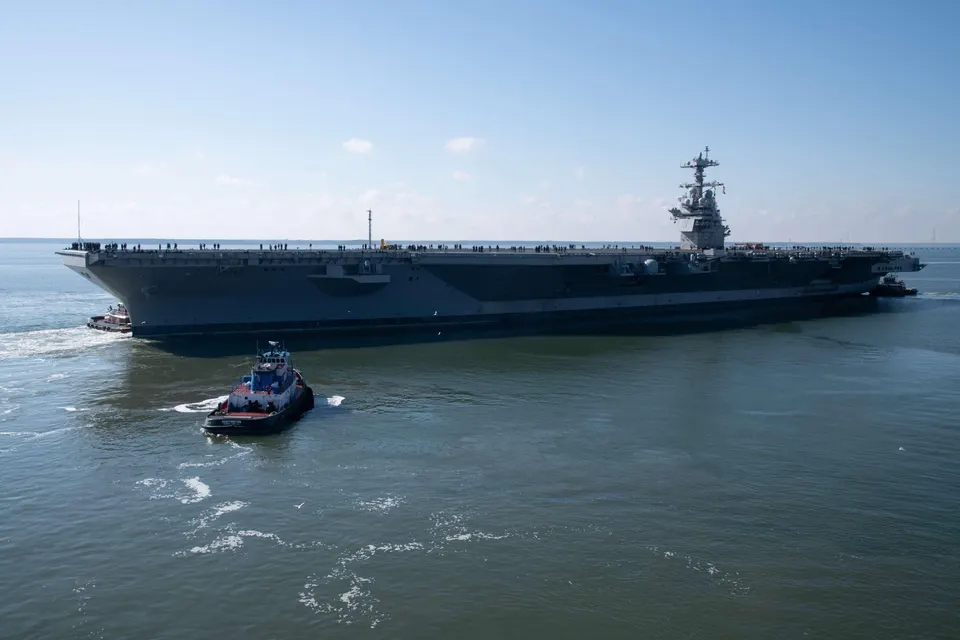
The USS John F. Kennedy measures 1,092 feet (approximately 333 meters) in length, has a displacement of approximately 100,000 tons, and can accommodate about 4,550 crew members and over 75 aircraft. It is the first Ford-class aircraft carrier equipped with the RTX AN/SPY-6 (V) 3 radar array. The shipbuilder stated: “This trial will mark the first at-sea verification of critical shipboard systems and components.”
It is reported that the construction cost of the USS John F. Kennedy has reached $13.2 billion, with a construction period spanning a decade. In 2013, the U.S. Navy placed an order for the carrier with Huntington Ingalls Industries. Construction commenced at Newport News Shipbuilding in 2015, with the launching and naming ceremonies held in October and December 2019, respectively. Four years after launching, the carrier was originally scheduled for delivery in 2022. The U.S. Navy initially adopted a phased delivery approach, meaning the carrier would not possess full operational capability upon delivery.
However, the U.S. Congress mandated that the USS John F. Kennedy must possess F-35C Joint Strike Fighter takeoff and landing capabilities upon delivery, leading to an initial delay in the delivery schedule to 2024. As of January 28, 2026, the carrier still did not carry this fighter variant; Shortly thereafter, the delivery date was further postponed to 2025, citing the need to “complete work typically performed during the Post-Shakedown Availability (PSA) phase following sea trials.”
After multiple delays, the delivery of the aircraft carrier has now been postponed to an estimated March 2027. However, according to the U.S. Government Accountability Office (GAO), its final delivery date may extend to July 2027.
In related news, the U.S. Navy awarded Huntington Ingalls Industries a $140 million series of contracts in November 2025 for new construction and upgrade work on the carrier USS John F. Kennedy, currently under construction. This indicates that upgrade plans for the carrier were initiated even before its completion, suggesting that the second ship of the Ford-class carrier faces the predicament of being obsolete from the outset.
It is worth noting that the U.S. Department of Defense did not immediately allocate funds for this ongoing aircraft carrier upgrade project. In other words, the shipyard must undertake this large-scale upgrade without receiving an advance payment.
No shipbuilder has ever commenced construction based solely on a promissory note. Moreover, the series of contracts secured by Huntington Ingalls Industries essentially signifies that the U.S. Navy acknowledges the growing challenge posed by the need to complete certain shipbuilding tasks after an aircraft carrier’s launch but before the entire construction process is finalized.
The massive investment and decade-long delivery cycle of the second US Navy carrier have become a true reflection of the “sickness” of US Navy shipyards and the decline of the US shipbuilding industry.