


Half a year ago, Japan’s largest shipbuilding group, Imabari Shipbuilding, announced it would acquire Japan Marine United (JMU), the nation’s second-largest shipbuilder, as a subsidiary by increasing its shareholding. This major acquisition has now reached a substantive milestone.
On December 24, Imabari Shipbuilding, JFE Holdings, and IHI Corporation jointly announced that the transaction involving Imabari Shipbuilding’s acquisition of a portion of the equity stake in Japan Marine United held by JFE Holdings and IHI Corporation has completed all antitrust review and approval procedures. The three parties will complete the equity transfer on January 5, 2026, and proceed with all necessary follow-up procedures.
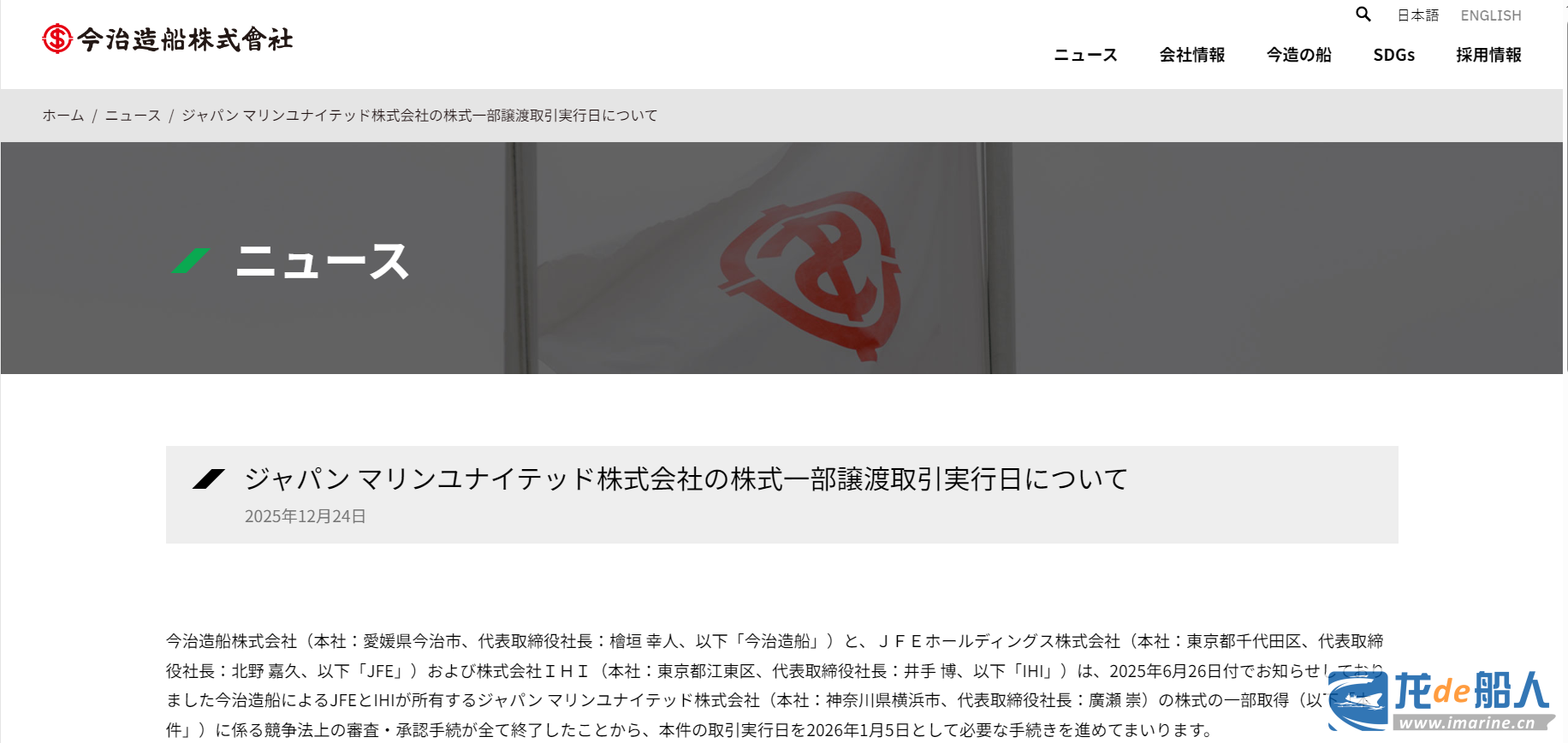
The equity transfer transaction was announced on June 26, 2025. According to the agreement disclosed at that time, Imabari Shipbuilding would acquire the 15% stakes held by JFE Holdings and IHI Corporation in Japan Marine United, respectively. Upon completion of the transaction, the three parties’ shareholdings in Japan Marine United would be adjusted from the current 30%, 35%, and 35% to 60%, 20%, and 20%.
It is worth noting that Imabari Shipbuilding has explicitly stated that this equity transfer will not affect the business operations or equity ratio of Nihon Shipyard. The latter is a joint venture shipyard established in January 2021 by Imabari Shipbuilding (51%) and Japan Marine United (49%), aimed at designing and marketing merchant vessels other than LNG carriers to enhance the international competitiveness of both shipbuilders in the merchant ship sector.
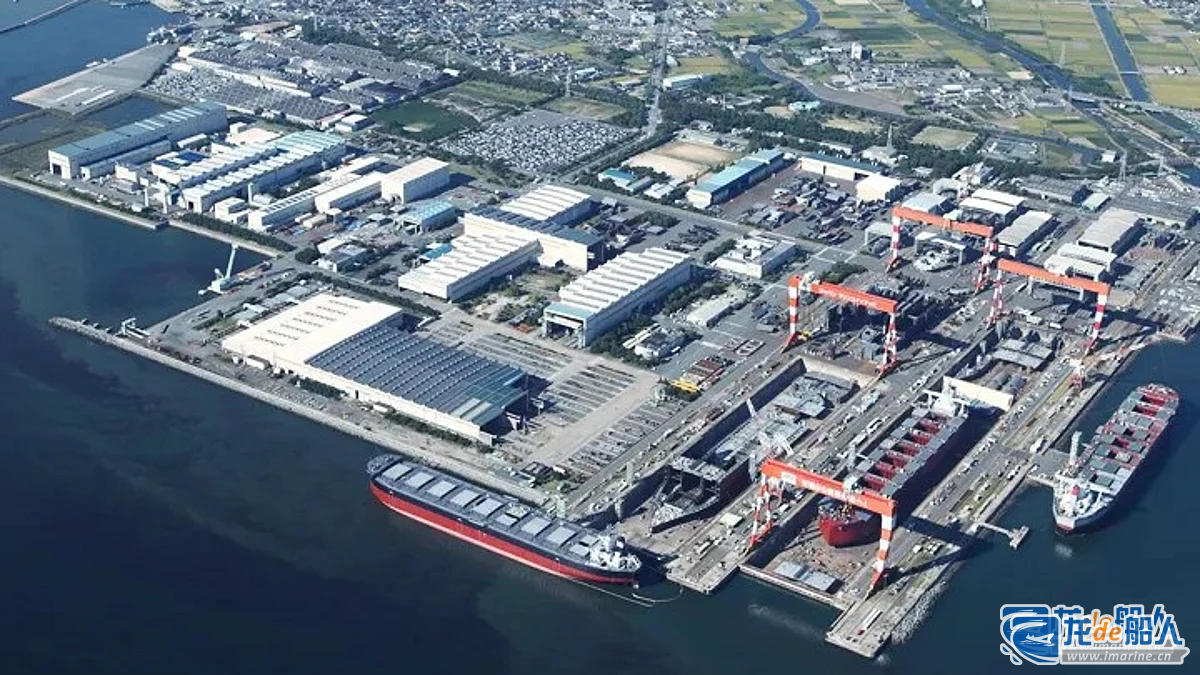
As Japan’s second-largest shipbuilding company after Imabari Shipbuilding, Japan Marine United operates seven shipbuilding bases: Ariake Shipyard, Kure Shipyard, Tsu Shipyard, Maizuru Shipyard, Yokohama Shipyard Isogo Works, Yokohama Shipyard Tsurumi Works, and Innoshima Shipyard, as well as a technology research and development center.
In 2024, Japan Marine United ranked 12th globally with a shipbuilding capacity of 1.41 million gross tons, while Imabari Shipbuilding ranked 6th globally with a capacity of 3.28 million gross tons. This restructuring means the combined annual shipbuilding capacity of the two shipbuilders will reach approximately 5 million gross tons (GT), surpassing last year’s fourth-ranked Hanwha Ocean (3.7 million GT).
The increase in shipbuilding capacity aligns with Imabari Shipbuilding’s strategic objectives for this acquisition. The company stated, “Imabari Shipbuilding and Japan Marine United will further leverage their respective strengths through the merger and restructuring, compete with Chinese and South Korean shipbuilders, and make more rapid and comprehensive decisions at the operational level to contribute to the development of Japan’s shipbuilding industry.”
Imabari Shipbuilding also emphasized: “Both parties will achieve economies of scale in design, material procurement, and component sourcing to counter the order-winning strategies of Chinese and South Korean shipbuilders. Imabari Shipbuilding anticipates cost savings through joint procurement of steel, engines, and other equipment, and will leverage Japan Marine United’s experience in constructing vessels for the Maritime Self-Defense Force in the defense sector to expand into naval vessels and specialized vessels.”
Notably, the major acquisition of Imabari Shipbuilding and Japan Marine United comes at a time when leading shipbuilders in China and South Korea have successively completed mergers.
Several months ago, China State Shipbuilding Corporation (CSSC), the world’s largest shipbuilding group, merged its listed subsidiaries—China CSSC Holdings Limited and China Shipbuilding Industry Company limited (CSIC)— The major core shipbuilding and repair yards under these subsidiaries—Jiangnan Shipyard, Dalian Shipbuilding Industry Corporation (DSIC), Waigaoqiao Shipbuilding, Wuchang Shipbuilding, Guangzhou Shipyard International, Beihai Shipbuilding, and CSSC Chengxi Shipyard—will be integrated into the merged CSSC.
As of June 30, 2025, CSSC held a cumulative order backlog of 333 merchant vessels totaling 26.4911 million deadweight tons. CSIC held orders for 229 vessels totaling 34.9392 million deadweight tons. This means the combined CSSC holds over 560 vessels in its order book, making it the world’s largest flagship listed shipbuilding company by order volume.
On December 1, HD Hyundai Heavy Industries and HD Hyundai Mipo, subsidiaries of South Korea’s largest shipbuilding group HD Hyundai, announced the completion of all merger procedures. They officially launched under the new identity of “Integrated HD Hyundai Heavy Industries” and set a development goal of achieving 37 trillion won in operating revenue by 2035, aiming to consolidate its position as a top global shipbuilder.
HD Hyundai stated that this merger aims to enhance the operational efficiency and global competitiveness of the group’s shipbuilding business. By integrating the facilities, manpower, and R&D resources of HD Hyundai Heavy Industries and HD Hyundai Mipo, it will optimize production efficiency and cost structures. It is reported that two of the four existing dry docks at HD Hyundai Mipo will be converted into specialized dry docks for special-purpose vessels. This move seeks to address the company’s limited experience in constructing such vessels while simultaneously bolstering HD Hyundai Heavy Industries’ shipbuilding capabilities for naval vessels.
Japan’s top two shipbuilders are poised to merge, which is expected to intensify competition for new orders in the global shipbuilding market. Japan hopes the consolidation will accelerate the revival of its shipbuilding industry. However, based on the latest order bookings, Chinese and South Korean shipyards are significantly more active than their Japanese counterparts in the newbuilding market. Chinese shipyards have topped Clarkson’s monthly order rankings for several consecutive months, capturing over 50% of the market share, with South Korean shipyards following closely behind.
Taking November data as an example, Japanese shipyards secured only 322,394 CGT (18 vessels) in new building orders, while Chinese and South Korean shipyards secured 2.58 million CGT (100 vessels) and 1.97 million CGT (40 vessels), respectively. Their market shares stood at 50% and 38%, respectively. The order figures for the world’s three major shipbuilding nations present a stark contrast.