


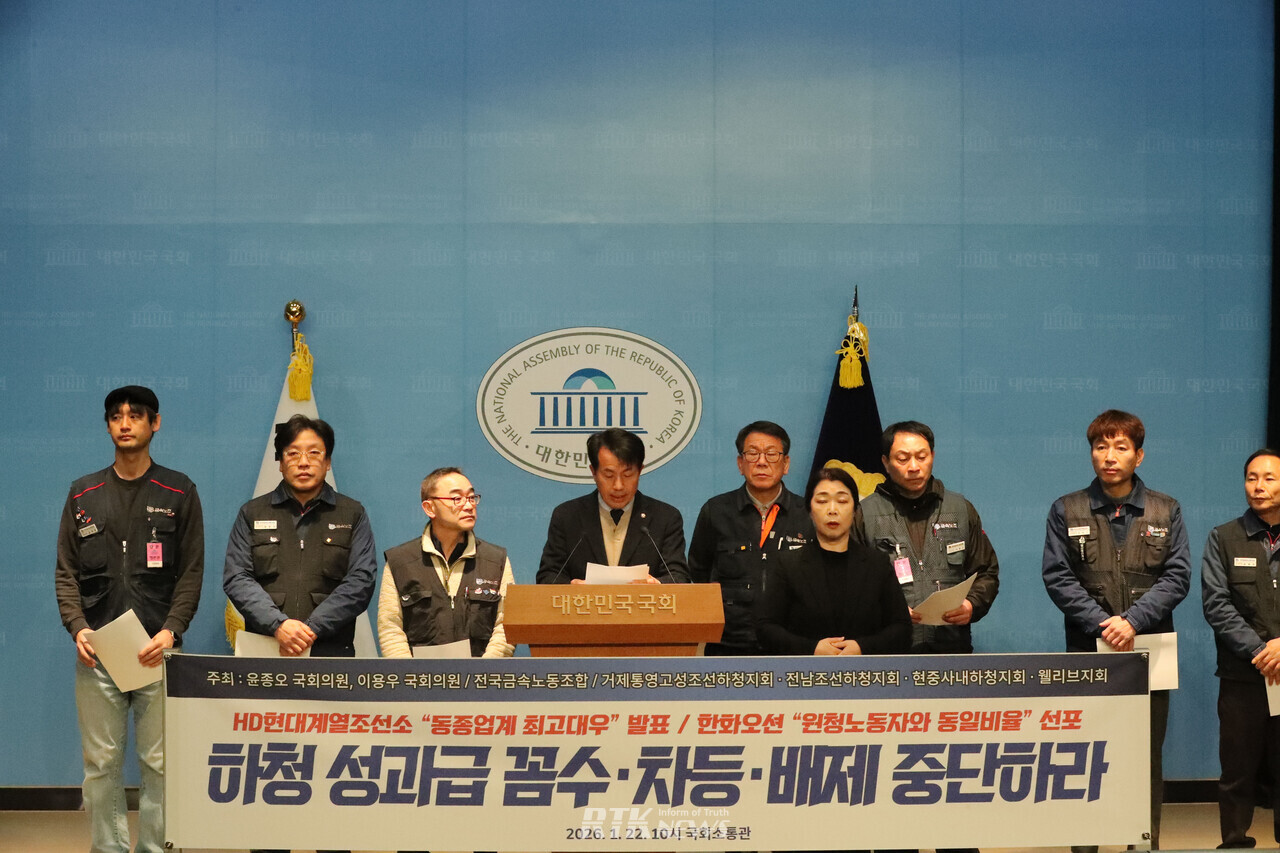
Recently, the Korean Metal Workers’ Union and Rep. Yoon Jong-woo of the Progressive Party held a joint press conference on year-end performance bonuses for outsourced workers at major shipyards. They demanded: extending Hanwha Ocean’s policy of proportional bonus distribution to all Korean shipyards; abolishing existing practices of exclusionary and differential bonus allocation; recognizing general contractors as the de facto employers responsible for determining outsourced workers’ wages and working conditions; and ensuring their participation in collective bargaining.
The Korean Metal Workers’ Union cited performance bonus data for regular employees and outsourced workers at HD Hyundai Heavy Industries, HD Hyundai Mipo, and Hanwha Ocean in 2024, urging major South Korean shipyards to expand the scope of implementing equal performance bonuses for both regular employees and outsourced workers.
Data from the Korean Metal Workers’ Union comparing year-end performance bonuses across shipbuilding companies shows that in 2024, the average performance bonus for full-time employees at HD Hyundai Heavy Industries was 9.5 million won (approximately US$6,500), while that for outsourced workers was only 3.4 million won (approximately US$2,300), equivalent to 35.79% of the average for full-time employees. The performance bonus for outsourced foreign workers was even lower, at only 2.05 million won, representing only 21.58% of the average for full-time employees.
During the same period, Hanwha Ocean’s average performance bonus for full-time employees was 4 million won (approximately US$2,700), while that for outsourced workers was 1.9 million won (approximately US$624), equivalent to 47.5% of the average for full-time employees; the performance bonus for outsourced foreign workers was only 1.33 million won (approximately US$912), equivalent to 33.25% of the average for full-time employees.
The Korean Metal Workers’ Union also emphasized that the relevant data merely compares the average level of regular employees with the highest level of outsourced workers, and the actual disparity in the ratio compared to regular employees may be even greater.
It has been reported that HD Hyundai Heavy Industries has already distributed performance bonuses for 2025 to its full-time employees, with an average amount of 17.21 million won (approximately US$11,800). However, the method and amount of bonuses for outsourced workers have not yet been announced. The shipyard had previously announced that it would distribute performance bonuses to outsourced workers at the “highest level in the industry,” and postponed the distribution date from December 2025 to February 2026.
According to South Korean media reports, Yoon Jong-woo mentioned at a press conference Hanwha Ocean’s recently announced policy to “align the performance bonus distribution ratio for outsourced workers with that of regular employees at Hanwha Ocean headquarters.” He stated this move was only fair and asserted: “HD Hyundai Heavy Industries, HD Hyundai Samho, and Samsung Heavy Industries should also pay outsourced workers reasonable performance bonuses.” However, several days have passed since Hanwha Ocean proposed this policy, yet no substantive changes have been observed.
The legislator further pointed out: “The global shipbuilding industry has entered a new period of super prosperity, but the industry’s achievements have not benefited outsourced workers. In South Korean shipyards, outsourced workers account for as much as 63.9%, which is 3.5 times the industry average. Moreover, outsourced workers undertake 70% to 80% of the shipyard’s direct production tasks.”
Yoon Jong-woo stated bluntly: “The reality on shipbuilding sites is that the total salary and performance bonus of outsourced workers working 270 days is only half that of regular workers on general contractors working 180 days. This unreasonable disparity in treatment is accelerating the loss of skilled workers. Major shipyards need to make a decision to promote Hanwha Ocean’s policy of equal performance bonus standards across the industry. Outsourced workers who perform the same arduous work on shipbuilding sites should receive bonuses of the same proportion or amount, and these bonuses should be paid at the same time.”
Regarding the situation at HD Hyundai Samho, a relevant source disclosed: “Foreign workers account for 40% of the shipyard’s workforce, yet their performance bonuses amount to only about 10% of those received by regular employees of the main contractor… The shipyard continues to follow the practice of differentiating bonuses based on seniority. While the main contractor cites incentivizing long-term service as justification, genuine long-term commitment should stem from employment security and fair compensation.” Rumors also suggest this year’s performance bonuses for outsourced workers will be lower than previous years, sparking significant confusion and skepticism. The main contractor should acknowledge its role as the true employer of all workers and eliminate discrimination through negotiations with the outsourced workers’ union.”
The head of the Geoje·Tongyeong·Goseong Shipbuilding Subcontracting Workers’ Union stated: “While South Korea’s three major shipbuilders have achieved substantial operating profits, subcontracted workers’ wages remain stagnant at minimum wage levels. Concurrently, skilled technical workers are steadily leaving shipyards, and young workers are increasingly avoiding shipyard employment.”