


Autonomous navigation is becoming a core track in the digital transformation of the global shipping industry. From inland waterway shipping to ocean voyages, intelligent technologies are gradually breaking through the efficiency bottlenecks and safety boundaries of traditional shipping.
As an innovation pioneer in the field of maritime autonomous navigation, BOTIX INC (hereinafter referred to as “BOTIX”) has built a full-stack technical solution for intelligent navigation featuring ship-shore-cloud integrated collaboration, based on its technological integration path of “AI + Ships”. It has developed a comprehensive product matrix of intelligent navigation systems covering the full spectrum from navigation assistance to end-to-end autonomous navigation, which meets the intelligent operation demands across multiple ship types and scenarios.
Recently, iMarine interviewed Mr. Huang Liming, Chief Technology Officer of BOTIX, to gain an in-depth understanding of the company’s strategic layout and development vision in the field of autonomous ship navigation.
Targeting the blue ocean of intelligent ships, leveraging mature experience to empower new tracks
As a key productivity tool in transportation, ships are still in the early stages of intelligence, making this an optimal time to enter the field. Mr. Huang Liming, a professional with 20 years of R&D experience in land-based autonomous driving technologies, has accurately identified the opportunities for intelligentization in the maritime sector. In his view, artificial intelligence (AI) technology has already achieved large-scale commercial deployment in the automotive industry, driving the industry to leapfrog from new energy to intelligentization and achieving multiple goals such as safety, energy efficiency, and operational effectiveness. In contrast, the maritime sector faces a critical gap: neither inland waterway nor offshore vessels have established mature autonomous navigation systems, making the industry’s demand for intelligent upgrades increasingly urgent.
Drawing on his experience in integrated vehicle-road-cloud technologies developed for land-based autonomous driving, Mr. Huang Liming believes these mature technologies and industrial practices can be fully transferred to the maritime sector , empowering its intelligent development. This is precisely the original intention behind BOTIX’s establishment—to focus on the R&D and commercialization of autonomous marine navigation products and technologies, striving to become an industry leader. Currently, BOTIX has completed a great deal of technological groundwork, such as building the “Jingzhe” test ship to promote the iterative development of autonomous navigation technology for ships, laying a solid foundation for subsequent commercialization.
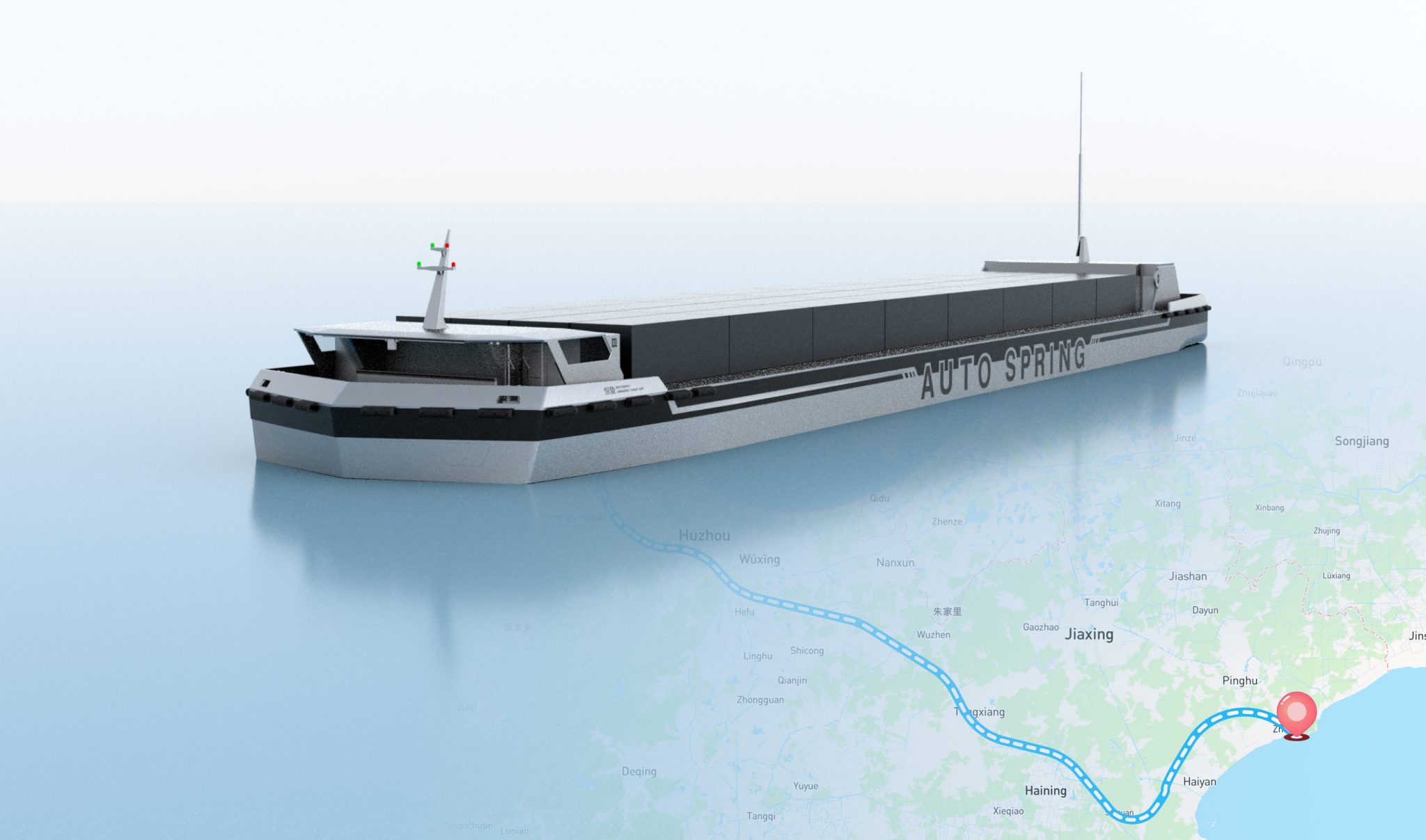
It is worth noting that autonomous driving on land and water is not a simple replication. Although they share commonalities in core objectives, technological systems, and core algorithms, the differences are also significant.
From the perspective of controlled objects, ships are maneuvered by propellers and rudders, whose motion models are completely different from those of automobiles. Moreover, ships are highly susceptible to wind and water currents, making modeling and precision control far more challenging. From the perspective of scenario environments, waterways entail hidden risks such as undercurrents and shallows, and environmental perception proves vastly more difficult than in terrestrial scenarios with clear signs and regulatory constraints. It is therefore imperative to tackle the design and engineering implementation of a host of algorithm modules from scratch—a key R&D focus for BOTIX.
Two-pronged approach to product launch, five key technologies build competitive barriers
With the core vision of “becoming the world’s leading supplier of autonomous navigation technology for ships”, BOTIX is deeply engaged in the research and innovation of navigation technology for ships, and currently focuses on two major product directions: ocean-going ship assisted navigation and inland waterway autonomous navigation.
In the field of ocean-going ship assisted navigation, BOTIX, in accordance with the International Maritime Organization (IMO) Autonomous Surface Ships Code (MASS Code), has taken the lead in launching “Lookout Guard”(瞭望宝), a warning product based on multimodal perception, which is about to enter the market-scale promotion stage. Centered on the core functions of assisted lookout and collision risk early warning, this system falls under the category of navigation support solutions. Going forward, this product will also deeply integrate shipping big data, incorporate intelligent decision-making and route optimization functionalities, and gradually achieve full coverage of a diversified portfolio of maritime intelligent products to meet the operational demands of different scenarios.
In the field of autonomous navigation in inland waterways, BOTIX’s self-developed autonomous navigation system has obtained certification from the China Classification Society (CCS), becoming the first domestic product to pass principle review and prototype validation, and capable of meeting the requirements of the “Intelligent Ship Specification” for full-voyage autonomous navigation (Nn) and autonomous operation vessel (A1). The system is currently advancing toward type certification. At its current stage, the system mainly adopts a single-ship intelligence solution and has achieved Level 3 (L3) supervised autonomous navigation. It not only reduces the required crew size from 2–3 members to just one but also delivers energy savings of no less than 5% through intelligent route optimization and decision-making control.
In the future, the inland waterway autonomous navigation system will gradually evolve into an integrated “ship-shore-cloud” intelligent shipping solution. Through a cloud-based control platform, centralized command and dispatch of ships will be achieved, complemented by a remote control cockpit for takeover during abnormal situations, ultimately realizing the implementation of Level 4 autonomous driving technology. During this technological evolution, the system will also support mixed convoy navigation, with the lead ship being a Level 3 intelligent ship equipped with a safety officer. Subsequent ships will follow unmanned, reducing the required crew by 80% and achieving an overall energy saving of 10% through wake effects, further reducing costs and increasing efficiency.
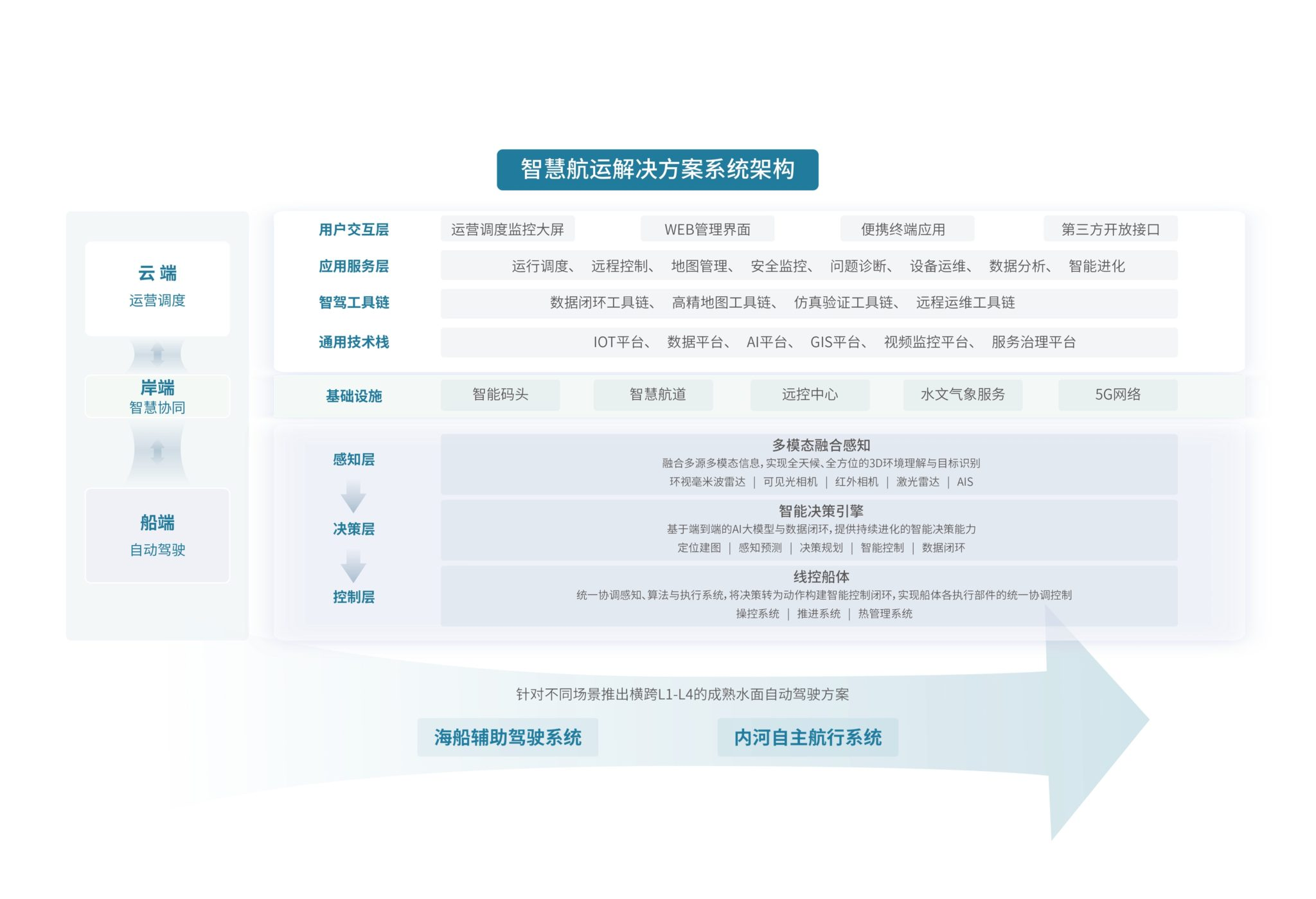
To better support the aforementioned product ecosystem, BOTIX has built five core technological barriers:
- First, establish a comprehensive ship-shore-cloud integrated collaborative technology architecture to accommodate intelligent requirements across multiple scenarios and ship types;
- Second, introduce a multimodal perception large model to achieve feature-level fusion of heterogeneous data from multiple sensors in the BEV space, supporting autonomous navigation of ships in all scenarios;
- Third, develop a long-range, high-resolution 4D millimeter-wave radar to achieve long-range perception at depths of over 1000 meters on the water surface, improving the environmental adaptability of the intelligent driving system;
- Fourth, develop intelligent decision-making and multi-target path planning algorithms for complex scenarios, coupled with a safe and redundant drive-by-wire solution, to solve precision control and multi-ship interface compatibility challenges;
- And fifth, Possess an intelligent navigation toolchain encompassing data closed-loop, high-precision mapping, and hardware-in-the-loop (HIL) simulation, which accelerates technology iteration and engineering implementation.
With Safety and Economic Viability as Core Pillars, Targeting a Paradigm Shift in Global Maritime Intelligence
“Safety and cost-effectiveness are the core attributes of ships as productive tools, and they are also the operational metrics that customers care about most”, Mr. Huang Liming clearly stated that BOTIX’s product development has always revolved around these two core principles.
In terms of safety, BOTIX has established a comprehensive safety redundancy system. Within the autonomous navigation system: visual cameras and LiDAR are deployed to achieve 360° redundant coverage, complemented by thermal infrared cameras and self-developed 4D millimeter-wave radar to enhance adaptability to harsh environments; a fused positioning solution integrating RTK combined navigation positioning and visual semantic positioning is adopted; the ship’s drive-by-wire system employs dual-PLC redundant hot backup and redundant ring network communication, ensuring safe safe navigation in the event of a single-point failure; meanwhile, full-scope fault diagnosis from the ship hull to the intelligent navigation system is implemented, with dedicated response measures formulated for fault levels of varying severity.
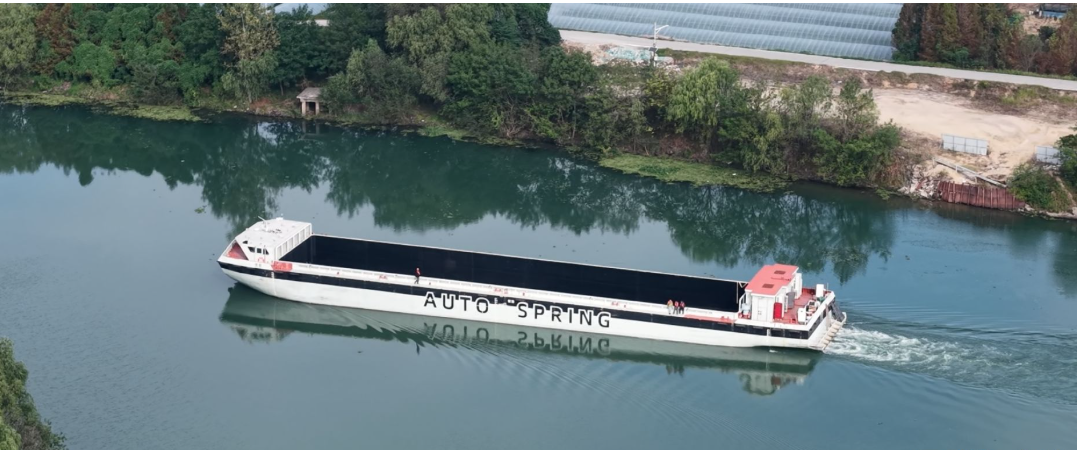
In terms of cost-effectiveness, BOTIX’s technical solutions have demonstrated clear commercial value. Take the Level 3 intelligent navigation system installed on the ship “Jingzhe” as an example: reducing the crew size of a single vessel to just one member cuts labor costs by approximately RMB 250,000 per year. Combined with energy savings and increased voyage frequency, total annual operational cost reductions reach about RMB 300,000. The subsequent implementation of convoy navigation solutions is projected to yield annual savings of RMB 300,000 to 500,000 per vessel.
To further validate its commercial viability, BOTIX plans to collaborate with industrial partners next year to adapt its full-suite intelligent navigation solution for vessels with more diverse power configurations. It will also conduct full-load and empty-load transport trials on designated demonstration waterways to complete the closed-loop verification of commercialization.
BOTIX currently pursues a “dual-market strategy” targeting both domestic and international markets. The company has initiated its overseas market expansion and is advancing technical collaborations with European partners, with plans to launch demonstration projects in Europe by the second half of next year. Mr. Huang Liming believes that seafarer costs are higher in the European and American markets, making the need for crew reduction, cost reduction, and efficiency improvement on ships more urgent. BOTIX’s technical solutions can precisely meet these needs. Furthermore, the core technology of the company’s autonomous navigation solution originates from China’s leading intelligent driving industry, relying on a well-established domestic supply chain system, giving it significant technological and cost advantages, and making it more confident in competing with European and American companies.
Looking ahead, autonomous navigation technology will follow a development pattern of “from low-level to high-level, from single-ship to collaborative,” using “AI+” to drive the shipping industry from decentralized operations to centralized management, and from manned to unmanned operations, reshaping the industry landscape and supply chain division of labor. In this intelligent transformation, WaveParticle Technology will play a leading role in intelligent technology, with its integrated “ship-shore-cloud” solution at its core, becoming a key driver for the intelligent and standardized development of the global shipping industry.