


During the SMM Hamburg maritime trade fair, CSSC Jiangnan Shipyard unveiled three highly competitive, innovative products: a new-generation ultra-large ethane carrier, a floating nuclear-powered AI data platform (AIDC), and a new-generation 16,000 TEU dual-fuel container ship (KUN 2.0).
New-generation very large ethane carrier
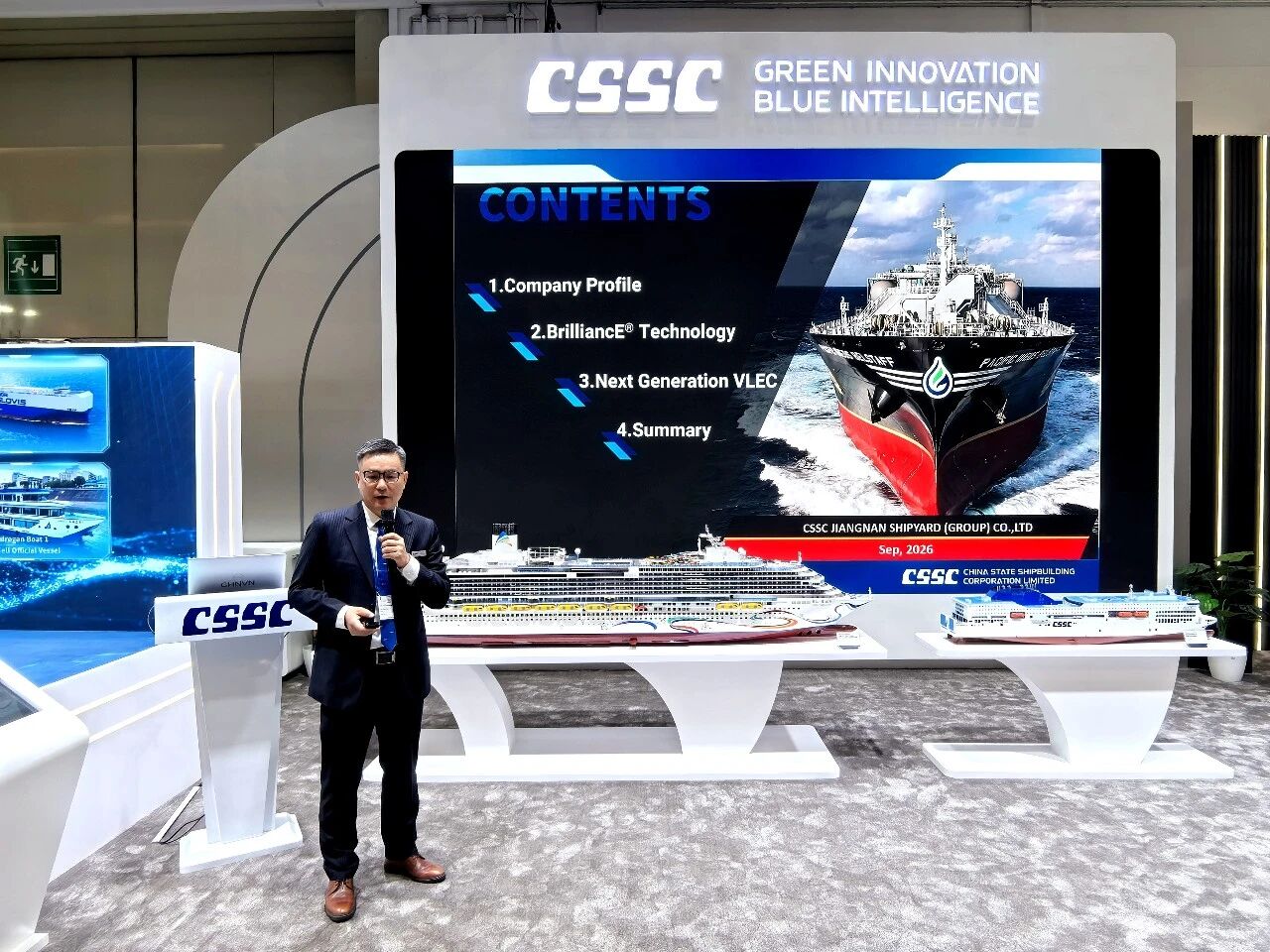
This newly launched ultra-large ethane carrier by Jiangnan Shipyard represents a significant leap forward in terms of cargo capacity, fuel efficiency, boil-off rate, and cargo versatility. By shifting the hull form design process from an “experience-driven” to a “data-driven” optimization approach, the vessel achieves significantly reduced hydrodynamic resistance and superior energy efficiency. It features the proprietary PnF-COMBi® insulation system developed in-house by Jiangnan Shipyard, resulting in a markedly lower boil-off rate. Beyond ethane, the vessel is compatible with various liquefied gases—such as ethylene and liquid ammonia—offering exceptional operational flexibility through its multi-cargo capability. It is equipped with the advanced BrilliancE® Type B cargo containment system and offers customers a choice of two material options: aluminum alloy or 5% nickel steel.
In terms of design philosophy, the vessel innovatively employs AI-driven performance optimization technology to construct a high-dimensional parametric hull model, marking a transformative shift in hull design from an “experience-driven” to a “data-driven” approach. Manufacturing is supported by a dedicated intelligent production line featuring automated equipment—such as friction stir welding workstations and welding robots—to ensure the high-precision construction of the aluminum alloy cargo tanks. Additionally, the vessel integrates the proprietary JNIS intelligent system developed by Jiangnan Shipyard; utilizing a ship-shore-cloud collaborative architecture, the system supports applications such as assisted navigation, intelligent operation and maintenance, and energy efficiency management, thereby driving cost reductions and operational efficiency. Its principal dimensions are compatible with the Houston Ship Channel and major global liquefied gas terminals, ensuring high operational flexibility.
Regarding green and low-carbon performance, the vessel design incorporates six key technical systems—hull form optimization, energy-saving devices, shaft generators, ethane clean fuel, a low boil-off rate (BOR) containment system, and intelligent navigation control. These measures comprehensively reduce energy consumption and carbon emissions, offering a “Jiangnan solution” for global clean energy transport.
New-generation 16,000 TEU dual-fuel container ship (KUN 2.0)
Grounded in the philosophy of forward design, Jiangnan Shipyard has comprehensively upgraded its 16,000 TEU dual-fuel container ship (KUN), launching the KUN 2.0 version.
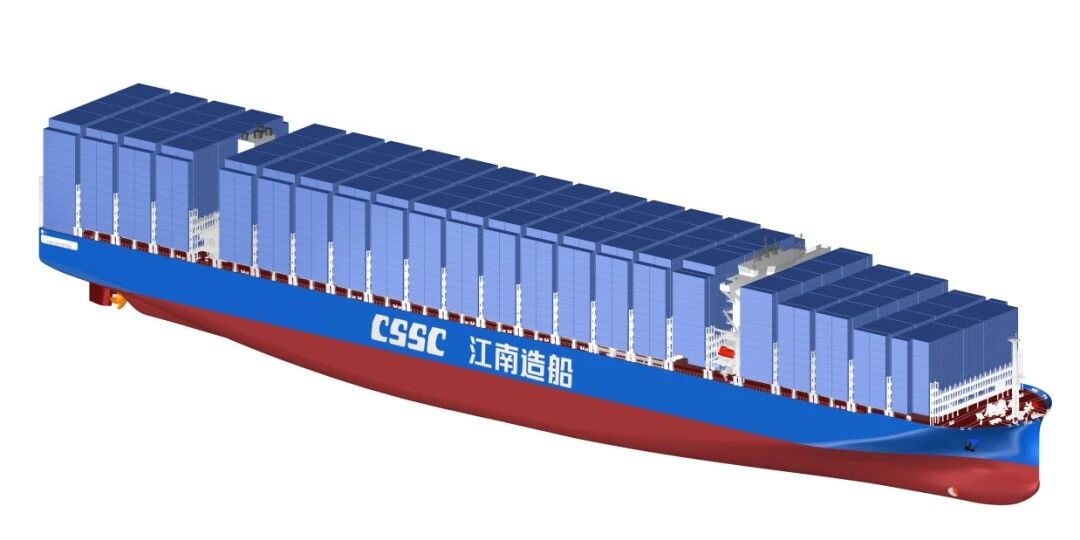
This vessel design focuses on multi-scenario optimization of general arrangements and hydrodynamic performance. It achieves further reductions in lightship weight and fuel consumption while maintaining essentially the same cargo-carrying capacity. Through in-depth R&D targeting key technologies—such as reconfiguring the engine room layout, lightweighting the hull structure, upgrading hatch covers and lashing systems, and optimizing electromechanical integration—the design effectively lowers lightship weight and comprehensively enhances operational cost-efficiency. Balancing operational profitability with environmental goals, it leverages robust technological innovation to drive the shipping industry’s low-carbon transition, offering a highly competitive “Jiangnan Solution” for global container trade.
During the exhibition, this vessel design also received Approval in Principle (AiP) certification from the classification society BV, further validating the quality of Jiangnan-built vessels through endorsement by a leading international authority.
Floating Nuclear-Powered AI Data Platform
In response to the surging demand for computing power and electricity driven by the explosive growth of the global AI industry, Jiangnan Shipyard is strategically positioning itself in the offshore computing infrastructure sector and has officially launched a floating nuclear-powered AI data platform.
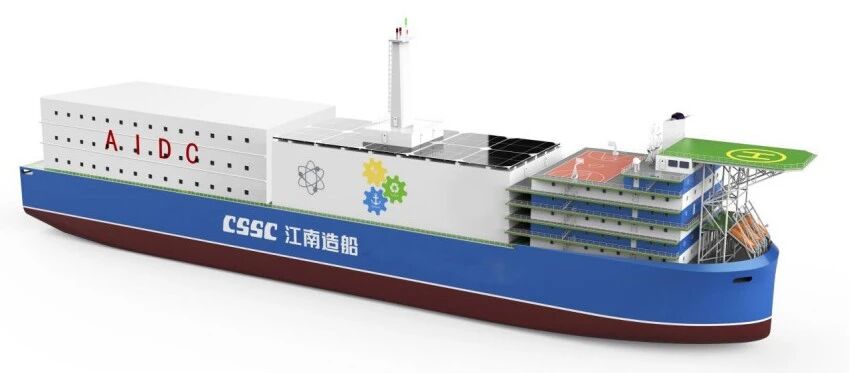
This vessel design utilizes a proven pressurized water reactor (PWR) system to drive two steam turbines for power generation, providing a continuous, reliable, and zero-carbon power supply for both the ship itself and the onboard data center.
The AI Data Center (AIDC) features a modular design and is centrally located at the stern, facilitating ease of construction and future expansion. The vessel can be towed to a designated terminal or moored at multiple offshore locations for long-term operation, connecting with onshore users via high-speed fiber-optic cables. Personnel responsible for AIDC operations and vessel maintenance are accommodated in the forward superstructure; the vessel is also equipped with a helideck, establishing a comprehensive offshore emergency response and logistics system.
During the exhibition, this vessel design received AiP certification from BV. Concurrently, Jiangnan Shipyard signed a joint development agreement with Lloyd’s Register (LR), marking a significant step in accelerating the transition of this futuristic concept into an engineering reality.