


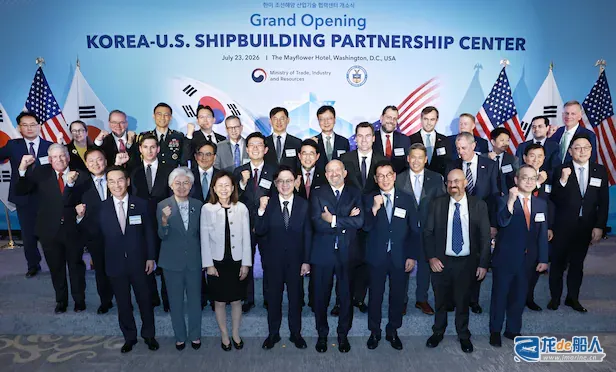
On July 23 local time, South Korea’s three major shipbuilding giants—HD Hyundai, Hanwha Ocean, and Samsung Heavy Industries—announced 15 South Korean shipbuilding cooperation projects at an unveiling ceremony held in Washington, D.C. The cooperation covers the design of commercial vessels and naval ships, the renovation and upgrading of existing shipyards, and the construction of new shipyards.
U.S. Secretary of Commerce Howard Lutnick stated, “Talk of cooperation alone is meaningless. The U.S. will evaluate the results of this cooperation based on the tangible metric of the ‘number of ships built in the United States’ achieved through collaboration between South Korea and the United States.”
Based on U.S. standards, Hanwha Ocean and HD Hyundai have mapped out relatively clear implementation plans and are expected to launch shipbuilding operations in the United States. Leveraging the Hanwha Philly Shipyard, Hanwha Ocean will be able to undertake commercial vessel and select defense shipbuilding projects in the U.S., as well as ship block fabrication. At the same time, it will partner with U.S. shipbuilder Vard Marine US to participate in the conceptual design project for the U.S. Navy’s new logistics support ship.
HD Hyundai is currently advancing partnerships with U.S.-based shipyards, including a joint venture with Edison Chouest Offshore to build medium-sized dual-fuel container ships and a collaboration with HII, the largest U.S. defense shipbuilder, to jointly develop and construct logistics support ships.
In contrast, Samsung Heavy Industries currently does not operate its own shipyard in the U.S., and its cooperation projects with the U.S. Navy remain in the design and R&D phase. The company is actively expanding its U.S. shipbuilding business base by providing automation production technology to U.S. shipyards and developing liquefied natural gas (LNG) bunkering vessels and autonomous ship technologies.
Hanwha Accelerates Design of Strategic Transport Ship
Building on South Korean-U.S. shipbuilding cooperation, Hanwha Ocean is making a full-scale push into the U.S. naval shipbuilding market. The shipbuilder will collaborate with Leidos Gibbs & Cox to jointly design a global strategic transport ship, which is typically used as a commercial logistics vessel but can be deployed to transport troops and supplies in emergencies.
As early as April 2026, Hanwha Ocean and Leidos Gibbs & Cox signed a comprehensive Memorandum of Understanding (MoU), and on July 23, they formally signed a professional technical services contract, marking the official entry of the strategic transport ship into the actual design phase. The initiative aims to combine Hanwha Ocean’s shipbuilding technology with the production facilities at Hanwha Philly Shipyard to secure defense contracts from the United States and its allies.
HD Hyundai Focuses on Upgrading and Modernizing U.S. Shipyards
In this collaboration, HD Hyundai is focusing on the modernization and upgrading of existing U.S. shipyards and the digitization of their production systems.
HD Korea Shipbuilding & Offshore Engineering, the intermediate holding company for HD Hyundai’s shipbuilding business, will conduct a comprehensive assessment of the facilities, equipment, and production processes at U.S. shipbuilder Fraser Industries and provide solutions for automation and modernization.
At the same time, HD Hyundai Heavy Industries will collaborate with Siemens to jointly develop a digital shipyard model tailored for U.S. shipyards. This approach integrates ship design, manufacturing, parts procurement, and quality control data through a 3D platform, enabling the pre-validation of production processes in a virtual shipyard to reduce construction delays and rework. HD Hyundai Heavy Industries plans to roll out this digital shipyard model to shipyards in the U.S. and other regions worldwide and commercialize it.
HD Hyundai Samho has expanded its cooperation to the port infrastructure sector by supplying four new port cranes to the operator of the Port of Tacoma. An HD Hyundai official stated, “We are currently seeking shipyards in the United States, with the ultimate goal of building ships directly in the U.S.”
Samsung Heavy Industries Focuses on Providing Robotic Automation Technology to U.S. Shipyards
Compared to HD Hyundai and Hanwha Ocean, Samsung Heavy Industries has adopted a differentiated strategy—rather than rushing to establish a shipbuilding base in the U.S. in the short term, it is focusing more on building comprehensive automated production systems for new U.S. shipyards and participating in the R&D and design of LNG bunkering vessels.
“Port Alpha,” a next-generation shipyard planned by U.S. unmanned naval vessel startup Saronic Technologies at the Port of Brownsville in Texas with an investment of over $3 billion, is expected to utilize Samsung Heavy Industries’ automation and production operations technologies. The two companies will jointly develop autonomous navigation and artificial intelligence (AI) technologies and collaborate to build a robot-based intelligent production infrastructure.
In the commercial shipping sector, Samsung Heavy Industries will collaborate with the U.S. shipyard Conrad Shipyard to jointly develop a 12,000-cubic-meter-class LNG bunkering vessel. Samsung Heavy Industries will be responsible for the vessel’s design and all core LNG technologies, while Conrad Shipyard will handle construction. This vessel type has already received basic design approval from the American Bureau of Shipping (ABS) and completed the full set of design verifications required for orders within the U.S.
To ensure that the Korea-U.S. shipbuilding cooperation project, MASGA, is translated into actual shipbuilding projects, Samsung Heavy Industries will partner with Vigor Marine to establish a training center to train welding and painting personnel, and will introduce virtual reality (VR) and augmented reality (AR) training technologies.
Hanwha Ocean also plans to establish a workforce training system in collaboration with local educational institutions, centered on the Hanwha Philly Shipyard, and to expand the participation of U.S. manufacturing companies in the shipbuilding equipment supply chain. The role of South Korean companies is expanding from that of mere technology suppliers to encompass the comprehensive development of design, production, workforce, and supply chains.
South Korea-U.S. Shipbuilding Cooperation: Institutional Support Is Key
The South Korean shipbuilding industry believes that the simultaneous announcement of more than 10 cooperative projects signifies that MASGA has officially moved from a broad declaration of cooperation to a phase of full-scale implementation. Although many projects are still at the MoU or joint development stage, the focus has already been narrowed to specific shipyards, ship types, and production technologies.
The key to future success lies in establishing an institutional framework that links South Korean shipbuilders’ technology and investment to actual orders. For U.S. naval vessel projects, construction must, in principle, take place at U.S. shipyards, and foreign companies wishing to participate in classified projects must possess an independent security assurance system. The “SHIPS for America Act,” which includes fiscal and tax incentives to promote commercial ship orders and streamline licensing procedures, is currently pending before the U.S. Congress.
A South Korean industry insider stated, “The results that can be achieved solely through the provision of technology by South Korean shipbuilders are limited… The success of MASGA will depend on the U.S. government’s support in stabilizing order volumes, providing investment incentives, and expediting approvals, as well as how quickly U.S. shipyards utilizing South Korean technology can deliver their first vessels.”