


South Korean shipbuilder Hanwha Ocean and steelmaker POSCO are set to launch a demonstration project involving the application of high-manganese steel to cargo tanks—a core component of liquefied natural gas (LNG) carriers.
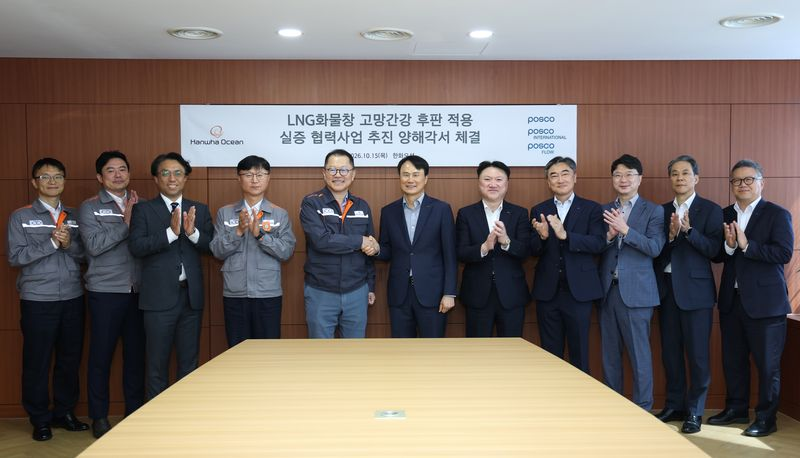
On October 15, POSCO and Hanwha Ocean held a signing ceremony for a Memorandum of Understanding (MoU) regarding a project to develop a demonstration vessel featuring high-manganese steel cargo tanks.
Under the agreement, the two parties—with Hanwha Ocean at the helm—will construct a demonstration vessel equipped with a high-manganese steel cargo tank. They will then verify its safety, durability, and operational efficiency under actual sailing conditions. The subsequent plan involves gathering operational data from the vessel to facilitate the commercial rollout of these high-manganese steel cargo tanks to shipowners worldwide.
POSCO stated that the South Korean market for LNG cargo containment systems has long relied on overseas technology. Should the superior performance and safety of this domestically developed high-manganese steel be successfully verified, it is expected to serve as a turning point for the South Korean shipbuilding industry, enabling it to build a competitive edge through differentiated cost structures and technological capabilities.
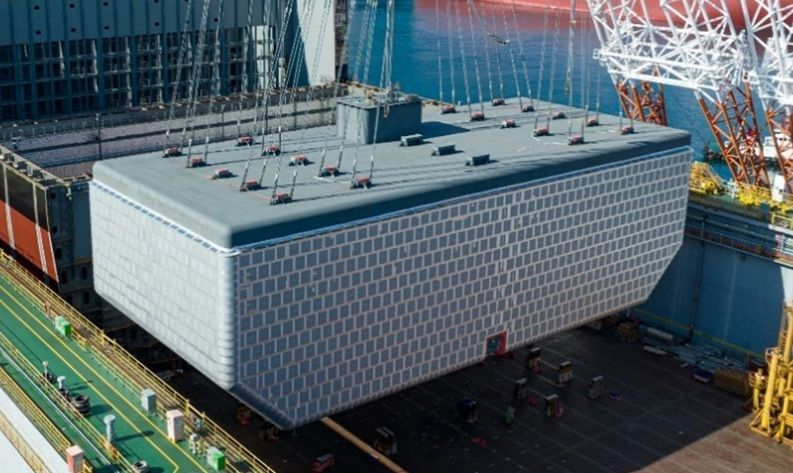
The high-manganese steel required for this collaboration is a specialized material developed using POSCO’s proprietary technology. It is characterized by its ability to maintain high strength and impact toughness even in cryogenic environments—at temperatures below -163°C. Compared to the high-cost nickel alloy steel (Invar) currently used in most LNG cargo containment systems, high-manganese steel leverages the abundant global supply of manganese, offering significant cost competitiveness and greater stability in material procurement.
POSCO views this collaboration as highly significant: while the application of high-manganese steel has previously been limited to fuel tanks for LNG-powered vessels, this partnership aims to extend its use to large-scale LNG cargo tanks. Notably, this represents a major market opportunity; whereas an LNG fuel tank requires approximately 1,000 tons of material per vessel, an LNG carrier’s cargo tanks can demand up to 10,000 tons per ship.
However, the commercial promotion of new materials requires performance verification through actual maritime operations. This partnership with Hanwha Ocean is poised to be a pivotal turning point; by accumulating operational data from high-manganese steel cargo tanks in real-world service, it will lay the foundation for the material’s commercialization and the securing of global orders.
POSCO further stated that its high-manganese steel cargo tanks can be customized to meet specific client requirements—ranging from “ultra-low boil-off rate (BOR)” to more economical BOR specifications—thereby minimizing LNG loss. Thanks to its superior structural rigidity, these high-manganese steel tanks can withstand the impact of liquid movement against the bulkheads—a phenomenon known as “sloshing”—which enhances operational practicality. Furthermore, the technology utilizes an independent tank design, where the cargo tanks are manufactured separately before being installed onto the vessel; this approach significantly shortens the construction timeline at the shipyard compared to conventional methods.
Against the backdrop of the global transition toward low-carbon energy, demand for LNG is projected to continue its steep upward trajectory. Consequently, the market for offshore LNG infrastructure—including LNG carriers, LNG bunkering vessels, and floating storage and regasification units (FSRUs)—is expected to experience explosive growth.
POSCO and Hanwha Ocean have announced plans to build upon their current demonstration project for LNG carrier cargo containment systems by expanding into other offshore energy assets, such as LNG bunkering vessels and FSRUs. Furthermore, given that high-manganese steel is suitable not only for LNG but also for the transport of various other cargoes—including hydrogen, ethane, and ammonia—the companies intend to phase in the use of this material across the entire market for cryogenic cargo transport.