


The final investment decision (FID) for the Venus oil field development project in Namibia has been postponed to 2027, according to industry sources. The market had previously widely expected the final investment decision to be made in July 2026, but the project has now been delayed because the Namibian government and the project developer, TotalEnergies, have yet to reach an agreement on the financial terms.
The Venus project entails the installation of up to 40 production and water-injection wells on the seabed—at a water depth of approximately 3,000 meters—off the southern coast of Namibia. First oil production is targeted for 2030, with processing, storage, and ship-loading operations to be handled by a Floating Production, Storage, and Offloading (FPSO) unit. This FPSO is designed with a daily capacity of 150,000 barrels, and the project is estimated to cost US$3 billion.
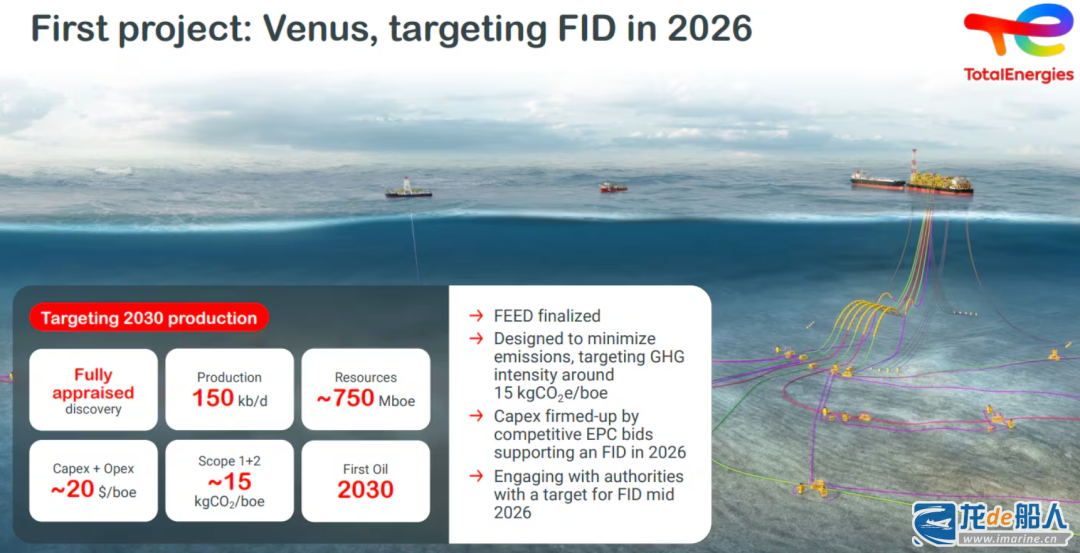
Currently, the new FPSO project for the Venus oil field development is in the bidding phase, with Hanwha Ocean and the Dutch offshore engineering firm SBM Offshore competing for the final contract. When this major offshore engineering contract will be awarded depends on when TotalEnergies makes its final investment decision. However, as the project is progressing more slowly than expected, uncertainty surrounding the contract is increasing.
For Hanwha Ocean, winning the bid for the Venus FPSO project is crucial. In recent years, the performance of the company’s offshore division has remained sluggish; although it swung to an operating profit of KRW 6 billion (approximately US$4.45 million) in the second quarter of 2026, this was primarily driven by one-off revenue from Petrobras’s FPSO P-79 project. Similarly, the operating profit of KRW 39 billion (approximately US$29 million) recorded in the fourth quarter of 2025 stemmed from a one-time gain resulting from additional settlements following changes to contract terms for existing projects.
Since jointly winning the contract for Petrobras’s FPSO P79 project with Italian offshore giant Saipem in 2021, Hanwha Ocean has faced a five-year drought in major offshore orders. Analysts in the South Korean financial market believe that this lack of large-scale orders has increased the company’s fixed-cost burden, potentially further eroding the profitability of its offshore division. Consequently, Hanwha Ocean is pinning its hopes on winning the Venus FPSO project to reverse the division’s fortunes.
However, market observers note that the key criteria for developers in selecting a winning bidder are price competitiveness and a proven track record. In this regard, Hanwha Ocean’s competitor, SBM Offshore, holds a slight advantage; the company is a specialist operator managing a fleet of 16 FPSOs and is currently collaborating with TotalEnergies on other FPSO projects.
At the same time, the South Korean shipbuilding industry believes that, in the field of FPSO construction, Hanwha Ocean does not hold a significant technological advantage over Chinese shipyards. Furthermore, since SBM Offshore holds the standard design for FPSOs and typically commissions Chinese shipyards to build the FPSO hulls, the likelihood of Hanwha Ocean securing this project is not high.
However, SBM Offshore has clearly stated that it has no intention of lowering its price quote to secure the Venus FPSO project. Against this backdrop, if Hanwha Ocean submits a lower bid, there remains a possibility of winning the contract. Nevertheless, even if Hanwha Ocean succeeds in securing the project, it would still face pressure regarding declining profitability in the short term; this is because the FPSO design phase typically spans 18 months to over two years, and this prolonged timeline would result in a gap in revenue generation.