


The Wall Street Journal reports that the Hanwha Philly Shipyard—once hailed by U.S. President Trump as a symbol of the revival of the U.S. shipbuilding industry—is facing questions about its commercial viability due to high labor costs, limited production facilities, and difficulties in attracting new customers.
In late 2024, Hanwha Group invested $100 million to acquire the Philly Shipyard in Pennsylvania, subsequently renaming it Hanwha Philly Shipyard. In August 2025, Hanwha Group announced it would invest $5 billion in Hanwha Philly Shipyard to build two new dry docks, three piers, and other shipbuilding facilities, with plans to increase its annual production capacity from less than two vessels to 20—a tenfold increase.
Regarding the future development plans for Hanwha Philly Shipyard, Hanwha Group announced with great fanfare that the yard would build LNG carriers, naval modules, and hull blocks, with long-term plans to construct U.S. naval vessels. Consequently, the Trump administration viewed this project as a prime example of the success of its tariff policies and foreign investment attraction strategy.
Although Hanwha Philly Shipyard is a flagship project of South Korean-U.S. shipbuilding cooperation, uncertainty is growing as to whether the massive investment made by Hanwha Group will translate into actual profits, given the shipyard’s excessively high construction costs and the difficulties it faces in expanding production capacity and securing orders from overseas shipowners.
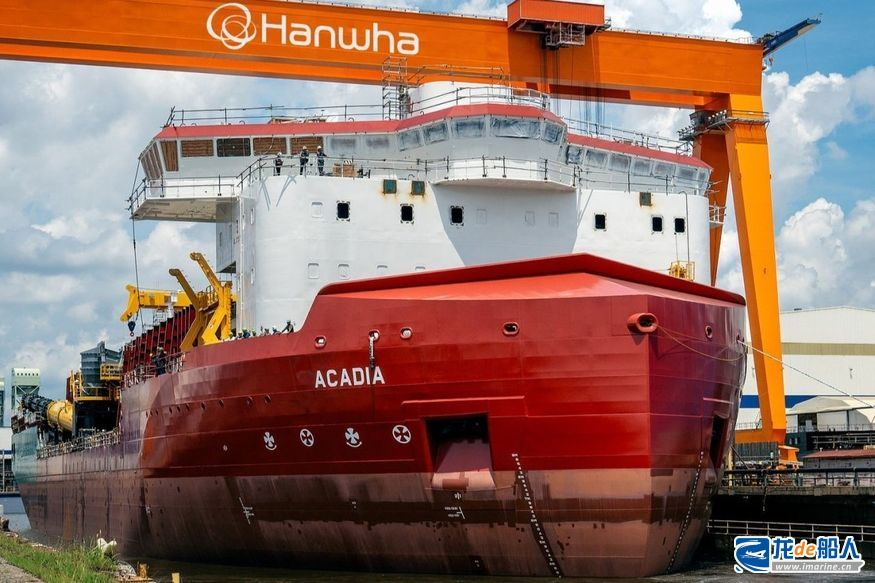
Specifically, the biggest problem facing Hanwha Philly Shipyard is the excessively high cost of shipbuilding in the United States. Take, for example, the three “Aloha”-class 3,600-TEU container ships ordered by the U.S. shipowner Matson: the total construction cost reached $1 billion, with each ship costing approximately $330 million—a price per vessel far higher than that of ultra-large container ship projects undertaken by Chinese and South Korean shipyards.
Based on Clarkson’s September data, the construction cost for a new ultra-large container ship in the 22,000-TEU to 24,000-TEU range is $248.5 million; in comparison, the cost per vessel for the feeder container ships ordered by Matson is approximately $81.5 million higher. The Wall Street Journal noted that high labor costs and a weak shipbuilding supply chain in the United States are the key factors driving up domestic shipbuilding costs.
With weak price competitiveness, Hanwha Philly Shipyard has struggled to secure a steady stream of orders from overseas shipowners. Since its acquisition by Hanwha Group in 2024, all of Hanwha Philly Shipyard’s commercial vessel orders have come from affiliates within the Hanwha Group—specifically, two LNG carriers and ten product tankers ordered by Hanwha Shipping. To date, no other external shipowners have placed orders with the shipyard. Prior to the acquisition, Hanwha Philly Shipyard’s commercial vessel orders consisted solely of three container ships from Matson.
The report notes that Hanwha Philly Shipyard must break free from its reliance on orders from within the group and demonstrate its price competitiveness to external shipowners—a task that is clearly an immense challenge. A senior executive at the maritime consulting firm Karatzas Marine Advisors stated, “From a purely economic perspective, it is difficult for overseas shipowners to place a high valuation on U.S.-based shipbuilders like Hanwha Philly Shipyard.”
In addition to cost issues, Hanwha Philly Shipyard’s production facilities and labor shortages also pose obstacles. In the nearly two years since its acquisition by Hanwha Group, Hanwha Philly Shipyard’s workforce has doubled to 2,500 employees, but to achieve the goal of building 20 ships per year, it still needs to expand its shipbuilding facilities and increase its number of skilled workers.
In terms of dry docks, Hanwha Philly Shipyard currently has two dry docks, only one of which is used for new ship construction, with an annual production capacity of just 1 to 1.5 vessels. To address this, Hanwha Group plans to build two new dry docks and three new berths, as well as expand its hull section production facilities; however, it must overcome the challenge of limited space at the existing site. This expansion plan is part of Hanwha Group’s $5 billion investment in Hanwha Philly Shipyard.
In summary, Hanwha Philly Shipyard’s profitability issues are evident. Prior to its acquisition by Hanwha Group, Philly Shipyard had posted losses for seven consecutive years (2018–2024); since Hanwha Group took over, it has reported losses for six consecutive quarters through the second quarter of 2026, with the operating loss for the second quarter of 2026 alone reaching approximately 19.2 billion won.
Hanwha Group initially expected Hanwha Philly Shipyard to return to profitability in 2026 but has now pushed that timeline back to 2027. The group stated that Hanwha Philly Shipyard’s ongoing losses are linked to factors such as project delays and rising costs associated with projects the shipyard had secured prior to its acquisition. Since the original shipbuilding projects were based on fixed-price contracts, rising construction costs could not be passed on to the ship prices, further eroding profits.
Taking Matson’s project for three 3,600-TEU container ships as another example, the original delivery schedule was set for the fourth quarter of 2026 and 2027, but it has now been confirmed that all ships will be delivered by the second quarter of 2028. Construction of the first vessel, the “Makua,” began in October 2024, but its naming ceremony was not held until October 10, 2026—two years later. Delays in the current project are causing a ripple effect on subsequent production.
In 2025, South Korea announced a commitment to invest $150 billion in the U.S. shipbuilding industry to help revitalize it. However, other leading South Korean shipbuilders have so far shown no intention of directly investing in U.S. shipyards, as the high production costs and profitability risks associated with shipbuilding in the United States remain their primary concerns.