


On January 24, a 13,000 DWT deck carrier built by Chinese shipbuilder Sanfu Shipbuilding for a Japanese owner was successfully launched at the company’s No. 2 slipway.
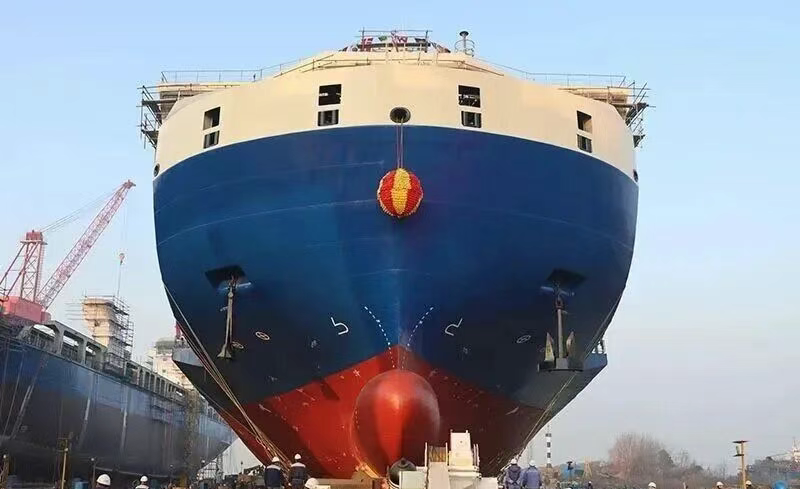
This series of 13,000 DWT deck carriers was designed by Germany’s HEAVY LIFT Design Company, featuring a forecastle design. The vessel has an overall length of 149.90 meters, a beam of 30.00 meters, a depth of 8.72 meters, a maximum deadweight of 13,000 tons, a design speed of 12.9 knots and is classed by NK.
According to reports, this vessel is a deck carrier specifically designed for Japan’s offshore engineering projects. It incorporates multiple advanced functional designs in loading space, propulsion systems, and electrical configurations, offering high loading flexibility, operational reliability, and superior energy efficiency. The vessel can efficiently accommodate diverse cargo transportation needs, including offshore equipment, wind power installations and port machinery.
In terms of loading system design, the vessel adopts a large-scale flat deck combined with foldable railings around it, creating an extremely unobstructed and spacious loading area. With a deck design load of 20 tons per square meter, it supports diverse loading and unloading operation modes including stern ramp ro-ro, significantly enhancing the flexibility of cargo handling.
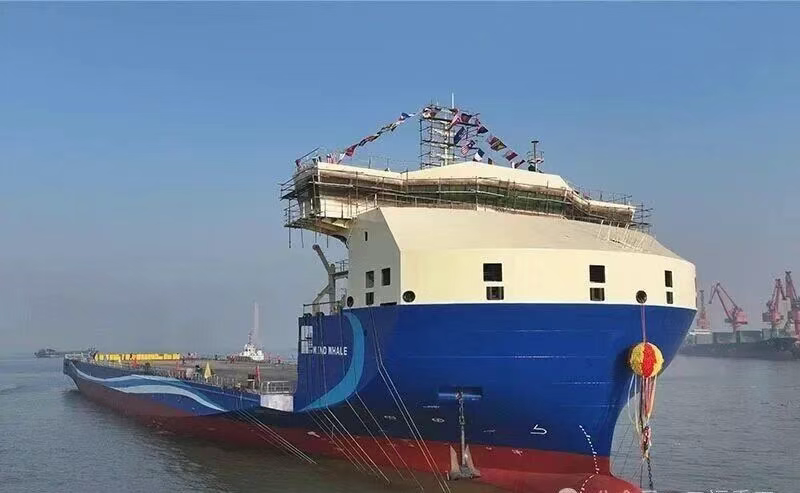
The ballast tanks feature a compact compartment layout with centralized ventilation design. Ventilation ducts are uniformly routed to the aft wall of the superstructure, completely eliminating deck-level vent pipes to maximize deck openness and enable unrestricted cargo stowage. Additionally, the compact ballast tank configuration allows for rapid adjustment of the vessel’s buoyancy state, ensuring stability during cargo operations and navigation.
For the design of the power control system, the vessel employs a dual redundant configuration. Two independent electric propulsion units serve as mutual backups, ensuring that the failure of a single unit does not compromise basic vessel maneuverability. The bow dual thrusters are similarly equipped with redundant mechanisms, guaranteeing reliable maneuvering capability even in the event of a single-side failure. This comprehensive approach ensures the safety of both navigation and operational activities.
For the design of its core power system, the vessel adopts ABB’s DC variable frequency technology and innovatively integrates a DC busbars with a battery energy storage system, which significantly improves energy utilization efficiency and power supply stability. Four variable frequency generators equipped with SCR denitration devices are centrally arranged in the forward engine room, meeting stringent environmental protection requirements. The system deeply integrates a route optimization algorithm and an intelligent energy efficiency management platform, realizing the efficient operation of the power system through intelligent regulation and control, and providing dual guarantees for the vessel’s endurance and operational economy.