


Belgian offshore contractor Jan De Nul has unveiled plans to expand its offshore energy fleet, adding two trenching support vessels designed specifically for submarine cable burial on the seabed. One vessel will be newly constructed, while the other will be converted from an existing water injection dredger.
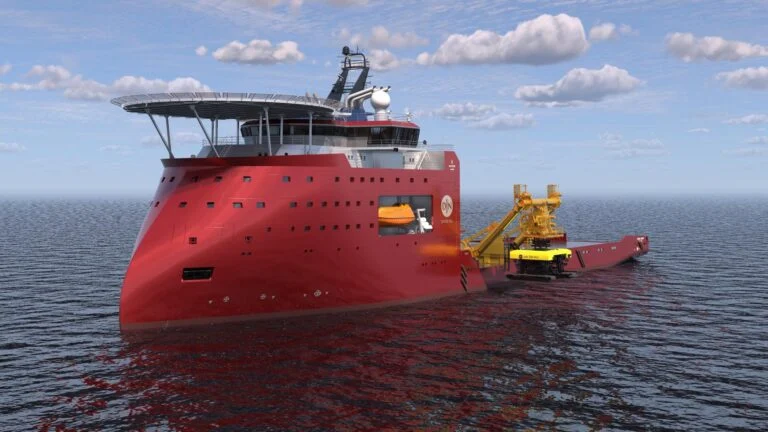
One of the new additions will be a purpose built trenching support vessel equipped with a subsea trenching robot capable of burying cables up to five metres beneath the seabed. The vessel is based on an Ulstein design and will be constructed at the China Merchants Heavy Industries (CMHI) shipyard in China, will be capable of running on biofuel and green methanol. Delivery is expected in 2028. Once delivered, it will join Jan De Nul’s expanding fleet dedicated to offshore renewable energy projects.
The trenching system will be operated from the vessel deck and designed to work in combination with cable installation operations. Burying cables beneath the seabed provides additional protection against anchors, fishing gear, and seabed movement.
This new vessel will feature ULEv technology. This Ultra Low Emission system filters up to 99 percent of nanoparticles from exhaust gases and significantly reduces polluting emissions.
The engines can operate on biofuel to lower CO₂ emissions and are prepared for potential future operation on methanol. This reflects a broader trend across offshore construction fleets as operators prepare for stricter environmental regulations.
Alongside the newbuild vessel, Jan De Nul will convert its existing vessel Henry Darcy into a trenching support vessel.
The vessel will be equipped with a subsea robot specifically designed to bury cables in shallow waters where installation conditions can be more complex. The robot has been ordered from subsea engineering partner Osbit.
Shallow water trenching is often required close to shore where cables approach landing points or connect to coastal grid infrastructure. These sections of the cable route can be among the most sensitive parts of offshore transmission systems.
Notably, in October last year, the group announced an order for a new rock installation vessel. Named the “George W. Goethals,” the vessel boasts a maximum lifting capacity of 37,000 tons and will primarily serve energy sector projects, with its core operational areas centered in the North Sea and Southeast Asia—regions where numerous energy projects are underway.
“With the Fleeming Jenkin and the William Thomson, we will soon expand our fleet with two XL vessels for the installation of subsea cables. Investing in vessels that can protect those same cables is a logical next step. Last year, we announced the rock installation vessel George W. Goethals, which protects cables and other energy infrastructure with a protective rock layer. Now we are also expanding our fleet with vessels designed to bury cables safely in the seabed,” said Wouter Vermeersch, Director Subsea Cables Offshore Energy at Jan De Nul.