


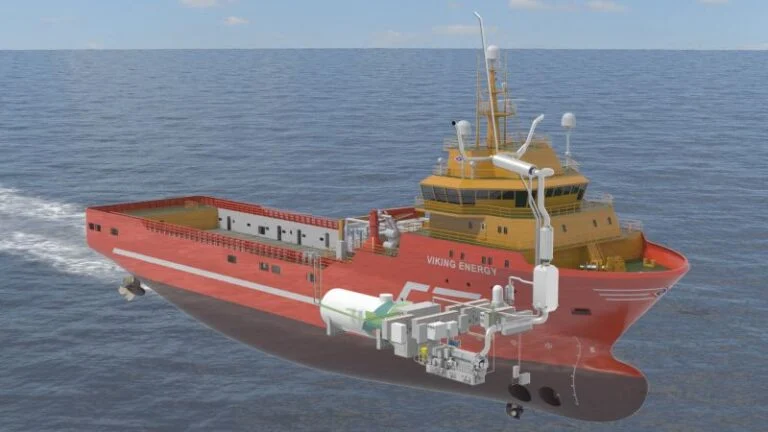
Norwegian offshore vessel owner Eidesvik Offshore announced that it has signed a conversion contract with Halsnøy Dokk for the platform supply vessel (PSV) Viking Energy. The plan is to convert this LNG-battery hybrid vessel into an ammonia-powered vessel equipped with dual-fuel engines, making it the world’s first ammonia-powered platform supply vessel.
As part of the Norwegian government-backed Apollo Project, Eidesvik Offshore received nearly $4 million in grants from the Norwegian Energy Agency last year for this conversion project.
Under the contract, Halsnøy Dokk’s retrofit work includes: installing a four-stroke Wärtsilä 25 dual-fuel ammonia engine; installing an ammonia fuel tank, AmmoniaPac fuel gas supply system, ammonia leak mitigation system, and exhaust aftertreatment system; and implementing structural retrofits, system integration, technical upgrades, and testing and commissioning.
The ship design firm Breeze Ship Design is responsible for the basic and detailed design work of Halsnøy Dokk for the “Viking Energy”, and its design has received approval in principle (AiP) from Det Norske Veritas (DNV).
Records indicate that the Viking Energy was built in 2003 using the VS 4403 design. It measures 95 meters in length, 20 meters in width, and has a deadweight tonnage of 6,013 tons, with a net deck area of 1,030 cubic meters.
Notably, the Viking Energy has long been a benchmark for industry retrofits: it was the world’s first platform supply vessel powered by LNG. In 2016, it was converted into a battery-hybrid vessel certified by DNV with the battery-powered class notation. Now, the vessel is set to undergo its latest retrofit, becoming the world’s first ammonia-powered platform supply vessel.
Since its delivery in 2003, the Viking Energy has been continuously chartered by Norwegian oil giant Equinor, with its charter agreement extended through April 2030. Equinor also holds an option to renew the vessel’s operations on the Norwegian continental shelf and has stated it will “provide significant financial support for converting it to ammonia-fueled operations.”