


HD Hyundai and Kiewit Offshore Services (KOS) recently announced the signing of a strategic partnership agreement aimed at collaborating on shipbuilding projects for the U.S. market and other strategic areas of mutual interest. The two companies share a collaborative relationship spanning several decades.
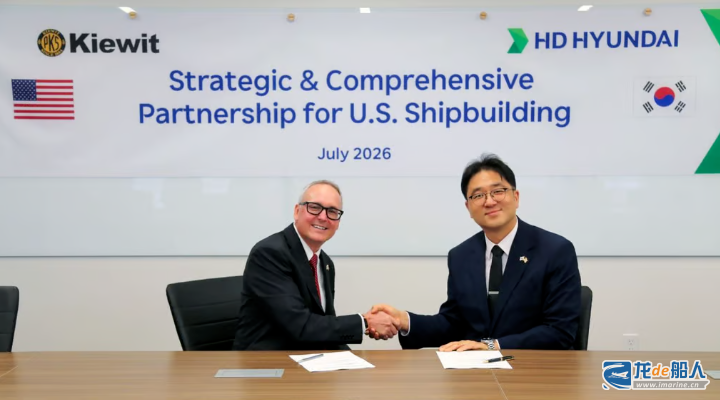
HD Hyundai stated that this partnership aims to support the expansion of U.S. shipbuilding capacity, strengthen the U.S. maritime industrial base, and enhance domestic manufacturing capabilities, while establishing a framework for the two parties to explore further collaborative opportunities by leveraging their complementary strengths.
Under the agreement, the two parties will collaborate on various U.S. shipbuilding projects, including the fabrication of hull blocks and modules. This partnership combines HD Hyundai’s expertise in ship design, manufacturing, procurement, and shipbuilding technology with KOS’s capabilities in large-scale component fabrication, construction, and complex project execution. The parties will leverage advanced manufacturing processes and proven production models to expand shipbuilding capacity at U.S. shipyards.
HD Hyundai stated: “Through its partnership with KOS, the Group will actively support the expansion of the U.S. shipbuilding industry and maritime infrastructure, while also exploring other areas of collaboration, such as floating assets.”
With over fifty years of global shipbuilding experience, HD Hyundai—through its shipyards in South Korea and abroad—has built and delivered, or is currently constructing, commercial vessels, offshore equipment, and naval ships. As a leading global shipbuilder and offshore engine manufacturer, HD Hyundai plans to leverage its partnership with KOS to aggressively pursue shipbuilding projects in the United States.
Leveraging its facilities along the Gulf Coast, KOS possesses decades of experience in delivering complex marine engineering projects. As a Kiewit company, KOS combines large-scale fabrication capabilities with EPC expertise, enabling it to support commercial and government shipbuilding projects and help expand U.S. shipbuilding capacity.