


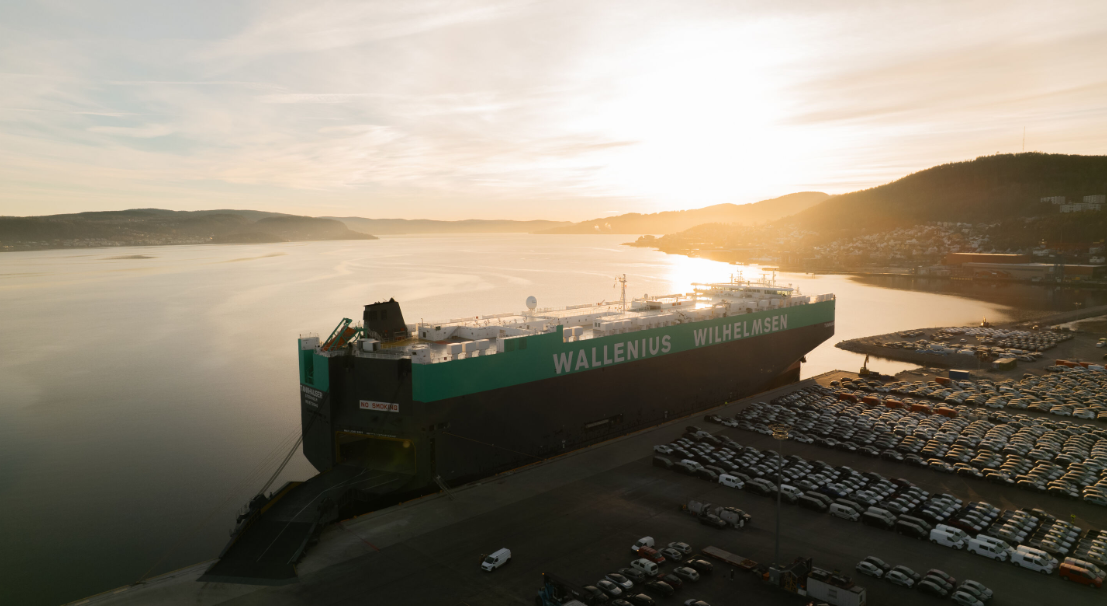
Norwegian car carrier operator Wallenius Wilhelmsen announced that it has renewed shipping contracts with unnamed global automotive distributors, securing approximately $190 million in net freight value.
The agreement spans two years with a one-year reciprocal extension option. The contract also includes a fixed surcharge clause covering multi-fuel usage, reflecting the company’s growing focus on flexible fuel solutions for its fleet.
This contract renewal is one of a series of contracts that Wallenius Wilhelmsen has recently secured and renewed.
In January 2026, Wallenius Wilhelmsen announced the signing of a one-year shipping contract with a major Asian automotive and heavy equipment manufacturer. The agreed-upon volume is projected to generate approximately $130 million in revenue.
Prior to signing new contracts with Asian clients, Wallenius Wilhelmsen completed a series of contract extensions and renewals with several key European industrial customers by the end of 2025. For instance, agreements with a European premium automaker were extended for three years through 2030, while contracts with a European heavy equipment manufacturer were renewed for two years through 2028. The combined value of these two renewed contracts totals nearly $500 million.
According to its official website, Wallenius Wilhelmsen is a market leader in ro-ro transport and vehicle logistics, providing global customers with transportation services for automobiles, trucks, ro-ro equipment and bulk cargo. The company operates across 28 countries and regions, managing a fleet of approximately 125 vessels serving 15 trade routes across six continents. It maintains a global inland distribution network, 66 handling centers, and seven maritime terminals.
Wallenius Wilhelmsen is currently actively expanding its fleet, having confirmed 14 PCTCs at China Merchants Jinling Shipyard (Nanjing), including 8 11,700 CEU PCTCs and 6 9,300 CEU PCTCs, with 2 option vessels held at the same shipyard. Among these newbuildings, 7 vessels are equipped with LNG dual-fuel engines, 7 with methanol dual-fuel engines, and 7 LNG dual-fuel PCTCs incorporate ammonia-ready design provisions.