


Recently, Russian authorities announced the next phase of development plans for the Northern Sea Route (NSR), a key component of President Vladimir Putin’s plan to create an Arctic transport corridor. The plan calls for a significant boost to the shipbuilding industry and improvements to infrastructure along the route to support continued growth in shipping volume over the next decade.
According to the specific plan announced by Russian Deputy Prime Minister Yuri Trutnev: By 2035, Russia will construct 10 new icebreakers and 46 rescue vessels, and plans to establish three rescue fleet bases along the Northern Sea Route to ensure year-round navigability of the Arctic shipping lane.
The Russian Arctic shipping route is managed by Rosatom, the Russian state-owned nuclear energy corporation. Rosatom reports that Russia currently has eight nuclear-powered icebreakers, including three older vessels: the “50 Let Pobedy” completed in 2007, the “Vaygach” commissioned in 1990, and the “Taymyr” commissioned in 1989.
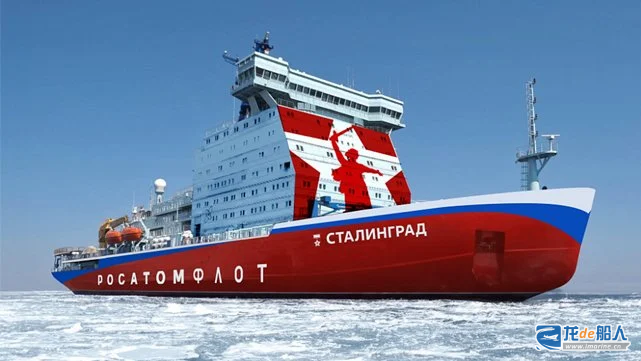
Currently, Russia is advancing its new type of nuclear-powered icebreaker—the Project 22220 nuclear-powered icebreaker, with several new vessels already in service: the “Arktika” in 2020, the “Sibir” in 2021, the “Ural” in 2022, and the “Yakutiya” in 2025. The fifth vessel, the “Chukota” completed the construction and installation of its nuclear reactor in the autumn of 2025 and is currently undergoing dry dock trials. The sixth vessel the “Leningrad” is under construction. The “Stalingrad” had its keel laid in November 2025, at which time its construction progress was 4%, and it was stated that it would accelerate the construction cycle by adopting prefabrication technology.
It is understood that the construction period for the Project 22220 nuclear-powered icebreaker is 5 years, but it is said that the construction period for the “Stalingrad” will be shortened to 4.5 years, and it is stated that several design optimizations will be carried out based on the operational experience of the first vessel.
The development of the Project 22220 nuclear-powered icebreaker began in the 1990s, with the aim of modernizing Russia’s aging icebreaker fleet. At that time, almost all of the icebreakers were still using technology from the 1960s.
It is worth mentioning that, through continuous design optimization, this type of icebreaker has finally become the world’s largest and most advanced nuclear-powered icebreaker, with a design life of 40 years, a total length of 173 meters, powered by two commercial nuclear reactors, each with a thermal power of 175 megawatts, a maximum speed of 22 knots, and the ability to break through ice layers up to 3 meters thick.
It is understood that Russia has the largest number of icebreakers, the most advanced technology, and the strongest polar operation capabilities in the world. In addition to the Project 22220 nuclear-powered icebreaker, Russia’s new generation of heavy nuclear-powered icebreakers, the Project 10510, has been under construction at the Zvezda since 2020, with the first vessel “Rossiya” scheduled to enter service in 2030.
In addition to the Project 10510 heavy nuclear-powered icebreaker, Zvezda is currently building the Russian ARC7 ice-class liquefied natural gas (LNG) carrier and an ice-class shuttle tanker. In 2025, Zvezda will complete two major shipbuilding milestones: the first delivery of the ice-class shuttle tanker “Valentin Pikul” with a deadweight tonnage of 69,000 tons; and the first domestically built ice-class LNG carrier in Russia, the “Alexey Kosygin,” which is also the first vessel in a series of LNG carriers built under the Arctic LNG 2 project.
The “Alexey Kosygin” was originally scheduled for delivery in early 2023, but delays were caused by equipment supply constraints. The “Valentin Pikul” took nearly seven years from order placement to delivery, with a construction cycle of four years from keel laying in December 2020 to delivery in early 2025. Both vessels share a common feature: most modules were designed and built by Samsung Heavy Industries, and then assembled at the Zvezda.
Currently, Russia’s shipbuilding industry is facing extreme difficulties due to Western sanctions. In order to resolve the industry’s predicament, Russia has adopted self-help measures such as internal integration to promote the development of the shipbuilding industry, but with little effect.
Taking the Zvezda shipyard as an example, VTB Bank originally planned to acquire it from Rosneft, and this acquisition was supported by Russian President Vladimir Putin. However, the deal ultimately failed and did not achieve the expected results. The reason for this was that VTB’s subsidiary, the United Shipbuilding Corporation (USC), could not provide sufficient funds for the acquisition.