


On May 25, Titan Wind Energy (Suzhou) Co., Ltd. (hereinafter referred to as “Titan Wind Energy” or “the Company”) issued a “Voluntary Announcement Regarding Winning a Ship Construction Order.” The announcement shows that the Company’s wholly-owned subsidiary in the offshore engineering sector has won a new order for the construction of the hull of a floating production storage and offloading (FPSO) unit, amounting to approximately RMB 568 million (approximately US$84 million).
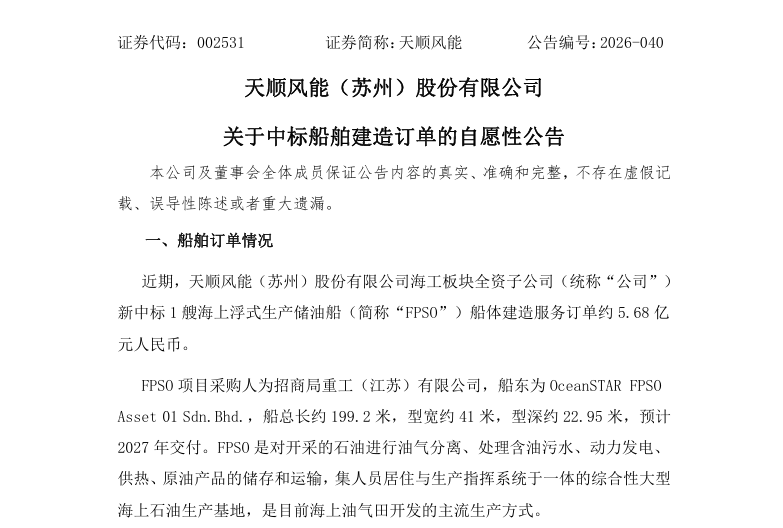
In its announcement, Titan Wind Energy stated that the purchaser for this FPSO project is China Merchants Heavy Industry (Jiangsu) Co., Ltd., and the shipowner is OceanSTAR FPSO Asset 01 Sdn. Bhd. The vessel has a total length of approximately 199.2 meters, a beam of approximately 41 meters, and a draft of approximately 22.95 meters, with delivery expected in 2027.
Titan Wind Energy stated that the company has established the capability to independently build high-end offshore engineering equipment on an international scale. Its mature technological expertise and standardized construction system in the field of high-end floating offshore engineering equipment have facilitated the successful implementation of this FPSO project. This achievement signifies that the company’s capabilities in high-end oil and gas vessel manufacturing have gained market recognition, which will help expand and consolidate the scope of its high-end shipbuilding business and its market position. It is of great significance for the company’s future efforts to further explore and secure other high-end oil and gas vessel projects.
Earlier reports indicated that China Merchants Heavy Industry (Jiangsu) had signed an engineering, procurement, and construction (EPC) contract with OceanSTAR Elite Group for the Integrated Redevelopment Project FPSO.
An FPSO is a large-scale, integrated offshore oil production facility that combines oil and gas separation, treatment of oil-contaminated wastewater, power generation, heating, and the storage and transportation of crude oil products, all within a single structure that also houses living quarters and production control systems. It is currently the primary method of production in offshore oil and gas field development.