


As a former leading private shipbuilding enterprise in China, the long-dormant shipyard facilities of Rongsheng Heavy Industries have now been successfully leased. The lessee has initiated the bidding process for constructing new 1,600-ton and 2,400-ton large gantry cranes, making full efforts to resume operations at the long-idle large dry docks.
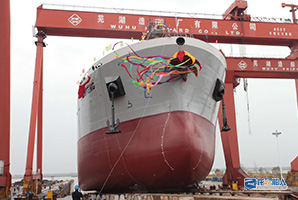
Reactivating Rongsheng Heavy Industries’ Idle Dock, Wuhu Shipyard Expands Capacity Once More
According to industry sources, Wuhu Shipyard recently established the “Nantong Shipbuilding Project Team” to accelerate the construction of its Nantong shipbuilding base and ensure that the project is put into production on schedule.
Sources revealed that the original site of Wuhu Shipyard (Nantong shipbuilding base) was the Rongsheng Heavy Industries factory area, which had been shut down for many years. Wuhu Shipyard will lease two of Rongsheng Heavy Industries’ four dry docks to build large vessels, including Newcastlemax bulk carriers and VLCCs.
Market sources indicate that Wuhu Shipyard has signed a letter of intent with an unnamed shipowner for the construction of a 210,000 DWT Newcastlemax bulk carrier; in addition, the Navios Group, led by Angeliki Frangou, has finalized an agreement with the shipyard for four VLCCs.
If the above order rumors are confirmed, it will be the first time this century-old shipyard has undertaken the construction of large vessels. Previously, the largest vessel built by Wuhu Shipyard was an 89,000 DWT Kamsarmax bulk carrier, ordered by AVIC COSCO between 2023 and 2024, with a quantity of 10 vessels.
Rongsheng Heavy Industries’ No. 1 to No. 3 docks were completed successively between 2005 and 2009, and No. 4 dock was completed and put into operation in 2011. Since the docks have been idle for many years, Wuhu Shipyard needs to carry out maintenance and renovation of the relevant infrastructure, as well as repair and add new equipment.
Currently, Wuhu Shipyard has initiated tenders for one 2400t×162m gantry crane and one 1600t×162m gantry crane for the block assembly, transportation, and block turning at Wuhu Shipyard (Nantong shipbuilding base). The delivery location is at the Nantong base of Wuhu Shipyard, Nantong City, Jiangsu Province.
This lease of idle space from Rongsheng Heavy Industries is the latest move by Wuhu Shipyard to expand its production capacity.
According to its official website, Wuhu Shipyard was originally founded in 1900 as Fujiheng Machinery Plant. It has now developed into a first-class modern shipbuilding enterprise in China with a history of 126 years. Its main business currently involves a series of civilian ships, including liquid cargo ships, car carriers, new energy ships, offshore engineering ships, bulk carriers, special ships and multi-purpose ships.
Excluding the Nantong base, Wuhu Shipyard includes the Wuhu Shipyard headquarters, the Weihai Shipbuilding base, Anhui Haizhi Equipment Research Institute, Shanghai Haizhi Zhiyuan Technology Co., Ltd., Wuhu Fujiheng Machinery Co., Ltd., Yingxing Financial Leasing (Anhui) Co., Ltd., and Tri Water New Energy Technology. The Wuhu Shipyard headquarters covers an area of 1,210,700 square meters, with a total shoreline of 1,355 meters, and has two 80,000-ton slipways and one 740-meter outfitting wharf; the Weihai base covers 680 mu (approximately 45 hectares).
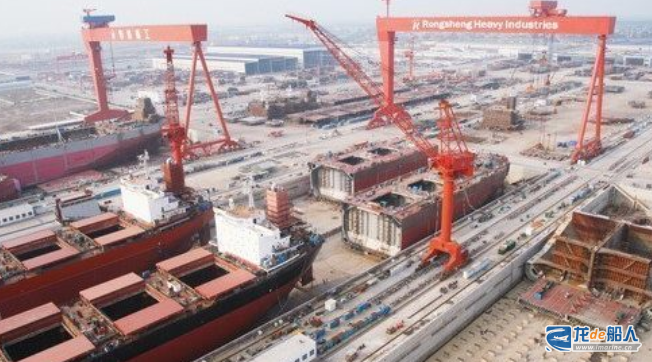
Top-tier shipyard exits market amid order cancellations and debt burdens
According to public information, Rongsheng Heavy Industries was founded in 2005 and started to build its shipyard in Nantong in October of the same year. Only 4 months after the construction of the shipyard started, Rongsheng Heavy Industries announced in February 2006 that it had taken orders for six 75,500 dwt ice-strengthened bulk carriers, and took orders for a total of 19 bulk carriers and 30 Suezmax tankers in 2006, which made Rongsheng Heavy Industries become the private shipbuilding enterprise with the largest amount of handheld orders in the country.
From 2006 to 2011, Rongsheng Heavy Industries enjoyed a period of rapid development, with its business expanding from shipbuilding and offshore to power engineering. In 2010, Rongsheng Heavy Industries was listed on the main board of the Hong Kong Stock Exchange, becoming the largest private enterprise listed in Hong Kong of that year. From 2010 to 2012, Rongsheng Heavy Industries ranked first in the world in terms of hand-held orders, and became the largest private shipbuilding enterprise in China.
Good times did not last long. In 2012, Rongsheng Heavy Industries had its first annual loss after listing, which amounted to RMB 573 million, and fell into the predicament of broken capital chain in 2013, and the total loans from financial institutions to Rongsheng Heavy Industries even exceeded RMB 25 billion at one time during the peak period of indebtedness.
In 2014, Rongsheng Heavy Industries was suspended for restructuring with a loss of RMB 7.75 billion and abandoned orders of up to 59 vessels, and announced the acquisition of New Continental Oil & Gas, which gained the co-operative operation rights of four oil fields in Fergana Basin of Kyrgyzstan, a country in Central Asia; In 2015, Rongsheng Heavy Industries changed its name to China Huarong Energy Company Limited (Huarong Energy) and changed its business to oil and gas market; In 2019, two 900-ton gantry cranes at the Rongsheng Heavy Industries site were dismantled and sold to other shipyards; in 2020, Rongsheng Heavy Industries site began to be leased.
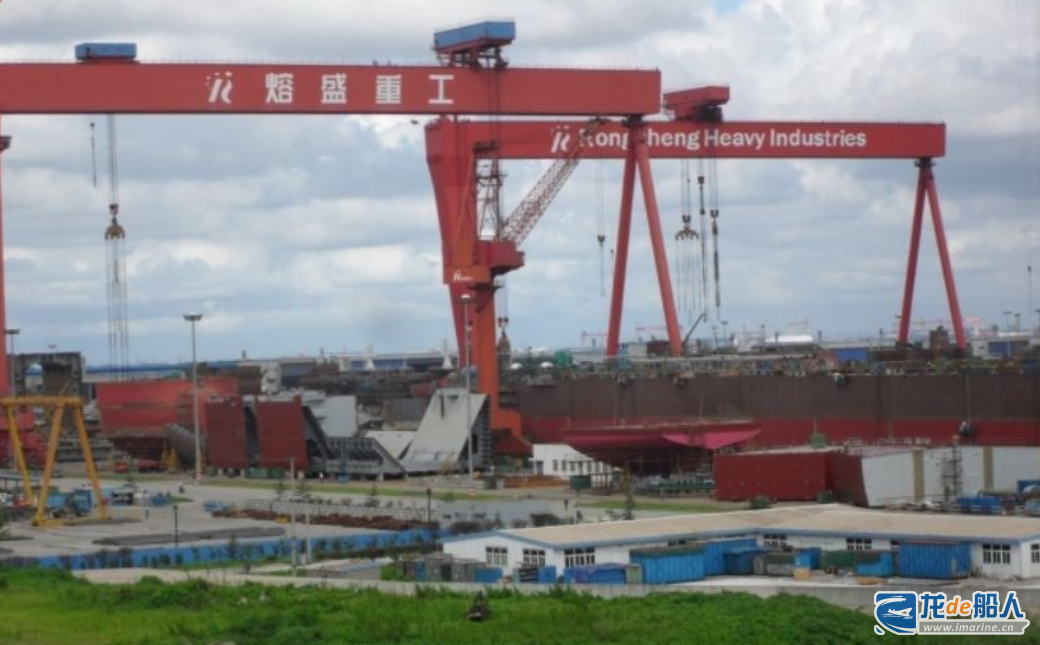
Riding the Supercycle Wave, Rongsheng Heavy Industries Reports Frequent Restarts
As the shipbuilding industry gradually recovers and enters a new super cycle, news of Rongsheng Heavy Industries taking on new orders and restarting its shipbuilding business has been frequently reported. As a former top-tier shipyard, Rongsheng Heavy Industries was first rumored to be considering restarting its shipbuilding business in 2022.
In May 2022, mining giant Vale sought to build 14 dual-fuel Very Large Ore Carriers (VLOCs) with a deadweight tonnage of 300,000 tons, stating it was in discussions with several Chinese shipyards including Rongsheng Heavy Industries; In November, Rongsheng Heavy Industries announced plans to rebrand as SPS Shipyard and signed a letter of intent with a subsidiary of Greek shipowner George Economou for the construction of 10 bulk carriers of two different types. However, reports at the time indicated that due to the substantial capital requirements, Rongsheng Heavy Industries’ relaunch efforts had made limited progress.
After that, rumors of Rongsheng Heavy Industries’ restart disappeared. Until August 2024, market reports indicated that Rongsheng Heavy Industries had secured funding and signed a series of orders for 12,000 TEU LNG dual-fuel container ships with Mediterranean Shipping Company (MSC). At the end of the year, Rongsheng Heavy Industries, under the name “Jiangsu New Rongsheng Heavy Industry Co., Ltd.”, signed an order with Greek shipowner Capital for two 210,000 DWT bulk carriers and completed the bidding for shaft generation systems for the two new ships. However, this restart also failed to materialize.
At its peak, Rongsheng Heavy Industries operated four large dry docks equipped with six 900-ton gantry cranes, one 600-ton gantry crane, and one 1,600-ton gantry crane—the largest in China at the time. The facility featured eight outfitting piers and two material piers, complemented by a steel plate pretreatment workshop, component factories, flat and curved section workshops, pipe fabrication workshop, and painting workshop. Its designed annual shipbuilding capacity was 8 million deadweight tons.
This time, Wuhu Shipyard’s lease of two idle docks and related workshops from Rongsheng Heavy Industries will not only help Wuhu Shipyard expand its production capacity, but also means that Rongsheng Heavy Industries’ idle resources can be revitalized and utilized against the backdrop of a current shortage of production capacity in the shipbuilding industry.
It is worth noting that, according to industry sources, Rongsheng Heavy Industries is in talks with a shipbuilder to lease two other dry docks. If all four dry docks are successfully leased, it will mark the restart of this large-scale shipbuilding base, which has attracted much attention in the industry, in a new capacity.