


Maersk, the world’s second-largest container shipping line and a Danish shipping giant, has once again announced a major shipbuilding plan involving up to 24 dual-fuel ultra-large container ships, and has already selected two Chinese shipyards.
According to TradeWinds, Maersk is continuing negotiations with two Chinese shipbuilders to build 12+12 24,000 TEU liquefied natural gas (LNG) dual-fuel ultra-large container ships. The order is valued at approximately $5.5 billion, with each vessel costing about $229 million. Sources revealed that the shortlisted shipbuilders for this container ship order are Hudong-Zhonghua, a subsidiary of China State Shipbuilding Corporation, and Hengli Heavy Industries, a private Chinese shipbuilder.
Reports indicate that Maersk’s newbuilding project for up to 24 dual-fuel ultra-large container ships initially attracted bids from multiple Chinese and South Korean shipbuilders. After comparing the shipbuilding technologies and prices offered by these companies, Maersk narrowed the list of candidates down to Hudong-Zhonghua and Hengli Heavy Industries, and negotiations are now in the final stages.
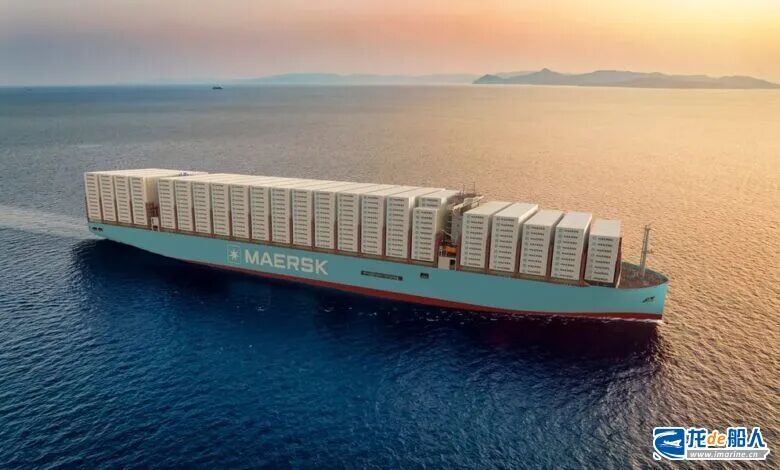
It is understood that Maersk had previously focused on methanol-dual-fuel vessels, which produce lower carbon emissions; however, due to delays in methanol infrastructure development and excessive costs, the company has shifted to LNG-dual-fuel vessels as an alternative and is showing a trend toward placing bulk orders with Chinese shipbuilders.
In the past, South Korean shipbuilders had long dominated the market for new-build LNG dual-fuel vessels and ultra-large “MegaMax” container ships of 20,000 TEU or more. However, in recent years, Chinese shipbuilders have rapidly expanded their order portfolio into these sectors by leveraging their comprehensive competitiveness, placing immense pressure on the South Korean shipbuilding industry.
Taking Maersk as an example, all 34 LNG-dual-fuel ultra-large container ships for which the shipping company has confirmed orders this year have been awarded to Chinese shipyards: 20 19,000-TEU ultra-large container ships to Hengli Heavy Industries and 14 18,600-TEU ultra-large container ships to New Times Shipbuilding. The new vessels are expected to be delivered in 2029 and 2030, with a total construction cost of nearly $6.6 billion.
If the latest order for up to 24 dual-fuel ultra-large container ships is again awarded to Chinese shipbuilders, it would mean that all of Maersk’s planned newbuilding projects this year—totaling up to 58 vessels with a combined value exceeding $12 billion—would be undertaken by Chinese shipbuilders, significantly strengthening their dominant position in the global newbuilding market.
Several months ago, Maersk announced adjustments to its logistics integration strategy, which had been in place for a decade, stating that “deepening our focus on our core maritime business and improving transport efficiency yields greater returns than expanding our logistics operations.” Consequently, the company officially launched a plan to expand its container ship fleet.
Market analysts note that Maersk’s decision to partner with Chinese shipbuilders to advance its container fleet renewal and expansion plan was primarily driven by the competitive pricing, faster delivery schedules, and increasingly refined shipbuilding technology offered by Chinese shipbuilders.
In terms of container ship construction technology, the technical gap between Chinese and South Korean shipbuilders in the field of environmentally friendly, high-value-added container ships has narrowed significantly. In some areas, Chinese shipbuilders have even surpassed their South Korean counterparts, despite these sectors having previously been virtually monopolized by South Korean shipbuilders. This indicates that the shipbuilding capabilities of Chinese shipbuilders are increasingly being recognized by major international shipowners.
Currently, leveraging ample production capacity and comprehensive competitive advantages, Chinese shipbuilders continue to secure new ship orders worldwide—particularly in the container ship and oil tanker markets—further solidifying the Chinese shipbuilding industry’s dominant position in global merchant ship construction.
Based on Clarksons data, from January to September 2026, total global new ship orders reached 70.71 million compensated gross tons (CGT) across 2,558 vessels, with Chinese shipbuilders securing 53.91 million CGT across 1,995 vessels, firmly maintaining their position as the undisputed leader. In the first half of 2026, global shipowners placed new orders for 388 container ships, with Chinese shipyards securing approximately 80% of these orders. In contrast, South Korean shipbuilders—once renowned for their unrivaled technological capabilities—held a market share of only 15%.