

Driven by a new “super-cycle” in the shipbuilding industry, South Korea’s three major shipbuilders—HD Korea Shipbuilding & Offshore Engineering (KSOE), Samsung Heavy Industries, and Hanwha Ocean—are seeing their existing production capacities reach saturation. To handle current order backlogs and meet future market demand, these three companies are actively expanding their production capacity.
According to reports released by the three shipbuilders, their average operating rates (facility utilization rates) for the first half of 2026 stood at 106.1%, 100.2%, and 100%, respectively.
The operating rate is a figure derived by comparing actual working hours against a baseline of normal production or target operating hours. Rates exceeding 100% indicate that actual output has surpassed the capacity defined by standard operating hours, meaning the shipyards are operating beyond normal limits through measures such as overtime work on holidays or night shifts.
The challenge lies in the fact that, despite operating at full capacity, the shipyards still cannot keep up with the volume of orders. There is growing concern within the South Korean shipbuilding industry that insufficient capacity could lead to missed opportunities to secure new contracts. To address this, the three major shipbuilders are expanding capacity through investments in equipment and the development of “smart shipyards.”
Specifically, Hanwha Ocean plans to invest KRW 686.9 billion in the second half of 2026 to upgrade shipbuilding facilities and to add a very large floating dock and a massive offshore crane by March 2027, aiming to reduce reliance on leased equipment while boosting shipbuilding capacity and efficiency.
Meanwhile, Hanwha Ocean is expanding the application of welding automation, centered on its Geoje shipyard. Currently, the adoption rate of AI transformation (AX) in the company’s indoor welding processes has reached 67%; the goal is to achieve 100% automation of welding processes by 2030, leveraging automation and digital technologies to reduce the time required for shipbuilding and enhance overall efficiency.
In the first half of 2026, Samsung Heavy Industries invested 99.2 billion KRW (approximately 72 million USD) in equipment, with plans to invest an additional 330.8 billion KRW (approximately 241 million USD) in the second half of the year. Aiming to establish a “smart, autonomous, and unmanned” shipyard by 2030, the company has formulated a “3X” strategy that integrates Digital Transformation (DX), AI Transformation (AX), and Robotics Transformation (RX), while expanding the application of automation and unmanned technologies across production, design, procurement, and logistics operations.
In the first half of the year, Samsung Heavy Industries’ “Pipe Robo-Fab” (an intelligent pipe manufacturing center) officially commenced operations, achieving full-process automation—spanning design, logistics, processing, measurement, alignment, and welding—for pipe components. With an annual output of approximately 100,000 pipe segments, the facility not only reduces production time and enhances quality consistency but also improves workplace safety.
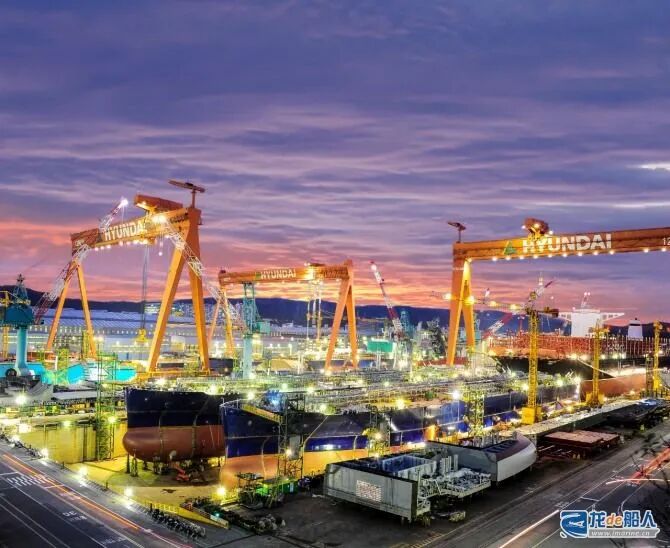
HD KSOE, a subsidiary of HD Hyundai, has invested 142 billion KRW in facility upgrades—such as replacing aging cranes—and plans to invest an additional 152.6 billion KRW in the second half of the year. Regarding smart shipyard initiatives, HD Hyundai is advancing the “FOS (Future of Shipyard)” project, which is scheduled for completion by 2030. This project aims to comprehensively boost overall shipyard productivity by leveraging technologies such as digital twins, artificial intelligence (AI), and big data. Upon completion, overall productivity is expected to rise by 30%, and the shipbuilding cycle is projected to be shortened by 30%.
It is worth mentioning that despite the risk of being unable to accept more new ship orders, South Korea’s three major shipping companies are very cautious about capacity expansion. The reason for this situation is that the shipbuilding industry is an industry that alternates between booms and downturns in cycles. If we only consider the current boom period and significantly increase production capacity, we may bear a heavy burden due to changes in market conditions in the future.