


A few days ago, market rumors surfaced that BYD, a leading Chinese automaker, would order 10 pure car and track carriers (PCTCs); BYD has reportedly confirmed this order.
Li Ke, Executive Vice President of BYD, recently confirmed in an overseas interview that BYD has ordered 10 new large ro-ro vessels to expand its shipping capacity. During the interview, Li Ke stated that tight market capacity has prompted BYD to purchase its own ro-ro vessels. Although BYD develops and manufactures nearly all of its components in-house and maintains close cooperation with European shipping companies, there remains a significant gap in shipping capacity for overseas auto exports; even with the addition of these 10 ro-ro vessels, capacity will still fall short of demand.
Based on previous reports, the total construction cost of the 10 new vessels exceeds $1 billion, with each vessel costing over $100 million; delivery is scheduled for the period between 2029 and 2031. The new vessels will be equipped with dual-fuel propulsion systems and will be capable of carrying more than 8,000 cars each, with the aim of balancing cargo capacity with international environmental regulations.
This batch of new ships will be built by Guangzhou Shipyard International,China Merchants Industry Weihai Shipyard, and China Merchants Heavy Industries Haimen shipyard (CMHI Haimen shipyard)—all subsidiaries of China State Shipbuilding Corporation. The specific number of orders for each shipyard has not yet been disclosed. At present, the shipbuilders have not confirmed the orders.
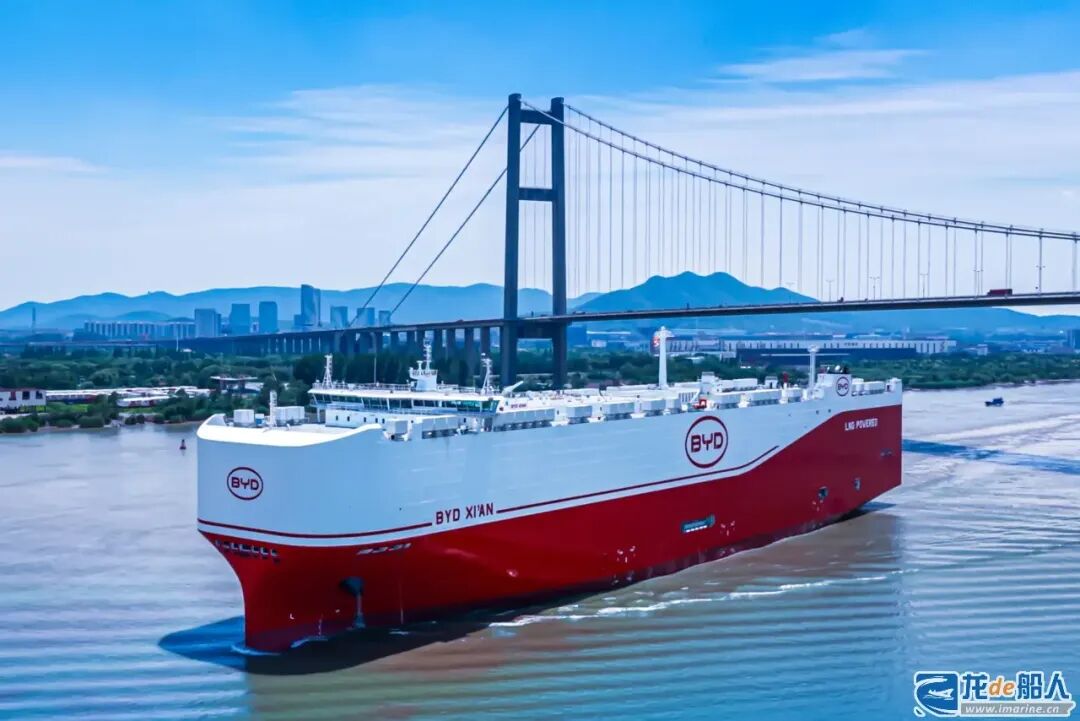
It is understood that, BYD announced in 2022 that it would begin construction on its first batch of eight PCTCs, with a total investment of 5 billion yuan. Specifically, these include two 7,000 CEU liquefied natural gas (LNG) dual-fuel PCTCs built by Guangzhou Shipyard International and six 9,200 CEU LNG dual-fuel PCTCs built by shipyards under China Merchants Group. Delivery of these vessels was completed over a period of approximately 21 months (from January 2024 to September 2025).
The eight new vessels that BYD has commissioned are named “Explorer No. 1,” “BYD CHANGZHOU,” “BYD HEFEI,” “BYD SHENZHEN,” “BYD XI’AN,” “BYD CHANGSHA,” “BYD ZHENGZHOU,” and “BYD JINAN,” with a total carrying capacity of 69,200 CEU.
The 7,000 CEU vessels previously built by BYD have a total length of 199.9 meters and a beam of 38 meters. Featuring 13 decks of extra-large loading space, they offer robust loading capacity and a scientifically designed layout, making them perfectly suited for the ocean transport of large volumes of new energy vehicles; The 9,200 CEU vessel measures 219.9 meters in overall length and 37.7 meters in beam, and is equipped with 16 decks. Designed specifically for the transport of new energy vehicles, it can simultaneously accommodate hydrogen-fueled vehicles and vehicles transporting hazardous materials.
Once the 10 newly ordered vessels are delivered, BYD’s PCTC fleet will grow to 18 vessels, with a total capacity exceeding 130,000 CEU. Upon delivery, these new vessels will help BYD improve delivery efficiency in overseas markets, reduce logistics costs and transportation lead times, thereby further expanding the size of BYD’s overseas fleet and accelerating the globalization of BYD’s automotive operations.
BYD has stated that the establishment of its dedicated fleet is a strategic move based on an in-depth analysis of its own strategic development needs and industry trends. This initiative not only lays a solid transportation foundation for BYD’s global expansion but also pioneers an innovative model for the Chinese automotive industry to “set sail overseas.”
So far this year, driven by growth in China’s automobile exports, the global market for new PCTC shipbuilding is experiencing a new surge in orders, with Chinese shipowners and automakers set to be the key drivers of this round of capacity expansion.
For example, all 20 PCTCs announced this year by Norway’s Global Car Carriers were built by Chinese shipyards; Israel’s Ray Car Carriers has placed an order with Guangzhou Shipyard International for 10+2 8,200 CEU PCTCs; and Norway’s Leno Shipping has ordered 6+8 9,100 CEU PCTCs from China Merchants Heavy Industry (Jiangsu).