


In the first half of 2026, Chinese shipbuilders secured a staggering 82.5% of orders in the global new shipbuilding market. Industry focus has shifted beyond mere production capacity to a deeper examination of China’s robust and comprehensive industrial ecosystem.
According to a recent report by BRS Shipbrokers, Chinese shipbuilders hold an orderbook totaling 445 million deadweight tons (DWT)—representing 75.1% of the global total—while South Korean and Japanese shipbuilders trail behind with market shares of 14.9% and 6.7%, respectively. This strong momentum in order acquisition has extended into 2026, with data for the first half of the year showing that Chinese shipbuilders captured 82.5% of global new vessel orders.
In this regard, BRS points out: “The deeper competitive advantage of China’s shipbuilding industry lies in the industrial ecosystem surrounding its shipyards—a highly dense network comprising equipment suppliers, engineers, skilled labor, infrastructure, financial support, and technical expertise that enables China to translate its massive shipbuilding capacity into large-scale actual production.”
The shipbroker explains: “Chinese shipbuilders generally employ a ‘modular construction and large-scale prefabrication’ model. By manufacturing hull blocks, equipment modules, and certain systems in parallel prior to final assembly, they boost shipbuilding capacity and shorten production cycles… This approach allows them to handle large-volume orders while simultaneously meeting increasingly complex shipbuilding requirements.” The fact that Chinese shipyards have delivered over 800 vessels so far—with some yards fully booked through 2029 and beyond—serves as the best testament to the effectiveness of this shipbuilding model.
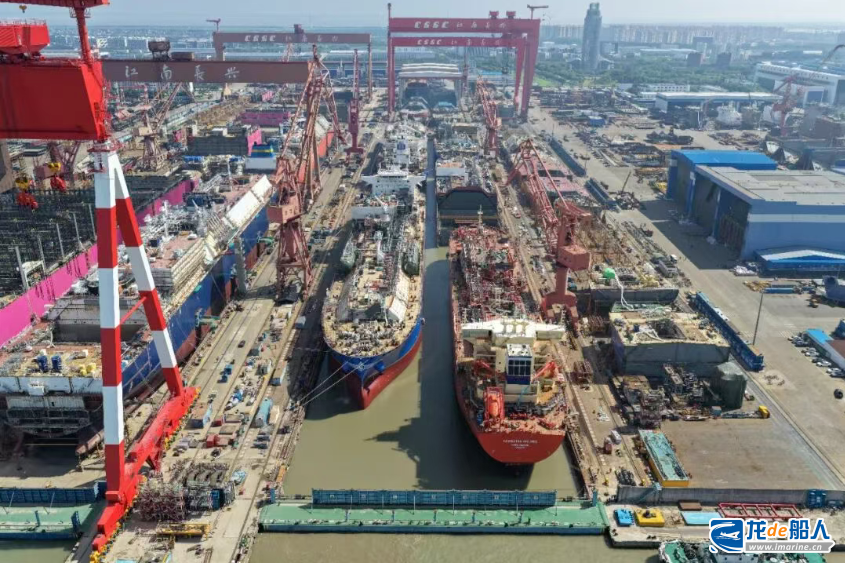
Beyond scale, China’s shipbuilding industry boasts multiple concurrent advantages.
In its report, BRS notes that the technical expertise gained through the serial construction of standardized vessel types constitutes a significant advantage for Chinese shipyards. Continuous accumulation of experience in areas such as design integration, procurement, production planning, quality control, and on-site construction helps boost productivity and mitigate project execution risks.
It is well known that Chinese shipbuilders hold a dominant position in the three major commercial shipping markets—bulk carriers, oil tankers, and container ships—having ranked first globally in order volumes for standard commercial vessels for several consecutive years.
South Korean shipbuilders currently maintain a competitive edge in the gas carrier construction market, whereas Japanese shipbuilders focus primarily on the bulk carrier market—while also holding a niche presence in Ro-Ro vessels, ferries, and certain tanker segments—though their overall market share has been severely eroded by Chinese and South Korean competitors.
Data indicates that while China has not yet fully displaced its Asian rivals across every market segment, Chinese shipbuilders are increasingly active in the high-tech vessel sector, extending their competitive advantage beyond traditional commercial ships. For instance, in markets for high-value-added vessels such as LNG carriers, Very Large Ammonia Carriers (VLACs), and Very Large Gas Carriers (VLGCs), South Korean shipbuilders no longer hold an absolute advantage, with Chinese shipbuilders even overtaking them in certain areas.
Meanwhile, the energy transition and orders for vessels powered by new, eco-friendly fuels have become key drivers for Chinese shipbuilders serving the global fleet. Data from BRS shows that Chinese shipyards currently hold orders for 1,082 dual-fuel or battery-powered vessels, comprising 738 LNG dual-fuel ships, 178 methanol dual-fuel ships, and 19 ammonia dual-fuel ships.
Analysts explain: “The ability to deliver eco-friendly vessels on a large scale demonstrates that Chinese shipbuilders are increasingly capable of integrating new propulsion systems and fuel storage and control technologies into their serial production processes.”
South Korea currently maintains a competitive edge in the gas carrier construction market. Meanwhile, Japanese shipbuilders focus primarily on the bulk carrier market and hold a presence in niche segments such as Ro-Ro vessels, ferries, and certain types of tankers; however, their market share has been severely squeezed by their Chinese and South Korean counterparts.
Furthermore, the competitiveness of Chinese shipbuilders is bolstered by an expanding financial ecosystem. BRS notes that domestic financing channels, state-backed financial institutions, and industrial policies provide crucial support for capacity expansion and the development of the marine equipment supply chain within China’s shipbuilding industry. This competitive advantage is further amplified when shipbuilding investments are combined with shipowner financing, leasing structures, and export support.
Shipbuilding technology also plays a pivotal role; BRS states that Chinese shipbuilders are widely integrating automation, robotics, machine vision, and digital platforms into their production processes, thereby enhancing shipbuilding precision and operational efficiency.
China’s Leading Position in Shipbuilding Remains Unassailable
Notably, BRS raised a key question in its report: Can China’s dominance in shipbuilding be challenged?
In addressing this, the shipbroker outlined several factors that could potentially constrain the growth of China’s shipbuilding sector: a mounting orderbook that may strain production capacity, equipment supply, and delivery schedules; geopolitical tensions that might prompt governments and shipowners to diversify supply chains or reduce strategic reliance on Chinese yards; and risks associated with trade restrictions, tariffs, and sanctions, alongside local measures, which could alter contract economics and financing conditions.
However, BRS emphasized that the impact of these factors varies depending on vessel types, shipowners, and trade patterns.
Furthermore, China’s Asian rivals—South Korea and Japan—retain an edge in specialized, high-tech vessel segments, while other shipbuilding nations are attempting to revitalize and expand their own domestic capabilities.
Yet, BRS maintains that for competitors to shake China’s position, the challenge lies not merely in building new shipyards, but in matching China’s comprehensive industrial ecosystem—including cost-competitive supply chains, the financial resources required for expansion, a skilled workforce and engineering talent, and sufficient production scale—a process that would take years to achieve.