

On July 31, Italian offshore engineering giant Saipem announced via its official website that the proposed merger with fellow industry leader Subsea 7 had reached a key milestone: as all applicable waiting periods under the U.S. Hart-Scott-Rodino (HSR) Antitrust Improvements Act of 1976 have expired, the proposed merger has cleared U.S. antitrust review, and the parties are authorized to complete the transaction in the United States.
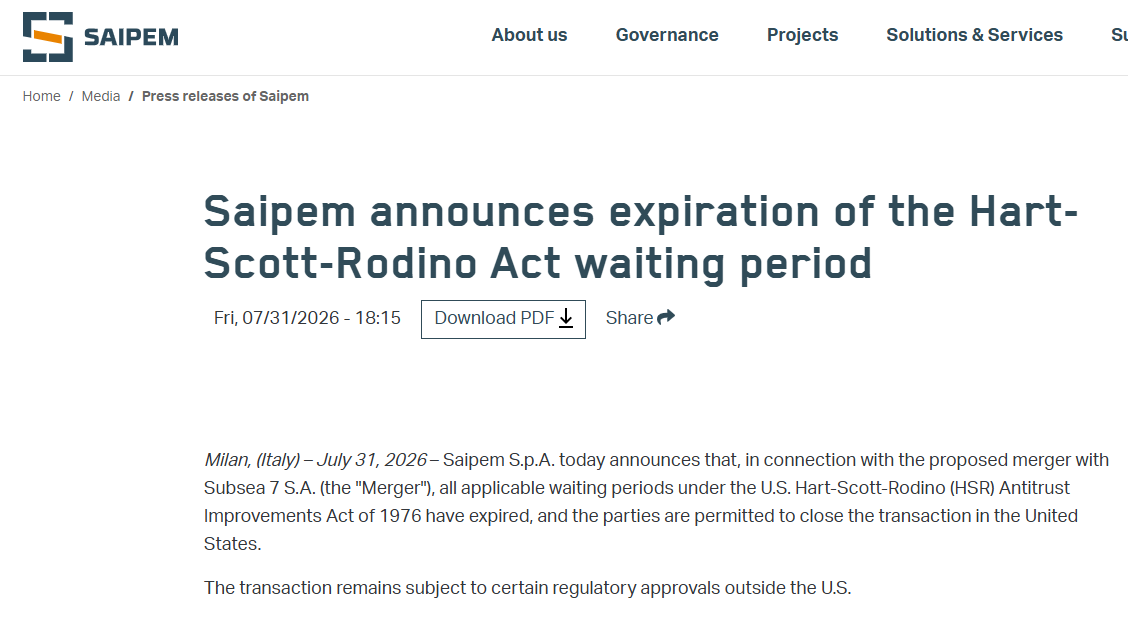
Saipem emphasizes that the proposed merger remains subject to certain regulatory approvals outside the United States. However, the final outcome of the merger remains uncertain, as the European Union has yet to review potential issues regarding market concentration in the offshore sector.
The European Commission has recently initiated an in-depth investigation under the EU Merger Regulation to assess the proposed merger, with a final decision expected by November 26, 2026.
The European Commission’s core concern regarding this investigation is that the proposed merger between Saipem and Subsea7 could significantly impact effective competition in certain markets for offshore engineering and construction services.
A preliminary investigation by the European Commission indicates that the merger could significantly reduce competition in the market for SURF (subsea umbilicals, risers, and flowlines) services used in oil and gas and carbon capture and storage (CCS) projects.
As previously reported, Saipem and Subsea7 signed a binding merger agreement on July 24, 2025, with the merger expected to be completed in the second half of 2026. Under the agreement, the proposed merger will be executed as an EU cross-border statutory merger in which Subsea7 is absorbed into Saipem; the new combined entity will be named Saipem7, with each company holding a 50% equity stake.
Shortly after the proposed merger agreement was announced, it faced strong opposition from ExxonMobil, Petrobras, Brazil’s antitrust regulator (Cade), and rival TechnipFMC, all of whom cited concerns regarding the risk of a monopoly.
Data indicates that Saipem currently operates six facilities and possesses an offshore fleet comprising 21 construction vessels—17 of which are company-owned—as well as 15 drilling rigs (nine of which are company-owned). Subsea7 operates a construction fleet of approximately 40 vessels.
The merged offshore industry giant will employ approximately 44,000 people—including over 9,000 engineers and project managers—and operate a diverse fleet of more than 60 vessels. With a global presence spanning over 60 countries and capabilities covering offshore operations ranging from shallow to ultra-deep waters, the company will offer a comprehensive portfolio of offshore and onshore services, spanning the entire lifecycle from drilling, engineering, and construction to field services and decommissioning.