


On vessels carrying liquefied natural gas (LNG) at an extremely low temperature of −163°C, cargo containment technology is critical to keeping the LNG stable in its liquid state while minimizing evaporation. This is why shipbuilders continue to advance LNG cargo containment technology through ongoing research and development.
Commercializing a Three-Tank Cargo Containment System
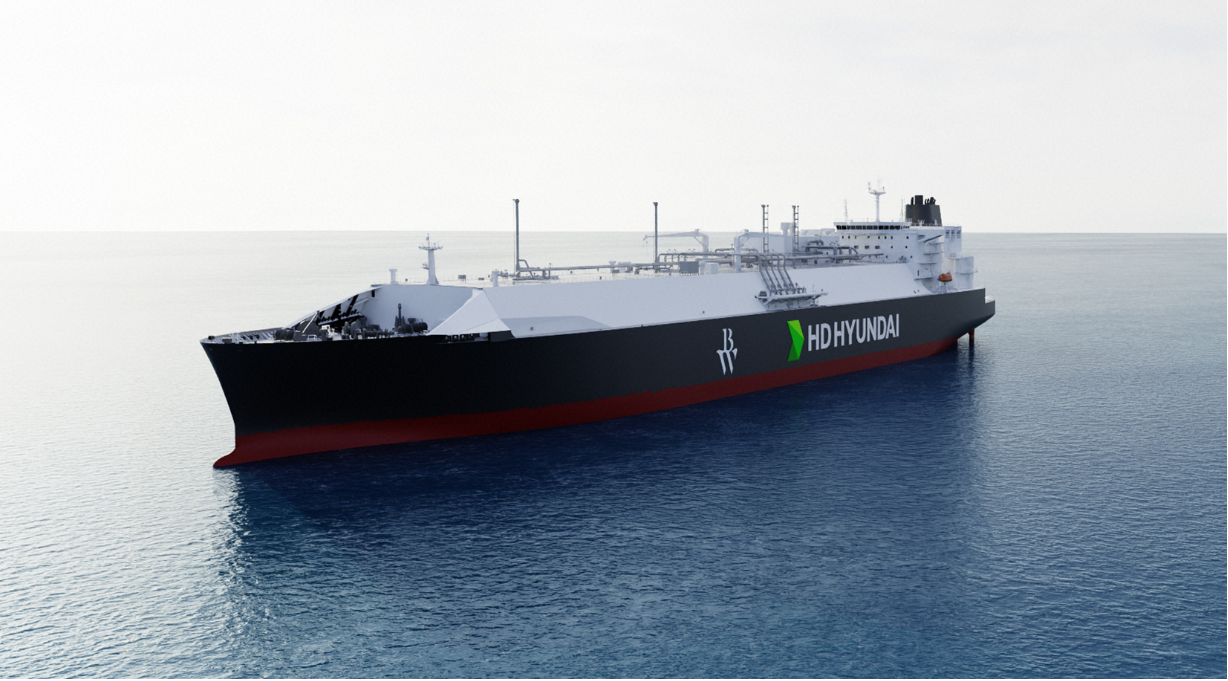
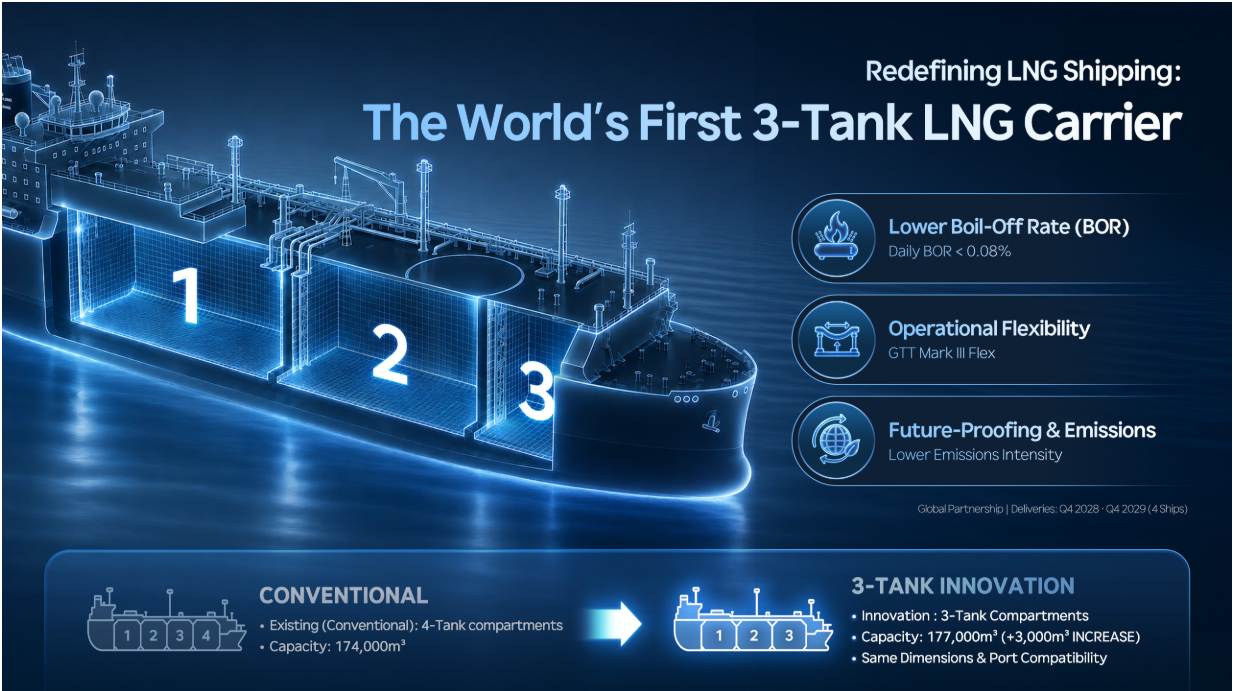
LNG carriers have conventionally been built with four-tank cargo containment systems. HD Hyundai Heavy Industries (HHI) has recently broken that convention, becoming the first in the world to commercialize a three-tank system. HHI is now building vessels around a 176,800-cubic-meter (m³) three-tank design developed in partnership with French cargo containment technology firm GTT and Norwegian classification society DNV. The first ships to carry the three-tank design are a four-vessel series ordered by BW LNG, with deliveries scheduled to run from 2028 through 2029.
Moving to three tanks reduces the space between cargo tanks without changing the ship’s overall size, freeing up room for more cargo. On the vessels now under construction, that has increased LNG capacity from roughly 174,000 m³ to about 176,800 m³. Shipowners have taken notice: the design increases transport efficiency while avoiding the terminal berthing constraints associated with larger vessels.
Lower Transport Costs, Greater Efficiency and Reduced Emissions
By removing one insulated bulkhead from a 174,000-m³-class LNG carrier, HHI freed up roughly 2,800 m³ of additional space. That extra capacity means more cargo per voyage, which lowers the Unit Freight Cost — the cost of transporting each unit of cargo — and translates into better returns for shipowners.
Reducing the total surface area of the cargo containment system also decreases the amount of heat transferred from outside into the tanks, reducing the daily Boil-Off Rate (BOR) of the LNG on board. The three-tank design achieves a daily BOR of 0.08%, approximately 6% lower than that of the four-tank configuration, reducing the energy required for reliquefaction and improving operating efficiency.
Less boil-off gas means less energy is consumed by the reliquefaction system, reducing carbon emissions. The increased cargo capacity further lowers emissions per unit of cargo transported.
To address concerns about sloshing that can arise in larger cargo tanks, HHI conducted detailed strength analyses and reinforced both the structure and insulation system. These measures enable the vessels to operate safely even under partial-load conditions.
HHI showcased its three-tank LNG carrier technology at a GTT-hosted technical seminar during Gastech 2026, the world’s largest gas industry exhibition, which opened in Bangkok, Thailand, on September 14.
At the technical seminar, Hong-ryul Ryu, Chief Technology Officer at HHI, delivered a keynote address highlighting the technical strengths of the three-tank LNG carrier and its strategic value in the future low-carbon shipping market.