


On September 15, Ulstein released a concept study report detailing a nuclear-hybrid conversion scheme for its SX157 offshore support vessel (OSV). Under most operating conditions, the proposed design is expected to reduce fuel consumption by more than 50%.

According to the report, the design retains two of the four main engines installed on the SX157-class OSV and replaces the other two with electric motors powered by a micro-reactor. Nuclear power will be used to meet low-load operating requirements, and diesel-electric engines can be activated when additional propulsion power is needed.
Ulstein stated that the SX157-class OSV, retrofitted with a nuclear-hybrid propulsion system, can operate entirely without conventional fuel during cruising and light-load towing. A representative of Ulstein said, “The core concept is that fuel consumption during cruising will be reduced by 100 percent, and significant emissions reductions can be achieved in virtually all operating modes.”
Ulstein emphasized that this conclusion applies to fuel consumption under the aforementioned operating conditions. The study does not yet include a comprehensive emissions assessment or a life-cycle analysis.
The SX157 vessel requires extensive retrofitting
Ulstein noted that the reference vessel for this study is an OSV with a length of 88.9 meters, a beam of 21 meters, a deadweight of approximately 4,250 tons, and a mooring pull of approximately 300 tons. Its primary operations include the long-distance transport of large structures, such as drilling rigs and floating production, storage, and offloading (FPSO) vessels.
Ulstein estimates that when towing at 45% of the maximum continuous propulsion power rating, daily fuel consumption is 47.87 cubic meters, with total fuel consumption over 30 days amounting to 1,436.1 cubic meters. If operated at 65% power, daily fuel consumption would reach 68.65 cubic meters, with total fuel consumption over the same period amounting to 2,059.5 cubic meters.
During the retrofit, approximately 48% of the vessel’s heavy fuel oil tank capacity will be used to install the reactor and related equipment. The liquid cargo tanks, hull structure, piping systems, and compartments will all require modifications, and the existing engine room cannot provide sufficient space for radiation shielding, power conversion equipment, thermal storage devices, and the reactor system.
The research report also evaluated a scenario involving the ship’s complete conversion to nuclear propulsion, which would require the removal of all main engines and auxiliary generator sets. Ustin believes that the hybrid power scheme is more feasible because it retains more of the existing equipment.
The supply of micro-reactors remains a major obstacle
Ulstein noted that this nuclear-hybrid retrofit solution utilizes Emerald Nuclear’s “Gem” micro-reactor, a nitrogen-cooled design that uses TRISO fuel. Each unit is planned to have an output of 5.0 megawatts and, depending on load conditions, can operate for 5 to 15 years.
According to Ulstein’s vision, the reactor would be replaced every five years, in sync with the classification society’s inspection cycle. The crew would not need to handle nuclear fuel at sea or perform reactor refueling operations.
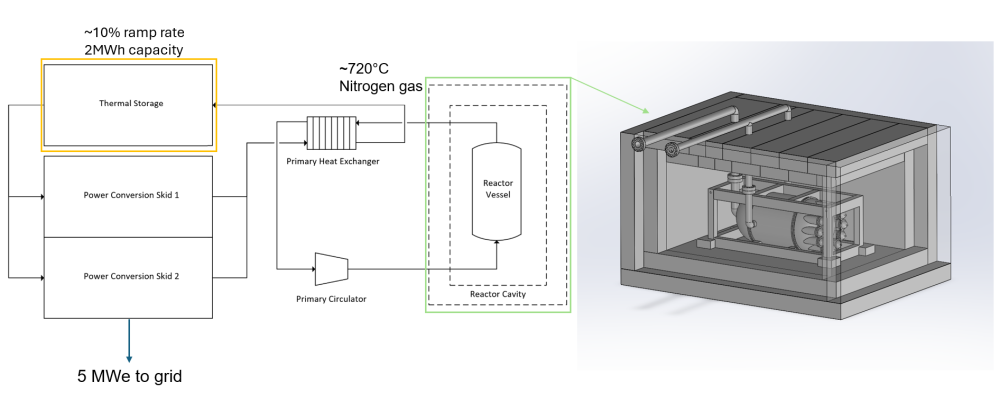
Ulstein stated, “The main obstacle at present is that micro-reactor technology suitable for maritime use has not yet been made commercially available.” In addition, any such project must obtain certification from a classification society and approval from the flag state, as well as meet port reception requirements, develop emergency response plans, clarify liability rules, and establish procedures for reactor replacement and waste disposal.
Ulstein’s study has not yet specified the retrofitting costs, reactor costs, or the return on investment period. When assessing the project’s commercial viability, factors such as shipyard retrofitting duration, vessel downtime, engineering design, certification and approval processes, insurance, financing, full-lifecycle operation and maintenance, and decommissioning must also be considered. Ulstein noted that this retrofitting solution is best suited for vessels with high fuel consumption, predictable electricity demand, and a sufficient remaining service life.