

ABS has awarded approval in principle (AIP) for a concept design for a nuclear-powered 15,000 TEU containership developed in collaboration with the Korea Research Institute of Ships and Ocean Engineering (KRISO) and the Korea Atomic Energy Research Institute (KAERI).
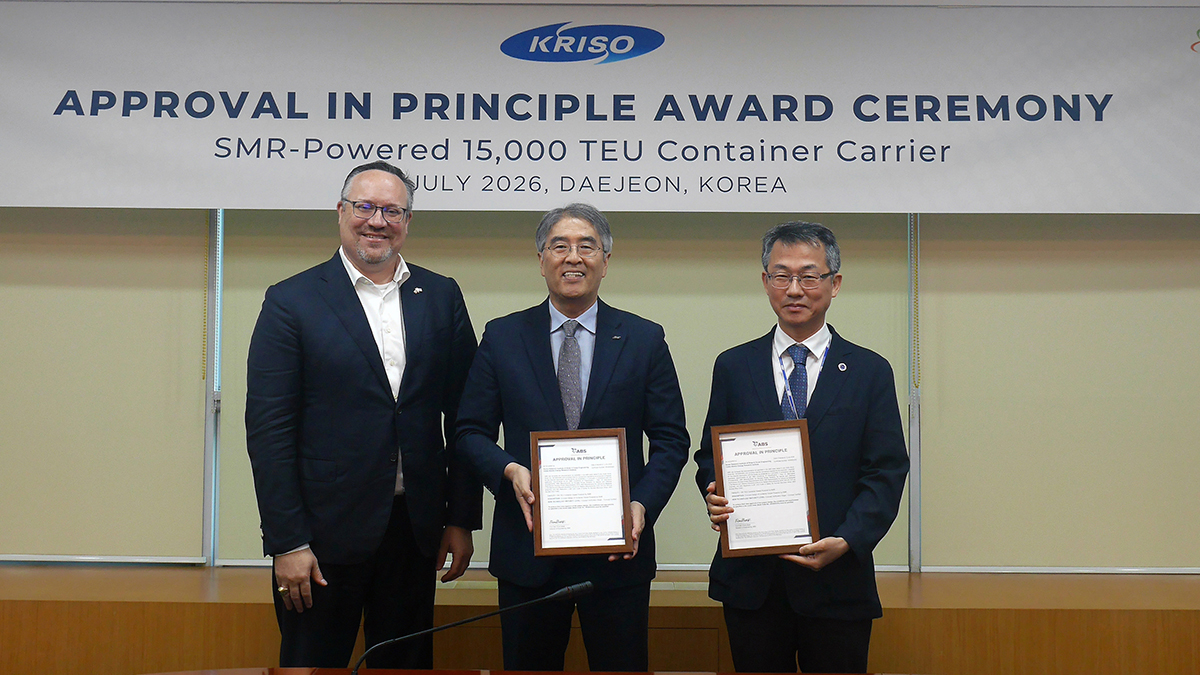
Equipped with a small modular reactor (SMR), the concept is a key milestone in an ongoing joint development project with ABS, KRISO and KAERI to evaluate the technical feasibility of nuclear-powered commercial shipping. The vessel concept features a marine molten salt reactor (MSR) and forms part of a broader multi-year collaboration focused on identifying technical challenges, advancing concept development and supporting the application of class and safety requirements to next-generation nuclear vessel designs.
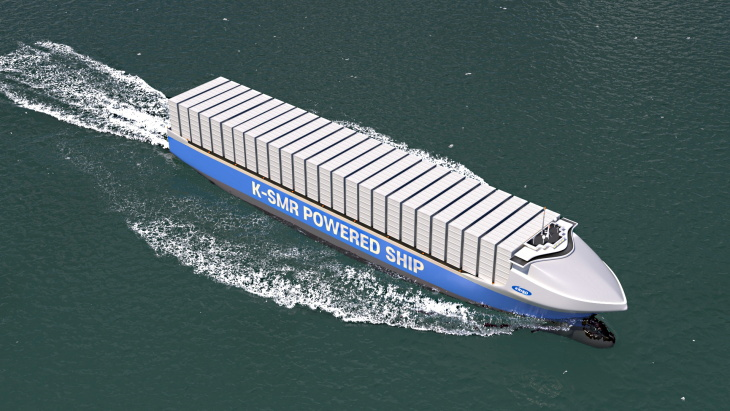
KRISO said the conceptual design for which it obtained Approval in Principle is “characterised by the optimisation of the power system, hull shape, and layout design to enhance the safety and operational efficiency of the SMR-propelled vessel”. The key features of the power system design include: output sharing through the redundant placement of two SMRs; storage of surplus power and supply when needed using an energy storage system. “Through this, the design was created to efficiently manage reactor output and the ship’s power demand, and to secure stable propulsion power,” KRISO said.
In terms of hull design and layout, the following were incorporated: a high-speed hull design of 25 knots; a central placement of the reactor to minimise wave impact and the risk of collision accidents; the application of a 15,000 TEU class hull capable of transiting the expanded Panama Canal; improved loading efficiency through the removal of existing fuel tanks and funnels; and an optimal layout of accommodation areas considering crew safety from radiation and visibility standards. “Through these measures, a hull design and layout that comprehensively consider loading efficiency, safety, and space utilization was realised,” KRISO said.
“Nuclear has the potential to fundamentally alter commercial shipping in vessel design, operating range and energy economics. ABS is focused on building the technical and safety framework needed to support that, and this AIP with KRISO and KAERI is a concrete part of that work,” said Patrick Ryan, ABS Senior Vice President and Chief Technology Officer.
Under the joint development framework, KRISO carried out the concept design for the 15,000 TEU nuclear-powered container ship, KAERI developed the concept design for the MSR, and ABS completed the AIP review of the overall concept. The collaboration builds on ABS’ broader work with Korean partners to advance nuclear applications for marine and offshore assets, including a memorandum of understanding signed with KRISO in 2025 to cooperate on nuclear-powered ships and floating nuclear power platforms.
Keyyong Hong, President of KRISO, said: “SMR-powered ships are a next-generation technology that will determine the future competitiveness of the shipping industry, and securing design technologies suited to the marine environment is above all essential to making them a reality. KRISO will continue to enhance the marine applicability of nuclear-powered vessels through R&D in ocean engineering and international cooperation, and strive to help Korea lead related technologies and international standards.”
Jinyoung Cho, Senior Vice President of KAERI, said: “KAERI will continue to refine the interface between the MSR system and the vessel, enhancing the design to address the unique operating conditions of ships, and pursue testing and demonstration of key technologies to support the commercialization of SMR-powered vessels.”