


On July 14, BOMESC Offshore Engineering Co., Ltd. (hereinafter referred to as “BOMESC” or the “Company”) released its “Announcement on Projected Loss for the First Half of 2026.”
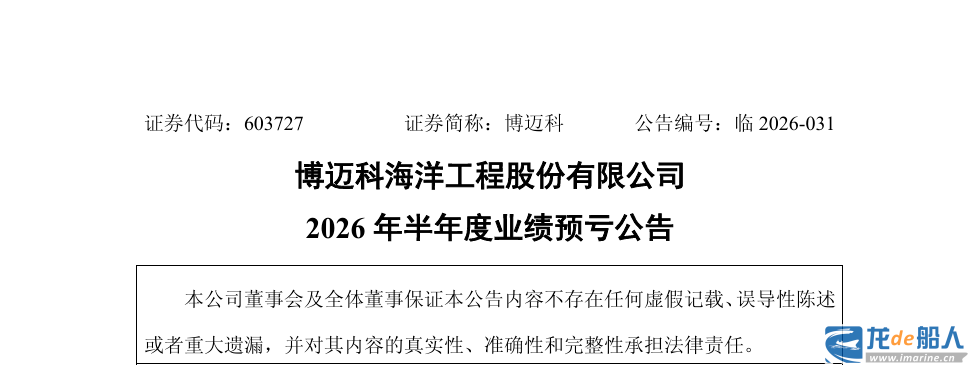
The announcement discloses that, based on preliminary calculations by the finance department for the forecast period (January 1, 2026, to June 30, 2026), BOMESC expects to record a net loss attributable to the parent company of RMB 78 million to RMB 65 million (approximately USD -11.52 million to USD -9.60 million) for the first half of 2026, representing a decrease of RMB 90.3858 million to RMB 77.3858 million (approximately USD 13.35 million to USD 11.43 million) compared to the same period last year; the company also expects to record a net loss attributable to the parent company—after deducting non-recurring gains and losses—of RMB 85 million to RMB 72 million (approximately USD -11.52 million to USD -9.60 million), representing a decrease of RMB 85.7503 million to RMB 72.7503 million (approximately USD 12.67 million to USD 10.75 million) compared to the same period last year.
Regarding the primary reasons for the projected loss, BOMESC noted that the company’s performance declined year-over-year during the first half of 2026, driven by the combined impact of three factors: the external industry environment, exchange rate fluctuations, and the transition between internal project cycles.
At the external level, ongoing global geopolitical conflicts continue to disrupt the landscape of the international energy market, leading to extended timelines for the implementation of overseas oil and gas projects and a general deferral of capital expenditure. BOMESC successfully signed a new overseas module fabrication contract in late April 2026. While the timing of this order aligns with the company’s operational plan, the associated revenue will be realized gradually, primarily in the second half of the year; the inability to generate substantial revenue during the first half has created short-term operational pressure. Furthermore, as BOMESC’s overseas projects are settled in US dollars, the temporary appreciation of the RMB against the dollar during this period resulted in exchange losses upon the conversion of foreign currency revenue, further eroding profit margins.
Internally, BOMESC is in a transitional period between old and new projects; the delivery of high-margin, large-scale offshore engineering module projects was largely completed by the end of 2025, and revenue recognition for the existing order backlog has essentially concluded. For 2026, newly signed orders are currently limited to preliminary stages—such as detailed design, raw material procurement, and pre-fabrication preparations—and have not yet entered the phase of large-scale construction and concentrated revenue recognition. This temporary contraction in revenue, compounded by the ongoing amortization of fixed production costs (including labor and equipment depreciation), has collectively resulted in a projected loss for the current period.
From a long-term profitability perspective, BOMESC notes that its offshore engineering projects are characterized by industry-typical changes in workload and the addition of incremental tasks during implementation; revenue from these changes—recognized gradually during the execution phase—effectively boosts the overall gross margin of the respective projects and provides positive support for operating results in subsequent years.
As previously reported, the new overseas module fabrication contract signed by BOMESC is valued at approximately US$220 million. The living quarters module is part of the EPC5 (COMP5) package for the NFPS offshore compression complex project, designed to sustain production at the oil and gas field. Tianjin BOMESC’s scope of work primarily covers the design, material procurement, and fabrication of the living quarters module, with completion scheduled for March 2030.
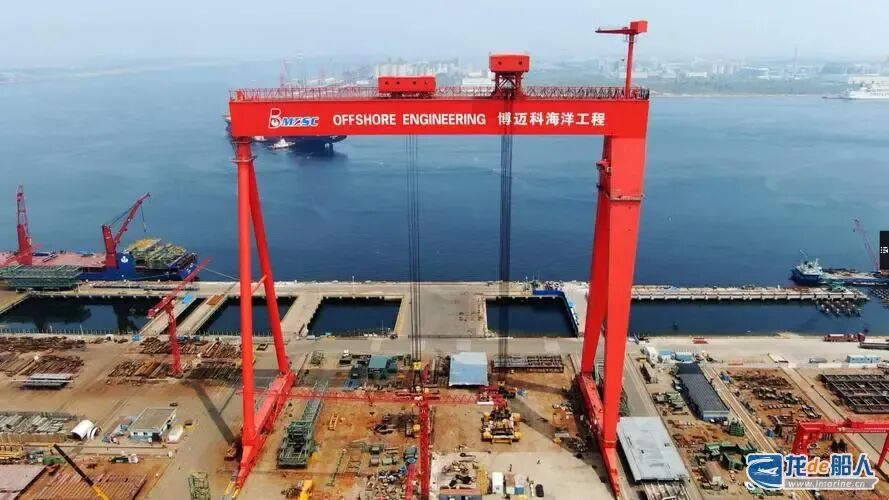
Established in 1996 and located in the Binhai New Area of Tianjin, China, BOMESC is a specialized EPC service provider for modules serving the international market, with nearly 100% of its business derived from international clients. The company’s fabrication yard covers an area of approximately 760,000 square meters and features a 1,000-ton gantry crane and 1,000 meters of deep-water quay frontage, boasting an annual module fabrication capacity of 150,000 tons.