


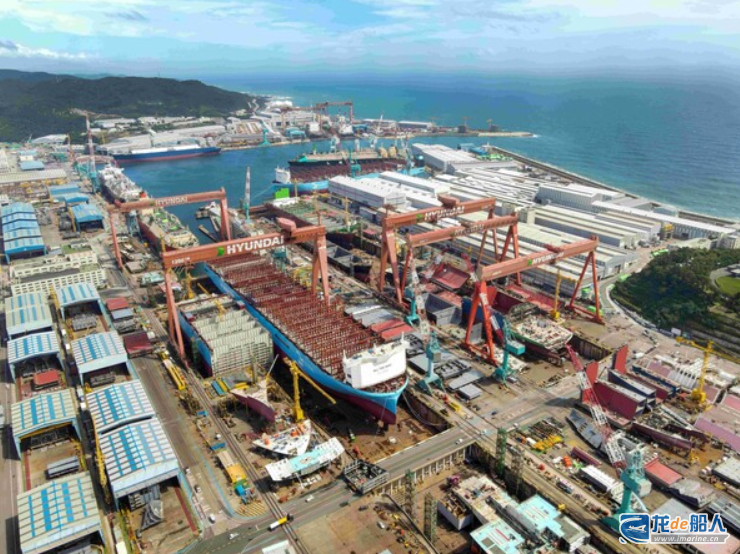
To address labor shortages in the shipbuilding industry, HD Hyundai Heavy Industries has begun restructuring its production operations and significantly expanding the recruitment of foreign workers. With the proportion of foreign employees surpassing 9% for the first time, the South Korean shipyard is rapidly transforming from a workforce dominated by local personnel into a multinational labor force.
According to the sustainability report released by HD Hyundai Heavy Industries on July 8, the total number of foreign employees reached 1,752 by 2025—nearly double the previous year’s figure of 877 and a 3.6-fold increase over the 493 recorded in 2023, all within just two years. The proportion of foreign personnel within the total workforce also surged from 3.7% in 2023 to 9.3% in 2025, bringing the 10% milestone within reach.
In 2022, there were only 18 foreign employees; in just three years, that figure has surged more than 97-fold. By nationality, Vietnamese workers top the list with 916 individuals, accounting for 52.3% of the total—more than half. They are followed by 412 Sri Lankans, 218 Thais, and 89 Indonesians, demonstrating that Southeast Asian labor has become a core driving force for South Korea’s shipbuilding hubs.
It is worth noting that although HD Hyundai Heavy Industries had planned to phase out foreign workers as recently as March of this year, it was forced to reverse course just four months later—significantly ramping up the recruitment of foreign personnel—due to a widening labor shortage.
The surge in the number of foreign employees is primarily due to the fact that, following a prolonged slump in the South Korean shipbuilding industry, skilled local workers who had left the sector did not return. With the industry’s recent boom—characterized by a sharp rise in workload and a shortage of shipyard workers—the South Korean government and the shipbuilding sector have relaxed visa restrictions for foreign workers, thereby opening the door to a larger labor supply. In fact, statistics from South Korea’s Ministry of Justice show that the number of residents holding E-7-3 visas for the shipbuilding industry rose from 1,017 in 2022 to 13,297 in 2025—an increase of approximately thirteenfold.
The labor situation in South Korea’s shipbuilding industry follows a strikingly similar pattern. Samsung Heavy Industries leads the “Big Three” shipbuilders with foreign workers accounting for 17.1% of its workforce, while Hanwha Ocean’s figure stands at 5.6%. With current order backlogs securing production capacity for more than three years, foreign workers have shifted from being an optional alternative to an absolute necessity for these leading shipbuilders.
As of the end of May this year, the total value of HD Hyundai Heavy Industries’ order backlog exceeded 91 trillion won (US$60 billion), equivalent to 5.2 times the company’s annual revenue from last year. Meanwhile, the engine and machinery sectors are operating at full capacity, indicating that the demand for labor will not diminish in the future.