


According to a report by South Korea’s Chosun Ilbo, against the backdrop of continued prosperity in the shipbuilding industry, shipbuilders in China and South Korea are adopting starkly different strategies for expanding production. South Korean shipbuilders are proceeding cautiously with investments in the shipbuilding sector to guard against a downturn in the industry, while Chinese shipbuilders are actively expanding their production capacity by building new shipyards one after another.
Reportedly, driven by an upswing in the shipbuilding industry and a surge in orders, the production capacity of South Korean shipbuilders is nearing saturation. Data from the Financial Supervisory Service’s electronic disclosure system shows that Hanwha Ocean’s facility utilization rate reached 99.5% in the first quarter of this year. During the same period, the utilization rates for Samsung Heavy Industries and HD Hyundai Heavy Industries stood at 98% and 99.4%, respectively.
Despite capacity utilization rates approaching 100%, South Korean shipbuilders remain reluctant to readily invest in expanding production capacity. They view shipbuilding as a quintessentially cyclical industry; given the constant risk of a downturn, large-scale capacity expansion would entail significant investment risk.
In fact, there is a view within the South Korean industry that the shipbuilding sector may soon enter a period of adjustment. Lee Eun-chang, a researcher at the Korea Institute for Industrial Economics & Trade (KIET), stated: “Although there has been a high volume of orders for eco-friendly vessels over the past three years, it is difficult to expect this exceptionally strong market trend to persist. While the long-term outlook remains optimistic due to environmental regulations, there is a possibility of a short-term market correction.”
On the other hand, Chinese shipbuilders have secured orders for 816 vessels so far this year—ranking first globally—and are actively expanding their production capacity.
In May 2025, Hudong-Zhonghua Shipbuilding, a subsidiary of CSSC, inaugurated a new shipyard on Changxing Island. The facility covers a total area of 431.8 hectares, with a projected total investment of 18 billion yuan (approximately US$1.178 billion at current exchange rates). The first phase of construction spans 214.6 hectares and involves an investment of 8 billion yuan; upon completion, Hudong-Zhonghua’s production capacity will be significantly boosted, with its capability to build large LNG carriers increasing from the current six vessels per year to more than ten.
Shanghai has issued a policy aiming to expand the scale of the shipbuilding and marine engineering equipment industry on Changxing Island to over 120 billion yuan (approximately US$17.676 billion at current exchange rates) by 2027, establish a world-class, modern shipbuilding base, and increase the annual production capacity for large LNG carriers to 18 vessels.
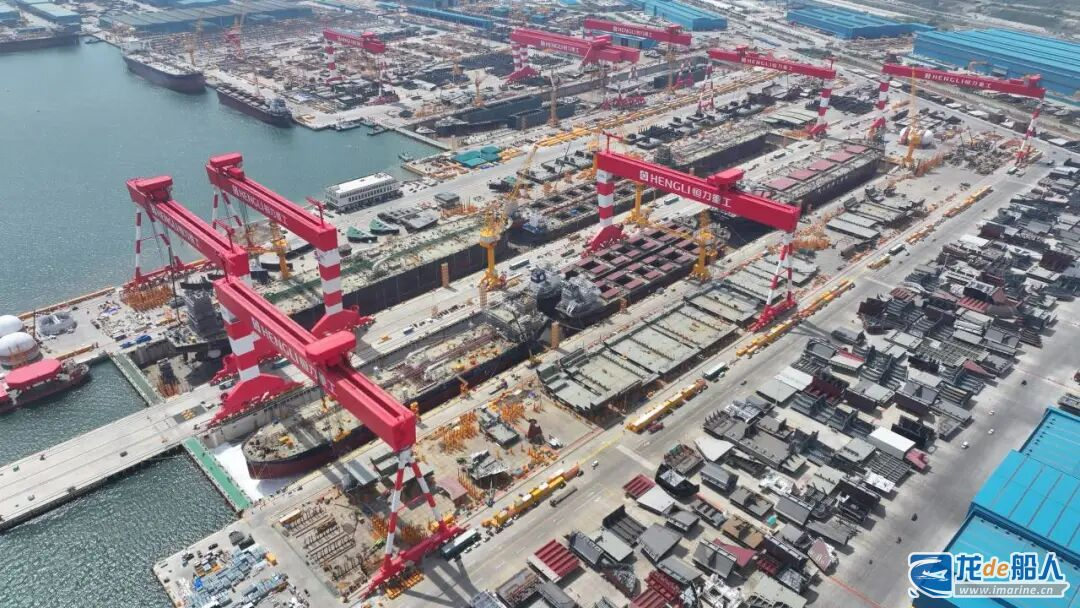
Hengli Heavy Industries, which acquired STX Dalian in 2022, is also making significant investments to expand its production capacity. A few months ago, the company announced an additional investment of 13.5 billion yuan to launch three major capacity expansion projects; upon completion, the shipyard will be capable of simultaneously constructing 22 large vessels. Hengli Heavy Industries has already announced orders for 207 new ships for the first half of 2026.
The Chosun Ilbo reports concerns within South Korea that if the country’s shipbuilders hesitate to invest in shipbuilding facilities, they will soon fall significantly behind China; “stagnation in shipbuilding investment could also lead to a narrowing of the technological gap between the two sides.”
Currently, most of the dry docks owned by South Korean shipbuilders were constructed prior to the 1990s. With the exception of a floating dock currently being built by Hanwha Ocean—scheduled to enter service next year—investment in new facilities has effectively stalled. South Korean shipbuilders are utilizing overseas production bases, such as those in the Philippines, to construct standard vessels, while focusing their domestic operations on high-value-added ships.
Industry insiders in South Korea have stated, “For shipbuilders to expand domestic investment, they must fundamentally create an environment insulated from global industry fluctuations. South Korea should consider offering incentives to shipping companies that place orders with domestic shipbuilders.”