

On June 23, Hengli Heavy Industries successfully launched a 93,000 cbm Very Large Ammonia Carrier (VLAC)—the world’s largest liquid ammonia carrier to be built on a slipway. The launch breaks with the conventional practice of constructing large gas carriers inside dry docks. The vessel has now entered the outfitting phase at the dock.
Hengli Heavy Industries stated that the launch of this vessel, which was carried out using the shipyard’s floating drydock, has set an industry benchmark for the safe launch of ultra-large specialty gas carriers.
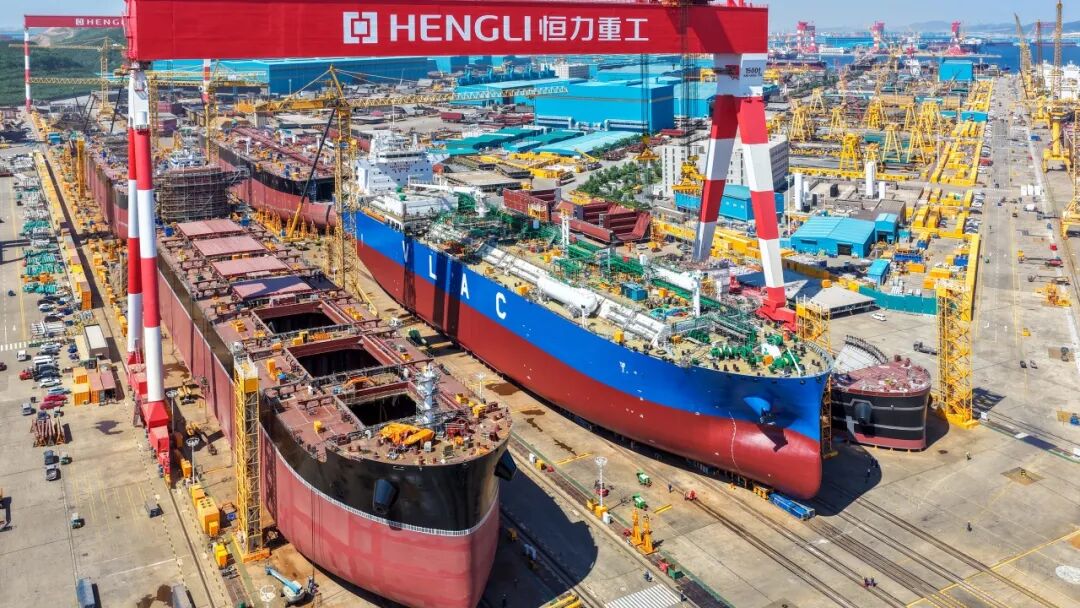
During the construction of this vessel, Hengli Heavy Industries achieved independent production of the liquid cargo tanks, and the vessel is equipped with a liquefied petroleum gas (LPG) dual-fuel engine manufactured in-house by Hengli Heavy Industries. From the liquid cargo tanks to the dual-fuel propulsion system, Hengli Heavy Industries has achieved a high degree of self-sufficiency in the core equipment for VLACs, giving it advantages in delivery time, construction costs, and quality management.
During the construction of the vessel, Hengli Heavy Industries carried out innovative technological breakthroughs in key areas such as block assembly, low-temperature steel welding, tank lifting and transportation, and precision control, successfully overcoming multiple technical challenges in large gas carrier construction. These efforts have laid the groundwork for subsequent serialized VLAC newbuilding programs.
According to reports, Hengli Heavy Industries’ first batch of 93,000 cbm of VLACs was ordered by its parent company, Hengli Group. The shipbuilding contract was reportedly signed in the third quarter of 2024, marking Hengli Heavy Industries’ official entry into the gas carrier construction sector.
In February and April 2026, Hengli Heavy Industries once again officially announced orders for four 93,000 cbm VLACs. Two were ordered by Emarat Maritime of Dubai, while the owners of the other two were not disclosed; the construction cost per vessel ranged from $100 million to $150 million.