


Recently, Germany’s Meyer Werft unveiled a concept design for a 100% battery-powered cruise ship, dubbed the “Vision” project, during the Seatrade Cruise Global exhibition. If a shipowner places an order in 2026, delivery could take place as early as 2031.
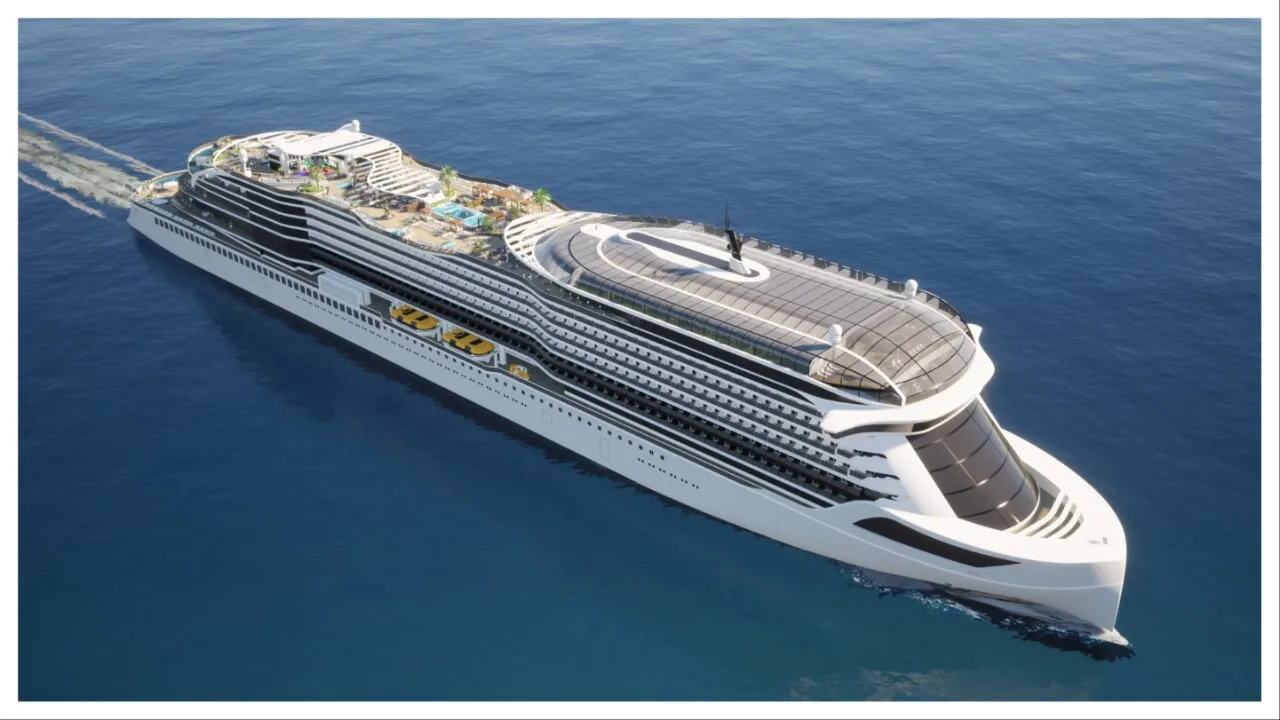
“We considered how we could reduce CO2 emissions and contribute to decarbonization through innovation. And not just in 50 years. We enable a reduction in greenhouse gas emissions of up to 95%,” said Tim Krug of the Meyer Werft Concept Development Group. With all-electric cruise ships, Meyer Werft will offer the market competitive vessel designs based on existing technology, thereby helping our customers achieve sustainable and profitable operations in the long term.”
This all-electric cruise ship is 275 meters long, can accommodate 1,856 passengers, and has a gross tonnage of approximately 82,000 tons, making it the world’s first 100% all-electric cruise ship with a gross tonnage exceeding 80,000 tons; The battery system is supplied by Norway’s Corvus Energy, and the new vessel can be deployed on most classic cruise routes in Europe. It is expected that by 2030, approximately 100 ports across Europe will provide the necessary charging infrastructure.
Another major advantage of the all-battery electric propulsion system—which eliminates the need for a traditional main engine—is that it significantly enhances onboard comfort, as engine noise and vibration on the “Vision” will be further reduced.
In addition, depending on customer requirements, this cruise ship design can also be built as a hybrid vessel equipped with a small generator, enabling it to undertake missions such as transatlantic voyages.
Meyer Werft also emphasized that the concept design for the “Vision” incorporates a completely new architectural approach: In traditional cruise ship design, vertical funnels running the length of the ship are used for exhaust treatment; however, these funnels—which typically occupy part of the sun deck area—can be completely eliminated, thereby enabling a new sun deck layout that offers unobstructed views. The project aims to create an all-weather cruise ship equipped with fully enclosed glass observation spaces; for example, the traditional water park area is designed as an indoor space at the stern, allowing it to remain open year-round.
A representative from Corvus Energy stated: “The technological integration demonstrated by the ‘Vision’ is a natural progression in battery-powered technology and a pivotal turning point for the cruise industry. The shift toward fully electric cruise ships signifies that the technology is safe and mature enough to revolutionize the industry.”