


The U.S. Coast Guard announced the award of two contracts to build up to six Arctic Security Cutter (ASC) icebreakers — ships designed to break through and navigate ice-covered waters — between the United States and Finland in a major step forward for America’s national security.
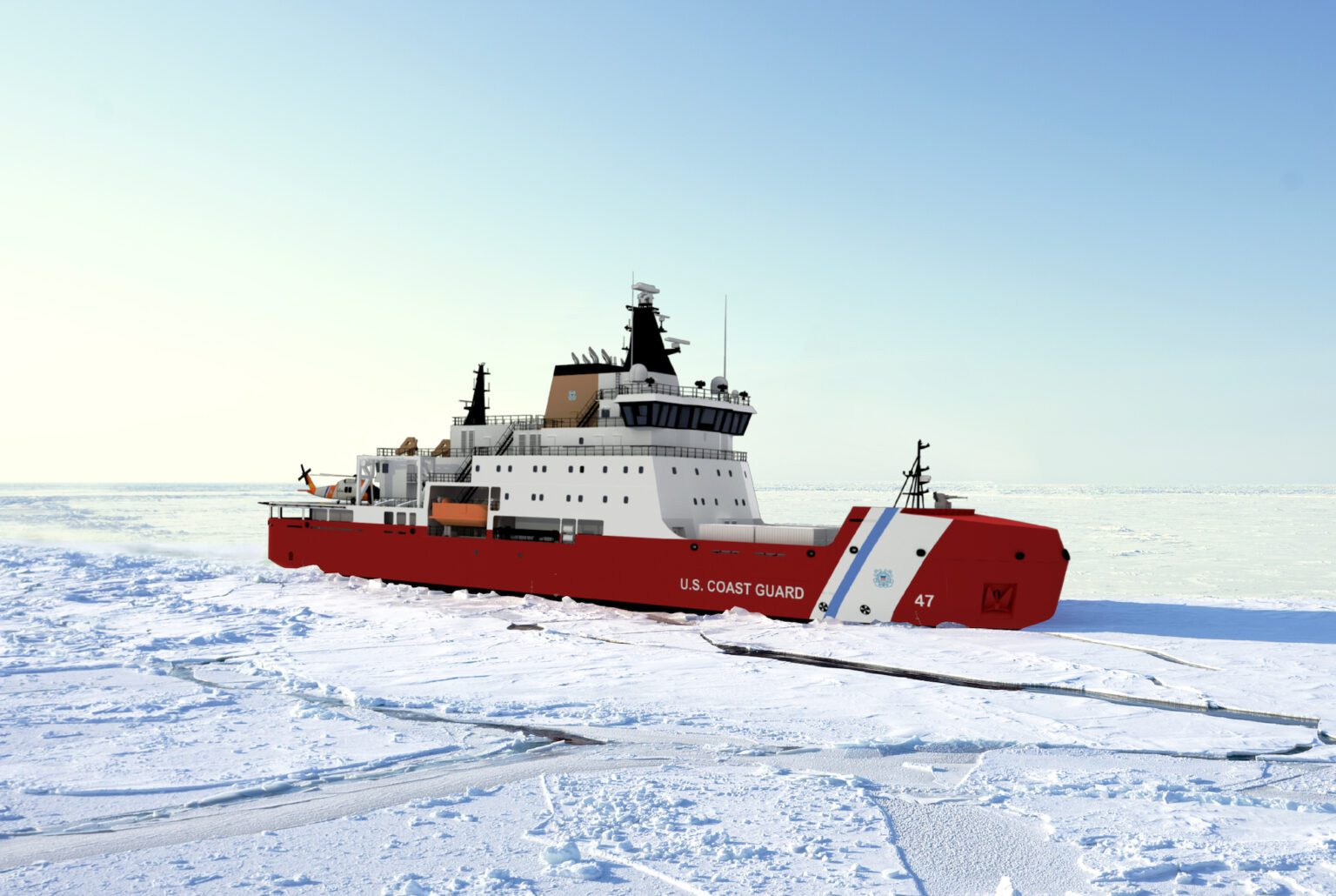
Contracts were awarded Friday to Rauma Marine Constructions Oy of Rauma, Finland, and Bollinger Shipyards Lockport, L.L.C. of Lockport, Louisiana, and are the result of President Donald Trump and Secretary of Homeland Security Kristi Noem’s visionary international agreements with Finland and the historic investments authorized in the President’s One Big Beautiful Bill Act.
Specifically, the four new ships to be built by Bollinger Shipyards will combine Finnish design and construction technology and will be built at the Houma shipyard in Louisiana. Employees from multiple shipbuilding sites along the Gulf Coast will collaborate on the construction work to achieve the goal of delivering the first ship in 2029.
This polar security icebreaker is designed to break through 1.2-meter-thick ice, with a range of 12,000 nautical miles and the capability to operate continuously for over 60 days. The vessel’s design will share a common platform with Canada’s future icebreaker fleet, aiming to enhance allied interoperability.
The Arctic Security Cutters will defend U.S. sovereignty, secure critical shipping lanes, protect energy and mineral resources, and counter our adversaries’ presence in the Arctic region. They will enable the Coast Guard to control, secure and defend U.S. Alaskan borders, facilitate maritime commerce vital to economic prosperity and strategic mobility, and respond to crises and contingencies in the region.
“The Arctic Security Cutter is one of the most consequential and time-sensitive shipbuilding programs in U.S. Coast Guard history, and today’s contract award is a clear vote of confidence in the men and women of Bollinger,” said Ben Bordelon, President and CEO of Bollinger Shipyards. “With clear direction from President Trump and an aggressive delivery timeline, our mission is straightforward: leverage the full strength of our shipbuilding facilities across the Gulf Coast, along with our proven partners, to deliver these cutters on schedule and mission ready on day one.”
“The awarded contract marks a historic milestone. It is a major vote of confidence in RMC and in the Finnish maritime industry network. We secured this significant deal thanks to our expertise and capability to build the ships within the required timeframe. Our fast delivery times make us the most affordable option on the market. Now it is time for us and our network to prove ourselves and demonstrate that we are worthy of trust,” said Mika Nieminen, CEO at Rauma Marine Constructions.
It is understood that the two shipbuilding contracts were signed under the Arctic Ice Cooperation Pact (ICE Pact). This agreement is a trilateral framework agreement signed by the United States, Canada, and Finland in July 2024, with the aim of accelerating the construction of much-needed polar icebreakers. As climate change leads to the shrinking of polar ice caps, the Arctic Ocean is increasingly seen as a trade route connecting the Pacific and Atlantic Oceans with major economies. Therefore, the United States, Canada, and Finland plan to build 70-90 icebreakers based on ICE Pact.
Although icebreakers are urgently needed, the U.S. Coast Guard currently operates only three polar icebreakers: the heavy icebreaker Polar Star, commissioned in 1976; the medium icebreaker Healy; and the recently commissioned icebreaker Storis, converted from a former merchant vessel. The U.S. Coast Guard has assessed that at least nine polar-class icebreakers are required to ensure year-round national security interests in the Arctic region.
Although icebreakers are urgently needed, the U.S. Coast Guard currently operates only three polar icebreakers: the heavy icebreaker Polar Star, commissioned in 1976; the medium icebreaker Healy; and the recently commissioned icebreaker Storis, converted from a former merchant vessel. The U.S. Coast Guard has assessed that at least nine polar-class icebreakers are required to ensure year-round national security interests in the Arctic region.
Notably, in October this year, a consortium led by Bollinger Shipyards was awarded the contract to design and build six polar-class icebreakers. The consortium comprises Bollinger Shipyards (USA), Rauma Marine Constructions (Finland), Seaspan Shipyards (Canada), and Aker Arctic Technology (Finland). It will utilize the proven “multi-purpose icebreaker” design jointly developed by Seaspan Shipyards and Aker Arctic Technology to meet the operational demands of extreme polar environments.
Additionally, Bollinger Shipyards is constructing the only fully funded heavy icebreaker in the United States. In 2022, Bollinger Shipyards acquired VT Halter Marine from Singapore’s ST Engineering Group, taking over this challenging shipbuilding project.
In August 2023, Bollinger Shipyards had already commenced steel plate cutting for certain modules of this heavy-duty polar icebreaker. However, construction did not formally commence until late 2024 following final approval. From the initial steel cutting to final delivery, the project may require 7 to 8 years. This extended construction timeline underscores the multiple challenges facing the project, including schedule delays, cost overruns, and deficiencies in the conceptual design.
Records indicate that Bollinger Shipyards, established in 1946, is the largest ship repair enterprise in the Gulf of Mexico region and one of the largest privately owned shipyards in the United States. It specializes in constructing patrol boats, salvage and research vessels, barges, offshore oilfield support vessels, drilling rigs, lift ships, tugs, and other steel and aluminum vessels. It operates 11 shipyards and 22 dry docks across Louisiana and Mississippi.
Rauma Marine Constructions is a privately owned Finnish shipbuilding company established in 2014. By acquiring the assets and operations of STX Finland Rauma Shipyard, it continues the region’s shipbuilding tradition dating back to the 16th century. Its core business encompasses the construction, maintenance, conversion, and upgrading of specialized vessels including car ferries, icebreakers, naval vessels, and government ships. As of 2024, its order backlog exceeds €1 billion, with deliveries scheduled through 2028.