


South Korean media reports that the “normalization of foreign workers” has become an irreversible reality for South Korea’s shipbuilding industry: foreign workers can be seen working on shipyards everywhere.
In recent years, foreign workers have become an indispensable pillar supporting South Korea’s shipbuilding industry. Yet they now face a potential crisis as the South Korean government considers abolishing the “E-9 non-professional employment visa” system, established to alleviate labor shortages in the shipbuilding sector. This move has drawn strong protests from the nation’s shipbuilding companies: “If the foreign workers who replace Korean nationals in performing 3D (dirty, demanding, dangerous) jobs are reduced, shipyards will be unable to complete existing orders on schedule.”
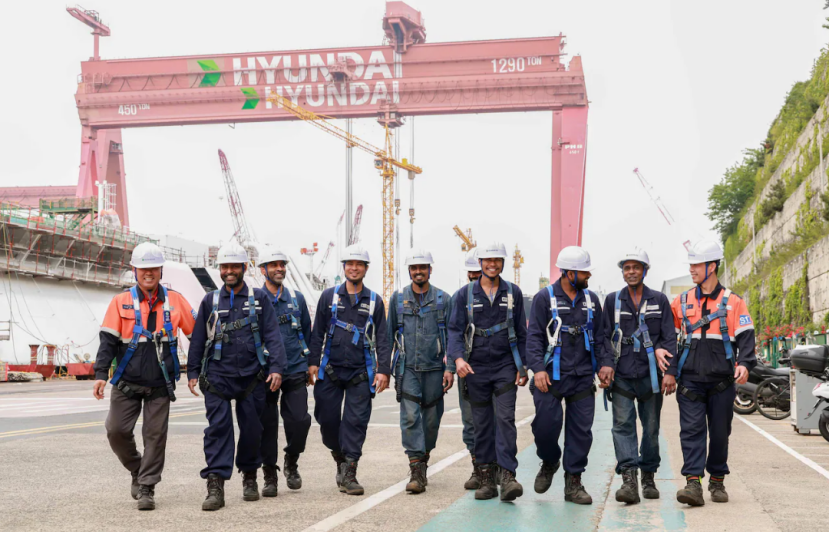
South Korea is considering abolishing its shipbuilding industry preferential policies due to insufficient quota utilization.
Several days ago, the Foreign Labor Policy Deliberation Committee under South Korea’s Ministry of Employment and Labor (MOEL) convened a meeting to discuss whether to abolish the “E-9 Shipbuilding Industry Special Visa Quota.” It is reported that a substantive decision has been made to proceed with the abolition process.
According to reports, the South Korean government issued a total of 130,000 E-9 visas in 2025. The “E-9 Shipbuilding Industry Special Visa Quota” is a temporary policy introduced by the South Korean government to alleviate the severe labor shortage in the shipbuilding industry in 2023, and is valid until the end of 2025. The quota for the first year (2023) and 2024 was 5,000 people each, but the quota for 2025 was reduced to 2,500 people, a decrease of 50%.
Reports indicate that approximately 80% of foreign workers in South Korea’s shipbuilding industry are employed through the “E-9 Shipbuilding Industry Special Visa Quota.” Since the implementation of this temporary policy, the proportion of foreign workers at South Korea’s three major shipbuilders (HD Hyundai, Hanwha Ocean, and Samsung Heavy Industries) has surged from 5% (4,640 workers) in 2021 to 18% (20,200 workers) in 2024. Concurrently, this temporary policy provides foreign workers with promotion opportunities, helping them become skilled workers in the shipbuilding sector and thereby qualify for South Korea’s E-7 visa.
It is understood that the South Korean E-9 (Non-Professional Employment) visa is issued to foreign workers in simple labor fields such as manufacturing and agriculture through the South Korean government’s employment permit system, which restricts family members from accompanying them and regulates movement between workplaces; the E-7 (Specific Activities) visa is issued by the South Korean Ministry of Justice to qualified foreign professionals, and applicants must meet strict requirements for education and professional experience.
Regarding whether to abolish the “E-9 shipbuilding special visa quota”, the South Korean Ministry of Employment and Labor stated: “Currently, shipyard manpower has been fully replenished, and the actual utilization rate of this special quota is only about one-third, making it difficult to support extending the quota period.”
South Korean labor groups and local politicians have also called for the abolition of this special quota for the shipbuilding industry, arguing that it constitutes “reverse discrimination against Korean workers” and “lacks beneficial effects.” Shipbuilding company unions pointed out: “Because companies can always hire foreign workers at the Korean minimum wage, the three major shipbuilders have shown significant shortcomings in improving the wages and benefits of shipyard workers.”
Those advocating for the abolition of visas argue that low-wage foreign workers are eroding local jobs and hindering overall wage growth in the shipbuilding industry. On November 24, Geoje Mayor Byun Kwang-yong requested the Ministry of Employment and Labor to reduce the visa quota for foreign workers, stating that “the influx of foreign workers is squeezing youth job opportunities and weakening demand for skilled positions.” Ulsan Mayor Kim Doo-kyum’s plan to expand the special visa quota for foreign workers has also met with strong local opposition.
The shipyard explicitly stated that foreign workers are a critical factor in ensuring on-time vessel delivery.
In response to calls from the South Korean government and various sectors of society to abolish the “E-9 shipbuilding industry-specific visa quota,” shipbuilding companies facing recruitment difficulties have expressed grave concerns: “The labor shortage in the shipbuilding industry persists. It is only thanks to foreign workers undertaking arduous tasks like welding and painting—jobs that Korean workers avoid—that shipyards can secure sufficient orders to ensure a steady workload for at least the next three years.”
Taking HD Hyundai Heavy Industries as an example, the company has recently accelerated its overseas expansion efforts. It is not only establishing local shipyards in countries such as Saudi Arabia, Peru, and India, but also plans to collaborate with U.S. firms on joint military vessel construction. As its global business footprint continues to expand, the company’s demand for labor has grown accordingly. This indicates that the need for foreign workers will only increase in the future.
The primary concern for the nation’s shipbuilding enterprises is the risk of workforce attrition amid existing order backlogs. Should the “E-9 Shipbuilding Industry Special Visa Quota” be abolished and integrated into the general manufacturing visa system, foreign workers would likely collectively shift to less physically demanding general factories rather than high-risk, high-intensity shipyards.
Shipbuilding companies believe that even if quotas for foreign workers are reduced, young Koreans are unlikely to seek employment at shipyards, as Korean workers already avoid jobs such as welding and painting.
South Korean industry insiders bluntly stated: “Reducing foreign laborers does not mean young people will enter the arduous shipbuilding industry. The specialized visa quota for shipbuilding serves as the minimum safeguard mechanism to retain foreign workers in shipyards.” Particularly in 2026, when the construction volume of container ships—which demand more labor than liquefied natural gas (LNG) carriers—will significantly increase, the impact of foreign labor shortages will become even more severe.