


As the shipbuilder of the container ship “Dali”, which crashed into and collapsed a U.S. bridge, HD Hyundai Heavy Industries has defended itself against the findings of the accident investigation: it argues that conversions made to the “Dali” after its delivery to the operator bypassed critical redundant systems, triggering a second power outage that left the vessel without propulsion and steering capabilities at the crucial moment before it hit the bridge.
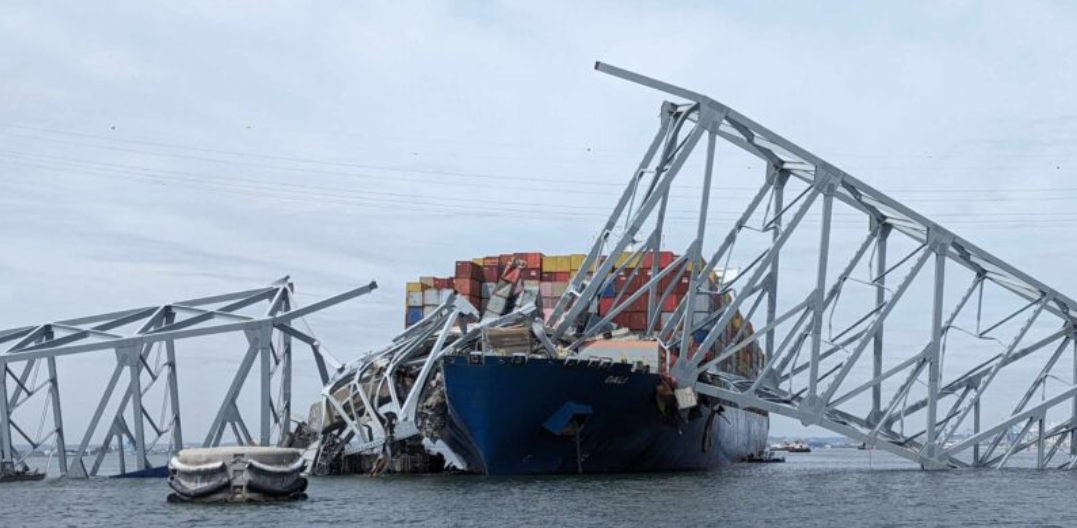
On March 26, 2024, the container ship “Dali” struck the Francis Scott Key Bridge in Baltimore, Maryland, USA, while departing the port, resulting in the deaths of six highway workers and the collapse of the bridge. Following the National Transportation Safety Board (NTSB) investigation into the bridge collision, HD Hyundai Heavy Industries issued a statement defending the original design of the “Dali”.
Following an investigation, the NTSB determined that the loose wire in the ship’s electrical system caused a breaker to unexpectedly open — beginning a sequence of events that led to two vessel blackouts and a loss of both propulsion and steering near the 2.37-mile-long Key Bridge on March 26, 2024. Investigators found that wire-label banding prevented the wire from being fully inserted into a terminal block spring-clamp gate, causing an inadequate connection.
In response, HD Hyundai Heavy Industries emphasized in its defense statement regarding the original design of the Dali: “This vessel was delivered with extensive redundant systems and automatic restart functions, intended to prevent catastrophic failures. As described by the NTSB, container ships like the Dali can be likened to ‘floating cities’—such vessels are equipped with on-board generator sets and feature safety protections to address ‘the inevitable unpredictability of operating complex systems in harsh environments’.”
HD Hyundai Heavy Industries pointed out that the “Dali” was originally equipped with four independent diesel generators, two independent transformers, and an automatic fuel supply pump, which could automatically restart without crew intervention after a power outage. They emphasized that these redundant configurations were mandatory requirements of the relevant classification societies. However, the shipyard alleged that “shortly after taking delivery of the ‘Dali’, the owner and operator circumvented the ship’s protection mechanisms by destroying critical redundant systems.”
HD Hyundai Heavy Industries explained that the operator replaced the automatic fuel supply pump with an electric flushing pump—a single-point system used only for cleaning, not fuel supply, requiring manual restart, and lacking critical safety features. Their statement reads: “Using a flushing pump as a fuel supply pump sacrifices the redundancy and automation of the fuel supply system and violates established classification society rules.”
On the day of the incident, the Dali experienced two power outages. The first outage was caused by a broken wire in the transformer system’s terminal block. Since the transformer was operating in manual rather than automatic mode, the crew had to manually switch to the backup transformer. However, Hyundai Heavy Industries pointed out that “during the switching process, the crew failed to restart the flushing pump supplying fuel to the generator, leading to the generator running out of fuel and causing a secondary power outage.”
HD Hyundai Heavy Industries maintains that had the ship’s systems on the Dali been operated according to their original design and manufacturing standards, “power would have been restored within seconds, and the tragic second power outage could have been avoided.”
For the operator, the NTSB stated in its investigation report: “Although unrelated to the initial power loss during navigation, the crew’s use of the flushing pump as a backup pump for the diesel generators during navigation constituted improper operation. This is because the fuel pressure required for Diesel Generators No. 3 and No. 4 could not be automatically restored after the power loss.” Consequently, the flushing pump failed to restart after the initial voyage power interruption, ceasing pressurized fuel supply to diesel generators 3 and 4. This triggered the second voyage power interruption (a dual failure of both low- and high-pressure systems).”
Therefore, the NTSB determined that Synergy Marine, the vessel management company for the Dali, had serious deficiencies in operational oversight. The NTSB reiterated that routine inspections over the past decade should have identified this loose wire, while HD Hyundai Heavy Industries reaffirmed that “shipowners and operators bear the responsibility for conducting regular and proper inspections and maintenance to ensure that systems and components on board remain in seaworthy condition.”
In addition to vessel system issues, the NTSB investigation identified other contributing factors: the absence of bridge deck protective measures and the failure to effectively notify highway construction personnel to evacuate. Drawing on this critical lesson, the agency has issued urgent recommendations to multiple federal agencies and bridge owners nationwide, requiring vulnerability assessments and the implementation of risk mitigation strategies.