


Samsung Heavy Industries (SHI) has achieved the industry-first full automation of the spool fabrication process, accelerating the development of its smart shipyard through the deployment of robotic production facilities. Samsung Heavy Industries plans to formally integrate artificial intelligence (AI) and robotics into its production operations to simultaneously enhance both production efficiency and quality competitiveness.
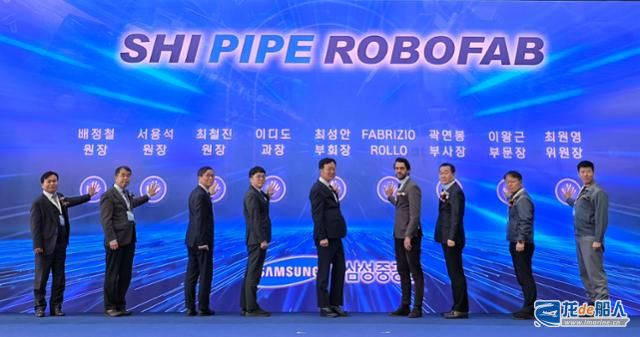
On March 16, Samsung Heavy Industries held a completion ceremony for its automated piping plant, “PIPE ROBOFAB” (Piping Smart Manufacturing Center), and officially commenced its operations.
As explained, piping systems serve as the “blood vessels” of a shipyard, responsible for conveying substances such as fuel, gas, and cooling water; they are, therefore, considered core components. Pipe spool fabrication is the process of welding and assembling components—such as elbows, tees, and flanges—into a single structural unit (a “spool”), in accordance with design blueprints. Previously, this manufacturing process relied heavily on manual labor performed by skilled workers.
The Piping Smart Manufacturing Center, which has now been completed and commissioned, covers a floor area of approximately 6,500 square meters and boasts an annual output of approximately 100,000 pipe sections. Its defining feature is the integration of the entire process—spanning from piping design to automated logistics, high-precision machining and measurement, positioning, and welding—into a single, unified intelligent system. Building upon this foundation, the facility incorporates Vision AI technology to automate the identification of work positions and quality verification, thereby establishing a production system centered around robotics.
Samsung Heavy Industries stated that, compared to traditional piping fabrication methods that were predominantly labor-intensive, the commissioning of its Smart Piping Manufacturing Center will not only reduce production lead times and enhance quality consistency but also significantly improve workplace safety.
The South Korean shipbuilding industry regards Samsung Heavy Industries’ Smart Piping Manufacturing Center as a landmark example of shipyard automation. This is because the global shipbuilding market is currently shifting toward high-value-added vessels—such as eco-friendly ships and liquefied natural gas (LNG) carriers—making ship piping systems increasingly complex. Coupled with a shortage of skilled welders, the demand for automated production processes is growing rapidly.
An industry insider in the Korean shipbuilding sector stated: “Piping is an area of the shipbuilding process characterized by a heavy workload and rigorous quality control requirements. Once automation—powered by robots and AI—becomes fully widespread, we can expect to see significant shifts in competitiveness regarding production efficiency and delivery schedules.”
The Samsung Heavy Industries labor union has stated that it will maintain a spirit of cooperation throughout the company’s transition toward becoming a smart shipyard. A representative from the Samsung Heavy Industries Labor-Management Council remarked, “AI and automation represent an inevitable trend in the shipbuilding industry. We intend to create new jobs by expanding the volume of new vessel orders, and we will maintain continuous dialogue to ensure both job security and a safe working environment for our employees on the shop floor.”
On the shipyard front, Samsung Heavy Industries regards its Piping Smart Manufacturing Center as the core outcome of its strategy for transforming into a smart shipyard. Building upon the “Engineering Data Hub (S-EDH)” established last year, the company is currently advancing a digital transformation (DX) initiative aimed at integrating data across design, procurement, and production. Its vision is to evolve this into a “3X Strategy”—a framework that combines AI Transformation (AX) and Robotics Transformation (RX)—thereby enhancing its production competitiveness.
Samsung Heavy Industries regards its Piping Smart Manufacturing Center as the core outcome of its smart shipyard transformation strategy. Building upon the “Engineering Data Hub (S-EDH)” established last year, the company is advancing a digital transformation (DX) initiative that integrates data across design, procurement, and production. Its vision is to evolve this into a “3X Strategy”—combining AI Transformation (AX) and Robotics Transformation (RX)—thereby enhancing its production competitiveness.
An official from Samsung Heavy Industries stated: “The piping robot workshop represents a production site where Samsung Heavy Industries integrates its proprietary advanced welding expertise with AI and robotics technology to revolutionize the piping section fabrication process; this will serve as a new catalyst for enhancing manufacturing competitiveness within the shipbuilding industry.”