

President Donald Trump announced on the day after the South Korea-U.S. summit (Oct. 30, Korea time) that he had officially approved the construction of nuclear-powered submarines in South Korea, Chosun Ilbo news reported.
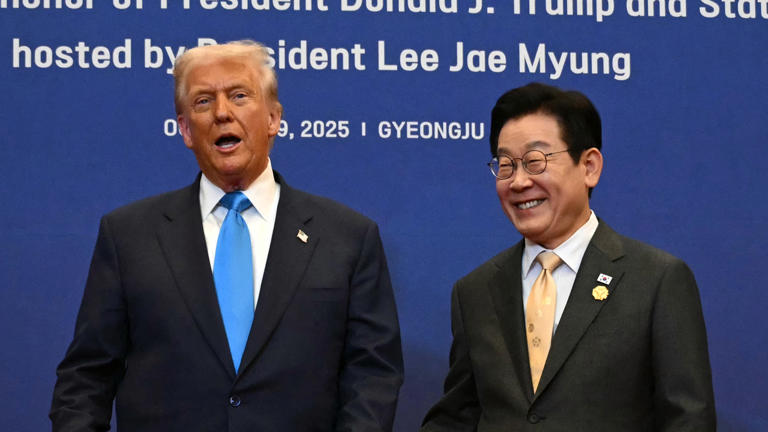
“The South Korea-U.S. military alliance is stronger than ever”, Trump said via social media platform Truth Social on the same day, adding that he “has given South Korea the go-ahead to build nuclear-powered submarines to replace aging diesel submarines.”
According to the Korean media, the construction of nuclear-powered submarines is not only a mere defense project, but also requires technical support and fuel supply from the the U.S., as well as the improvement of the ROK-U.S. Atomic Energy Agreement. Trump’s statement releases a signal that the U.S. will support the relevant program at the policy level.
In his social media post, Trump said, “The U.S. Hanwha Philly Shipyard will play an important role in the construction of South Korea’s nuclear-powered submarines.” Although the Shipyard Shipyard was not directly designated for the construction of the submarine, the reference to this iconic shipyard, which symbolizes the shipbuilding cooperation between South Korea and the U.S., shows the willingness to cooperate.
Hanwha Philly Shipyard is understood to be a major U.S. shipbuilding facility acquired by Hanwha Group last year, and is the centerpiece of the Korea-U.S. Shipbuilding Cooperation Program, MASGA. Hanwha Group had announced in August this year that it would invest an additional US$5 billion in the shipyard and had ordered 10 multi-ship newbuildings from it, including two LNG carriers.
In response to the U.S. Section 301 investigations into China’s maritime, logistics, and shipbuilding industries, China’s Ministry of Commerce recently added five U.S. subsidiaries of Hanwha Philly Shipyard, among others, to its retaliatory list, prohibiting organizations and individuals within my country from engaging in related transactions or cooperation with them.
According to the information disclosed by China’s Ministry of Commerce, Hanwha Ocean’s relevant subsidiaries in the U.S. assisted and supported the U.S. government’s relevant investigative activities, jeopardizing China’s sovereignty, security and development interests.
Korean media also said that Trump’s statement was interpreted as “declaring that it will strengthen South Korea-U.S. technological cooperation in response to China’s constraints”. Trump’s comments came on the second day of the South Korea-U.S. summit, after South Korean President Lee Jae-myung requested “a decision on the supply of fuel for nuclear-powered submarines.”
Lee Jae-myung said at the time that “diesel-powered submarines have limited submergence capability” and emphasized that “if the supply of fuel is allowed, South Korea can build nuclear-powered submarines with conventional weapons using its own technology and contribute to the defense of the Korean Peninsula”. Donald Trump reportedly agreed immediately and instructed follow-up consultations, which means that the South Korean government’s willingness to introduce nuclear-powered submarines has been substantially publicized.
In response, South Korean Navy Chief of Staff Kang Dong-gil stated in the National Assembly that if a decision is made regarding South Korea’s nuclear-powered submarines, it will take more than 10 years to build, with completion expected in the mid-2030s or later. He predicted that the future nuclear-powered submarines will be “over 5,000 tons,” and the fuel will be “at a level suitable for peaceful use, with uranium enrichment levels below 20%.”
For his part, South Korean Defense Minister Ahn Kyu-bak responded, “South Korea has all the conditions to build nuclear-powered submarines, and the only thing missing, nuclear fuel, can be done in cooperation with the the U.S.” As to whether it will be built at the Hanwha Philly shipyard in the U.S., Ahn Kyu-bak said, “Further discussions between South Korea and the U.S. will have to be held on this issue.”