

Swedish marine technology company Alfa Laval has completed the certified factory acceptance test (FAT) for the FCM Ammonia fuel supply system, class certified by China Classification Society (CCS), confirming commercial readiness for ammonia-fueled engines.
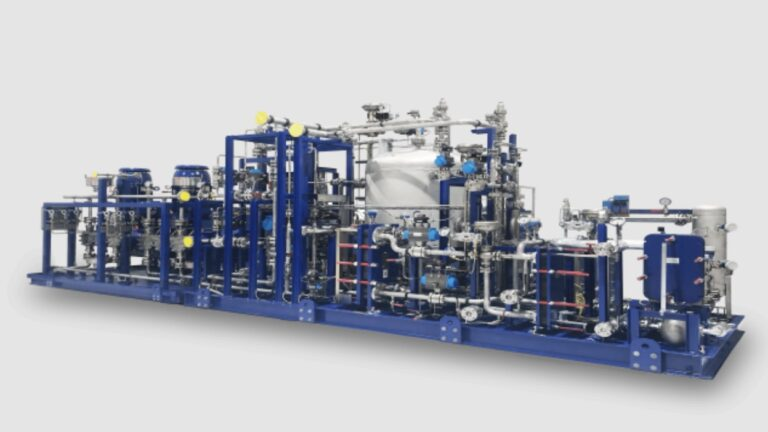
The FAT validates the design, control architecture, safety layers and ammonia-handling routines in a marine environment, with the test program covering full hardware integration and I/O verification, control and safety logic validation, simulation of operational and fault scenarios, functional testing of ammonia-handling, and detailed documentation review conducted in accordance with class requirements.
According to Alfa Laval, it confirms that the fuel supply system has passed all functional and safety verification procedures in accordance with required standards, demonstrating that it is engineered and tested for safe integration into an ammonia-fuelled two-stroke engine environment.
The FAT has been completed for the first FCM Ammonia out of seven units ordered by Chinese shipowner Tianjin Southwest Maritime (TSM) for its dual-fuel ammonia carriers.
“By completing the certified FAT for Alfa Laval’s FCM Ammonia, one of the first in the industry for a two-stroke dual-fuel ammonia application, we position ourselves as frontrunners supporting the safe adoption of ammonia in commercial shipping,” said Roberto Comelli, Europe E&S Manager, Marine Separation & Fuel Supply Systems, Alfa Laval. “This milestone confirms that our ammonia fuel supply technology has reached a new level of industrial maturity, and together with our partners, we are ready from design to production and will help the industry transition.”
CSSC Power Group Corporation (CPGC), which is the system integrator and buyer, has validated the fuel supply system design and production quality, as well as conducted a comprehensive review and on-site witnessing of the fuel supply system in accordance with the Guidelines for Ships Using Alternative Fuels and relevant international regulations.
The FCM Ammonia system is part of a wider ammonia propulsion project. The two-stroke dual-fuel ammonia engine is supplied by WinGD, while the vessel will be constructed at CSSC Huangpu Wenchong Shipbuilding for TSM.
Following class approval and customer validation, the next phases will include installation on board the LPG/ammonia vessel, commissioning activities, followed by fuel and gas trials at sea. Additional identical modules will follow as the vessel program progresses, with CCS continuing to oversee the upcoming phases.