


The latest data from the Baltic and International Maritime Council (BIMCO) shows that as of September 1, 2026, global ship orders totaled 203.2 million corrected gross tons (CGT), a 13% increase from the 180 million CGT recorded during the same period last year. Among these, Chinese shipbuilders secured 74% of the global CGT in new ship contracts over the past year, and their order backlog accounted for as much as 64% of the global total. South Korea ranked second with 19%, followed by Japan with 6%.
In terms of ship types, Chinese shipyards hold a leading position across six major ship types. Their share of outstanding orders in the tanker, liquefied gas carrier, dry bulk carrier, roll-on/roll-off (Ro-Ro) vessel, and other dry cargo vessel sectors is no less than 72 percent. They hold a particularly dominant position in the container ship sector, accounting for 81 percent of global container ship orders.
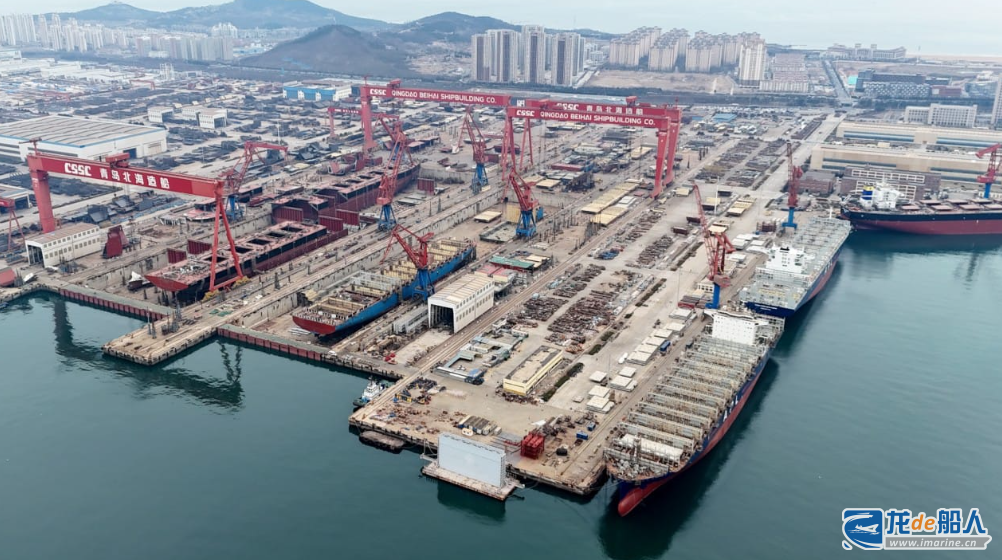
Niels Rasmussen, BIMCO’s Chief Shipping Analyst, said, “Over the past 12 months, container ships have dominated both the order book and order growth. The data shows that container ships account for 30 percent of the world’s order book in adjusted gross tons and have contributed 68 percent of global order growth over the past year.”
The securing of a large volume of orders means that delivery volumes from Chinese shipyards will increase significantly over the coming years.
Deliveries from the three major shipbuilding nations are projected to peak at 40.1 million CGT in 2025, but the total planned for 2026 is as high as 55.9 million CGT, and this figure is expected to surge to 60 million CGT in 2028. Of this total, Chinese shipyards plan to deliver 44 million CGT in 2028—a volume that will set a new historical record and is nearly double the 2025 delivery volume (22.7 million CGT).
BIMCO states that Chinese shipbuilders, in particular, need to expand their production capacity to manage the delivery pressure expected in the coming years. At the same time, the organization warns that such expansion carries risks; should demand for new orders weaken, there is a potential for underutilization of production capacity.
Historical data shows that the massive shipbuilding boom leading up to the 2008 global financial crisis drove shipyards to work through their backlogs, resulting in global delivery volumes reaching 54.4 million CGT in both 2010 and 2011. Subsequently, delivery volumes fell to a low of 31.2 million CGT in 2020, before beginning to recover.
A decline in order volumes—compounded by a subsequent drop in deliveries and the global economic downturn—has caused the number of active shipyards in China to fall from 379 in 2010 to 117 in 2019. Globally, the number of active shipyards decreased by 60% between 2009 and 2017.
Based on the highest annual production volume over the past five years, the average order backlog for Chinese shipyards currently stands at 4.2 years, compared to 1.9 years for South Korea and 1.7 years for Japan. If the highest annual CGT scheduled for delivery between 2021 and 2030 is treated as each country’s current production capacity, the average order backlog for Chinese shipyards would drop to 2.1 years, while that for Japan and South Korea would both fall to 1.6 years.