


Mediterranean Shipping Company (MSC)’s rapid expansion has reached yet another incredible milestone: the total size of its existing fleet and confirmed orders has now easily surpassed 10 million TEU, which is roughly equivalent to the total capacity of the global liner industry 20 years ago.
Based on Alphaliner data, MSC’s operational fleet stands at approximately 7.4 million TEU, accounting for 21.5% of global liner capacity; its order book for newbuilds has reached approximately 2.94 million TEU.
Meanwhile, MSC’s newbuilding program continues to expand. Alphaliner also reported that MSC has reportedly placed an order for six additional 21,700-TEU LNG-dual-fuel container ships with Chinese shipbuilder Zhoushan Changhong International. The new capacity of 130,200 TEU brings the total of the carrier’s existing fleet and orders to approximately 10.47 million TEU.
In terms of ship prices, based on the current price of approximately $235 million per vessel, the total cost of the six new ships from Zhoushan Changhong International is about $1.4 billion. Consequently, the delivery schedule for the series of 21,700-TEU vessels ordered by both parties has been extended to 2030.
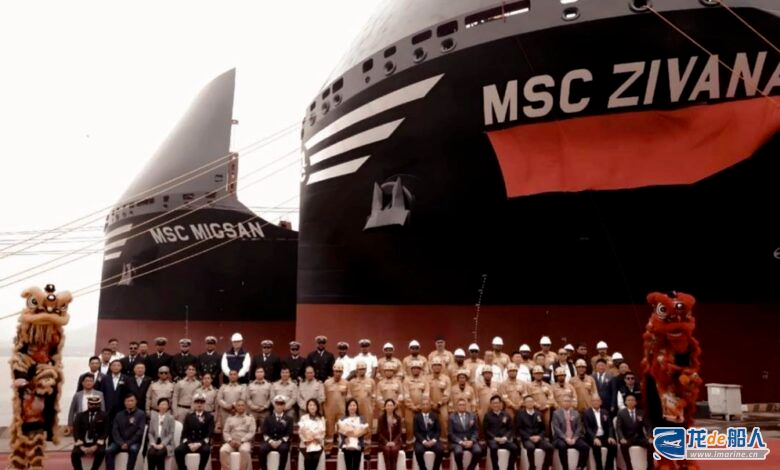
This historical comparison for MSC is striking. According to Alphaliner data, the total capacity of the global liner fleet surpassed the 10 million TEU mark in August 2006 and reached 10.467 million TEU on January 1, 2007; at that time, MSC’s container fleet capacity had just crossed the 1 million TEU threshold, with an operational capacity of 1.02 million TEU; Maersk, the world’s largest liner shipping company at that time, had a capacity of 1.76 million TEU.
In other words, MSC’s current fleet size and total order backlog are equivalent to the combined capacity of the entire global liner fleet twenty years ago.
Since the beginning of the pandemic, MSC’s growth has been unprecedented. In November 2025, MSC surpassed the 7 million TEU mark, having taken just 15 months to go from 6 million TEU to 7 million TEU; at the same time, MSC has been driving an unprecedented surge in secondhand vessel acquisitions, having purchased more than 550 secondhand container ships since August 2025.
Over the past decade, landlocked Switzerland has leaped to become one of the world’s top ten shipowning nations, relying almost exclusively on MSC.
From another perspective, the current global container ship fleet stands at approximately 34.4 million TEU. This means that MSC’s existing fleet and order backlog combined account for more than 30% of the total operational fleet, but this does not imply that the shipping line will simultaneously operate 10.5 million TEU of capacity.
As new vessels are delivered, older vessels will be scrapped, and chartered vessels will be returned upon the expiration of their leases; MSC’s fleet plan will be adjusted accordingly. Nevertheless, this proportion still highlights the extraordinary scale MSC has built. Today, this shipping company’s container capacity—whether in operation or under construction—is equivalent to the total capacity possessed by the entire liner shipping industry 20 years ago.