


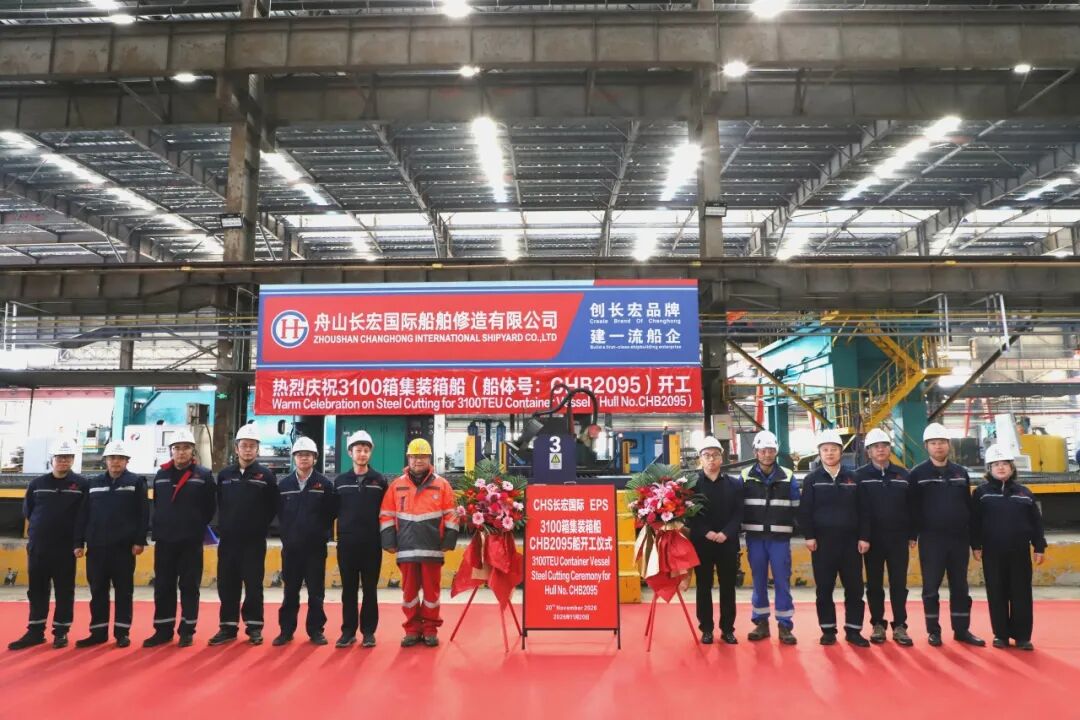
On November 20, Zhoushan Changhong International held a steel-cutting ceremony to mark the start of construction on the first vessel in a series of 3,100-TEU container ships being built for the Singapore-based shipowner EPS, signaling that the six-vessel project has officially entered the construction phase. The shipbuilding contract for this project was signed in November 2025.
Designed by Neptun, this vessel has an overall length of approximately 199.98 meters, a beam of 35.2 meters, and a draft of 17.9 meters, and is classified by DNV. The hull design is optimized for various draft and trim conditions. Under 88% SMCR operating conditions, the vessel can achieve a speed of over 18.4 knots. In economic speed mode, fuel consumption is significantly reduced, and the refrigerated container capacity has been optimized from the original 600 FEU to 768 FEU, resulting in a significant increase in refrigerated container loading capacity.
In terms of environmental performance, the vessel is equipped with a fixed medium-voltage shore power system, which allows the ship’s generators to be shut down while in port, effectively reducing carbon emissions and air pollutants such as sulfur emissions. In addition, the vessel is fitted with a shaft generator to enhance operating economy; both the main engine and the main generator are equipped with SCR systems to meet Tier III emission requirements.
In addition, the vessel is equipped with three marine cranes, enhancing its port adaptability and enabling it to independently complete loading and unloading operations without relying on quay cranes. This makes it particularly suitable for small- and medium-sized ports and feeder ports with limited lifting capacity, reducing waiting times for quay cranes and improving loading and unloading efficiency. The living quarters incorporate the LIFE-AT-SEA design philosophy—exclusive to the EPS project—which improves the crew’s living and working conditions, promotes their physical and mental well-being, and enhances the vessel’s operational safety.