


Having successfully entered the sectors for Very Large Crude Carriers (VLCCs) and Very Large Ammonia Carriers (VLACs) by adopting a “build-before-sale” model, Hengli Heavy Industries is reportedly planning to use the same approach to venture into the construction of Liquefied Natural Gas (LNG) carriers. This move could make Hengli Heavy Industries the sixth shipbuilder in China capable of building large-scale LNG carriers.
Expanding into a New Market Segment, Hengli Heavy Industries Plans to Build Two LNG Carriers
According to TradeWinds, Hengli Heavy Industries, a private Chinese shipbuilder, plans to build two LNG carriers on its own. If the project proceeds as planned, it will mark a major breakthrough in Hengli Heavy Industries’ business expansion in the gas carrier sector, making it the second private shipbuilder in China—after Yangtze River Shipbuilding—to construct large LNG carriers.
It is understood that Hengli Heavy Industries has been planning its entry into the LNG carrier sector for some time. Two years ago, the shipbuilder initiated discussions with GTT, a leading French provider of liquid cargo containment systems, and successfully signed a patent cooperation agreement with the company for membrane-type containment systems.
In the second half of 2024, the technical team from France’s GTT made multiple on-site visits to Hengli Heavy Industries, while Hengli Heavy Industries assembled a dedicated team to visit GTT (China) for exchanges and learning; the two parties engaged in multiple rounds of discussions regarding technical cooperation and patent licensing. During this period, Hengli Heavy Industries completed the construction of an LNG carrier mock-up tank in just one month, successfully passed GTT’s series of qualification audits, and obtained approval certificates from eight major classification societies: ABS, BV, CCS, DNV, KR, LR, NK, and RINA.
On January 22, 2025, Hengli Heavy Industries and France’s GTT formally signed a patent cooperation agreement for membrane-type containment systems. The two parties shall engage in in-depth cooperation in areas such as the application of technologies for LNG membrane-type containment systems and membrane-type LNG fuel tanks, as well as the design and construction of Very Large Ethane Carriers (VLECs), LNG bunkering vessels, dual-fuel container ships, VLCCs, and Suezmax tankers.
For LNG carriers—specialized vessels designed to transport LNG at -163°C—the liquid cargo containment system represents the core technology. France’s GTT, a pioneer in the global development of membrane-type containment systems, has licensed its patented technology to Hengli Heavy Industries; this move serves as a recognition of Hengli Heavy Industries’ production capabilities and shipbuilding expertise. Securing this license is a crucial prerequisite for Hengli Heavy Industries to enter the LNG carrier market, given that the vast majority of existing LNG carriers utilize membrane-type containment systems developed by GTT.
Due to the extreme complexity involved in constructing LNG carriers, only a limited number of shipyards worldwide are capable of building them. Currently, there are five shipyards in China engaged in the construction of LNG carriers—Hudong-Zhonghua, Jiangnan Shipyard, Dalian Shipbuilding Industry Corporation (DSIC), China Merchants Heavy Industries (CMHI) Haimen Shipyard, and Yangzijiang Shipbuilding—all of which have successfully delivered completed vessels.
Yangzijiang Shipbuilding, in particular—the first private Chinese shipbuilder to secure orders for LNG carriers—has seen its first vessel of this type, the 175,000-cubic-meter “YANGZE LNG 01,” complete its maiden cross-border commercial voyage; it holds the distinction of being the first large-scale LNG carrier built by a private Chinese shipbuilder.
Now, news that Hengli Heavy Industries plans to build its own LNG carriers suggests the company is poised to become the sixth shipyard in China—and the second private one—to construct such vessels.
Furthermore, Hengli Heavy Industries’ entry into the LNG carrier market, backed by its massive shipbuilding capacity, is expected to intensify competition for orders in this segment between Chinese and South Korean shipbuilders. With five Chinese shipbuilders—including Hudong-Zhonghua—rapidly catching up, South Korea’s competitiveness in the LNG carrier sector no longer enjoys an absolute advantage.
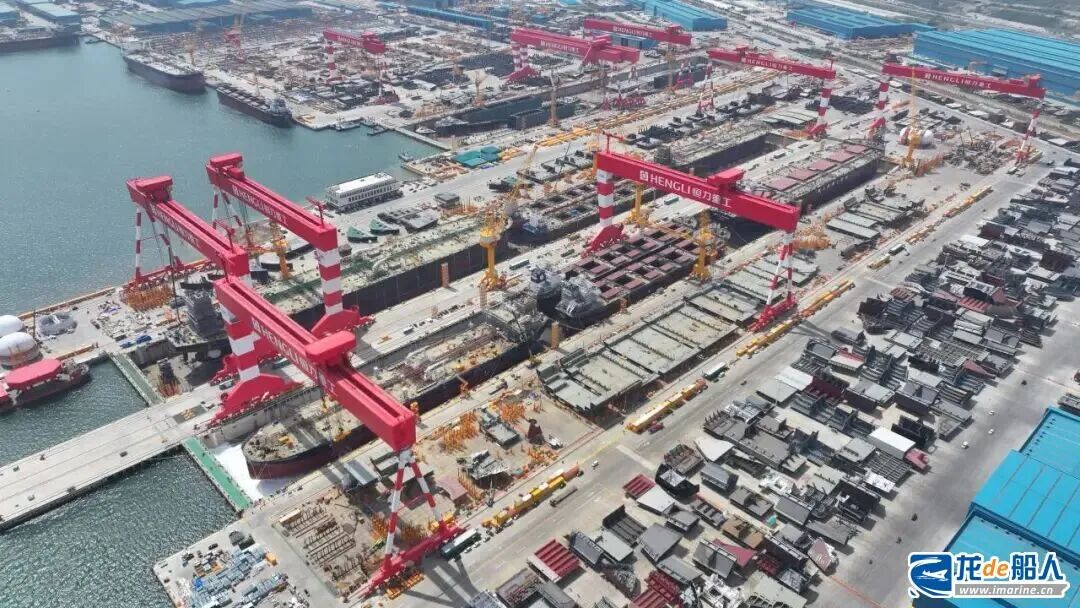
Drawing on past successes, will two LNG carriers be built first and sold later?
Sources indicate that for the construction of these two LNG carriers, Hengli Heavy Industries is once again opting for a “build-before-sale” strategy—that the shipbuilder constructs the vessels first and subsequently markets them to shipowners based on prevailing market conditions. This is a preferred shipbuilding model for the company; backed by its powerful parent firm, Hengli Group, Hengli Heavy Industries has successfully established a presence in the VLCC and VLAC sectors using this approach.
Hengli Heavy Industries officially entered the VLCC construction market in September 2023 with an order from Hengli Group for two 306,000-dwt VLCCs, marking a significant milestone in its development; in September 2024, Hengli Group commissioned the shipyard to build another four VLCCs of the same type. All six of these VLCCs have been resold to Dynacom Tankers—a tanker shipping company owned by Greek shipping magnate George Procopiou—and are currently in the delivery phase.
Just days ago, reports emerged that Hengli Group had placed an order with Hengli Heavy Industries for another four VLCCs; given the current booming market for VLCCs, it is highly likely that this new batch of vessels will also be resold.
In the VLAC sector, Hengli Heavy Industries once again leveraged orders from the Hengli Group to enter the market.
In 2024, the Hengli Group placed orders with Hengli Heavy Industries for four 93,000-cubic-meter VLACs. This move marked Hengli Heavy Industries’ official entry into the gas carrier construction sector, making it the second private Chinese shipbuilder to enter the market for very large liquefied gas carriers—though the distinction of firing the “first shot” for private enterprises in this market belongs to Yangzijiang Shipbuilding. Reportedly, these four new vessels have already been resold to overseas shipowners.
According to data recently disclosed by Hengli Heavy Industries, it ranked first among global individual shipyards in terms of VLAC orders during the first seven months of 2026, securing 14 vessels. In just two years, Hengli Heavy Industry has demonstrated formidable competitiveness in securing orders within the VLAC newbuild market.
Buoyed by the positive market reception of its “build-before-sale” strategy for VLCC and VLAC vessel types, Hengli Heavy Industries is now applying this shipbuilding model to LNG carriers—vessels often described as the “jewel in the crown” of the shipbuilding industry.
Furthermore, Hengli Heavy Industries’ focus on the LNG carrier sector is inextricably linked to market demand for this type of vessel. France’s GTT forecasts that approximately 550 new orders for LNG carriers will be placed globally over the coming decade (spanning 2026 to 2035).