


Labor and management at HD Hyundai Heavy Industries and Hanwha Ocean failed to reach an agreement during negotiations over 2026 wages and collective bargaining, leading both shipbuilders to launch strikes. While Samsung Heavy Industries has not yet initiated a strike, its labor council is boycotting wage negotiations and planning protests. As labor-management conflicts spread across South Korea’s shipbuilding industry, there are predictions that unions from the country’s major shipbuilders might organize a joint, large-scale strike.
With negotiations between labor and management deadlocked, the South Korean government has weighed in on the demand for performance bonuses pegged to a fixed percentage of operating profit.
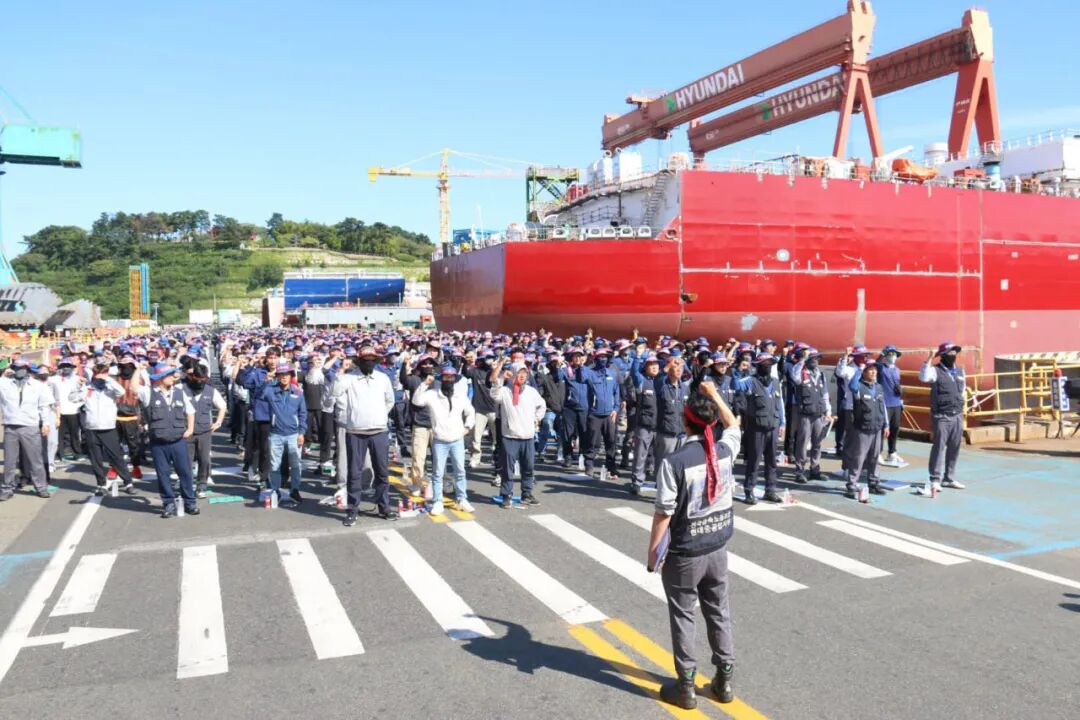
As a leader in the South Korean shipbuilding industry, the HD Hyundai Heavy Industries union—having secured the legal right to strike on August 27—launched a strike on September 2 and plans to extend the daily strike duration to seven hours from September 16 to 18.
Since negotiations for the 2026 wage and collective agreement began on June 2, labor and management have held multiple rounds of talks but have yet to reach a consensus.
The union is demanding a monthly base salary increase of 149,600 won (approximately US$109.04) and a 100% increase in bonuses. Notably, the core demand—and a first for the South Korean shipbuilding industry—is for the company to allocate a fixed percentage (at least 30%) of its operating profit to employees as performance bonuses.
In response, HD Hyundai Heavy Industries presented its third wage proposal during the 20th round of formal negotiations on September 10; the offer included an increase in the monthly base salary by 110,000 won (approximately US$80.18), an incentive bonus equivalent to 200% of the base salary plus a lump sum of 10 million won (approximately US$7,300), and gift vouchers worth 500,000 won (approximately US$364.45).
Although the latest proposal from management represented a concession compared to previous offers, it was still rejected by the union, which insisted that “management needs to present a substantive proposal that adequately reflects the profits generated by the shipbuilding industry’s boom.”
HD Hyundai Heavy Industries expressed difficulty in acceding to the union’s core demand: the allocation of at least 30% of operating profits as performance bonuses.
Based on a simple calculation using HD Hyundai Heavy Industries’ 2025 operating profit (2.0375 trillion won), the performance bonus pool allocated at a 30% rate would exceed 610 billion won. Based on the first half of 2026, the company has already achieved an operating profit of 1.9453 trillion won. Based on this projection, the total performance bonus for HD Hyundai Heavy Industries in 2026 (calculated at a 30% ratio) is expected to reach a staggering 1 trillion won (approximately US$7.289 billion).
The South Korean government has clarified its stance that demands for performance bonuses based on a specific percentage of operating profit do not constitute a mandatory subject for collective bargaining. In negotiation guidelines issued on September 3, the Ministry of Employment and Labor stated that demands linking bonuses to corporate profits could infringe upon the interests of third parties—such as the state and shareholders—and unduly restrict corporate management decisions and execution; therefore, such demands cannot be considered mandatory bargaining subjects.
The Minister of Employment and Labor remarked, “Demanding a certain percentage of operating profit as performance bonuses prior to tax payments could lead to misunderstandings among foreign investors, potentially resulting in reduced investment or weakened corporate competitiveness.”
Hanwha Ocean: Escalating Strike Disrupts Production
Since August 31, the Hanwha Ocean labor union has been staging a mix of partial and full-scale strikes on weekdays, involving over 4,700 members. As of September 15, the industrial action has lasted 12 days and is intensifying. Notably, the strike on September 9 lasted eight hours, disrupting shipyard operations; for instance, some cranes and transport equipment at the Geoje shipyard were brought to a standstill.
Although labor and management held two rounds of negotiations during the strike period, they failed to reach an agreement.
During the 20th round of negotiations held on September 8, Hanwha Ocean presented its initial wage proposal: a monthly base salary increase of 95,000 won (approx. US$69.25), a one-time bonus of 5.5 million won (approx. US$4,000), annual welfare points worth 600,000 won (approx. US$437.34), and gift vouchers valued at 1.5 million won (approx. US$1,093.35).
In contrast, the union’s demands include a monthly base salary increase of 149,600 won (approx. US$109.00), raising the bonus rate from 800% to 900%, extending the retirement age, and improving the bonus distribution system. The union has rejected Hanwha Ocean’s proposal, and negotiations have reached an impasse.
A union representative stated, “With the shipbuilding industry’s business cycle expected to improve significantly by 2026, financial performance is projected to be much better than last year; however, management’s wage proposal fails to reflect this outlook. While the high-value-added vessels primarily built by the company contribute to improved profitability—and employees have shouldered a heavy workload during this time—the proposed wage increases fall short of expectations.”
Samsung Heavy Industries Has Yet to Present a Wage Proposal; Union Boycotts Negotiations
Unlike Hanwha Ocean and HD Hyundai Heavy Industries, Samsung Heavy Industries—one of South Korea’s “Big Three” shipbuilders—has not yet reached the stage of an actual strike. However, the company is facing serious labor-management conflict as wage negotiations drag on.
Since May, labor and management at Samsung Heavy Industries have held 16 rounds of negotiations, yet the company has still not submitted a wage proposal. In response, the company’s labor council boycotted the 17th round of talks originally scheduled for September 10 and staged protests in front of the Samsung Group office building in Seoul and near the residence of Samsung Group Chairman Lee Jae-yong.
The labor council believes that the wage proposal has been delayed due to Samsung Group’s internal review processes and plans to urge the group to make a direct decision on the matter. The council’s demands include a 9.3% increase in the base wage for 2026, the abolition of the wage peak system, an unconditional extension of the retirement age, and the hiring of additional frontline workers.
Having secured the mandate to strike through a vote held in July, the labor council stated, “If management still fails to present a wage proposal following these protests in Seoul, labor actions will escalate further.”
Unions at Eight South Korean Shipbuilders Plan Joint Strike
As the scope of strikes in South Korea’s shipbuilding industry continues to expand, the “Shipbuilding Industry Union Alliance”—comprising labor unions from eight South Korean shipbuilding companies—plans to take joint action after the Mid-Autumn Festival. If, by September 18—before the Mid-Autumn Festival—management has not presented a proposal acceptable to union members and no agreement has been reached in the wage negotiations, the alliance will convene a representatives’ meeting to formulate a comprehensive plan of action, including a joint strike after the holiday.
The industry is concerned that a prolonged strike would disrupt production schedules and shipyard operations, jeopardizing the delivery of a massive order backlog spanning three to four years. Shipbuilding relies on the seamless integration of various processes—such as the fabrication, transport, and assembly of hull blocks—meaning that an interruption in one stage inevitably impacts subsequent phases. Delays in vessel delivery caused by production stoppages would inevitably result in a heavy financial burden.
Industry insiders noted, “Failure to effectively fulfill existing orders due to strikes could negatively impact the ability to secure new contracts… Given the substantial order backlog, it is crucial to resolve labor-management disputes and devise a plan to maintain stability on the production floor.”