

On August 13, A.P. Moller – Maersk released its financial results for the second quarter of 2026. Driven by robust market demand, rising ocean spot freight rates, and broad-based growth across its business segments, Maersk delivered a strong performance in the second quarter.
Global demand for transport and logistics remained resilient during the quarter. Due to disruptions along the Strait of Hormuz shipping route, cargo destined for the Gulf region was diverted to alternative ports and transshipped via inland routes, while affected maritime capacity was rapidly redeployed to other lanes experiencing demand growth. Import demand in Africa, North America, and Latin America was particularly strong, driven by sustained export growth from the Far East—especially China. Meanwhile, ocean freight spot rates rose significantly, driven by robust market demand, increasingly imbalanced trade flows, tight capacity, and worsening port congestion in Europe, the Middle East, the east coast of South America, and West Africa.
Leveraging its strengths to drive volume growth across its business segments, Maersk delivered a strong financial performance in the second quarter. Revenue rose 20% year-on-year, increasing from $13.1 billion to $15.8 billion. The Ocean business was the primary driver of this growth, contributing an additional $2 billion in revenue. EBITDA increased from $2.3 billion to $3.0 billion, while EBIT rose from $845 million to $1.6 billion, resulting in an EBIT margin of 10.0%.
The maritime business performed exceptionally well both operationally and commercially, with revenue growing by 23% and profitability significantly improving. Cargo volume increased by 4.1%, driven primarily by exports from Asia. Average freight rates rose by 22%. Vessel utilization remained at a high level of 96%. As high cargo volumes offset the impact of rising operating costs, unit costs on a fixed energy cost basis decreased by 0.8%. EBIT were $935 million, up from $229 million in the same period last year. In the first quarter of 2026, EBIT was -$192 million.
The logistics business has continued to improve over several quarters, with the EBITDA margin reaching 5.1% this quarter, up 0.5 percentage points from the previous quarter. Revenue increased by 15% year-over-year and 11% quarter-over-quarter. Landside transportation and services (Landside) served as the primary growth driver, with the Landbridge solution—which connects ports in the Gulf region—performing particularly well; The Forwarding business posted steady growth, driven by strong volume growth in air freight and project logistics; the Solutions business benefited from a high-quality mix of new and existing contracts, making a positive contribution to the improvement in the logistics segment. EBITDA was $217 million, up from $175 million in the same period last year. In the first quarter of 2026, it was $173 million.
The ports business made progress on several key projects, demonstrating its long-term commitment to strategic growth and capacity expansion. Although the conflict in the Middle East posed certain challenges, the strong underlying performance of the ports business was sufficient to offset the related negative impacts. Revenue grew by 11%, with revenue per natural container increasing by 7.1% due to higher rates and increased storage revenue. Throughput grew by 2.2%. EBIT were $458 million, compared to $461 million in the same period last year and $436 million in the first quarter of 2026.
On the investment front, in Brazil, APMT officially opened a new container terminal at the Port of Suape. This major project, representing an investment of $350 million, is the first fully electrified container terminal in South America. In addition, Maersk’s newly constructed distribution and warehousing facilities in the surrounding area have further strengthened the company’s integrated logistics capabilities at the Port of Suape and throughout northeastern Brazil.
In Vietnam, Maersk Terminals and the Hateco Group have signed an agreement with the Da Nang City Government to jointly build and operate the Lien Chieu Container Terminal. The total investment in the project exceeds $1.7 billion.
Financial Guidance
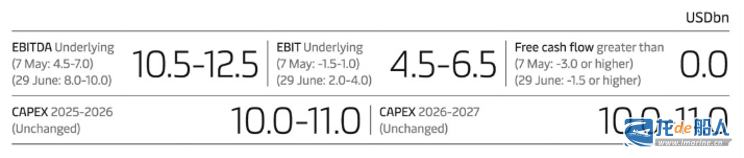
Based on actual performance in the second quarter of 2026 and an assessment of market trends for the remainder of the year, Maersk has raised its full-year financial guidance for 2026. This guidance is based on an expectation of approximately 4% volume growth in the global container market for the full year. Maersk now projects full-year underlying EBITDA of $10.5 billion to US$12.5 billion (previously $8.0 billion to $10.0 billion), underlying EBIT of $4.5 billion to $6.5 billion (previously $2.0 billion to $4.0 billion), and free cash flow exceeding $0 (previously projected at no less than negative $1.5 billion).
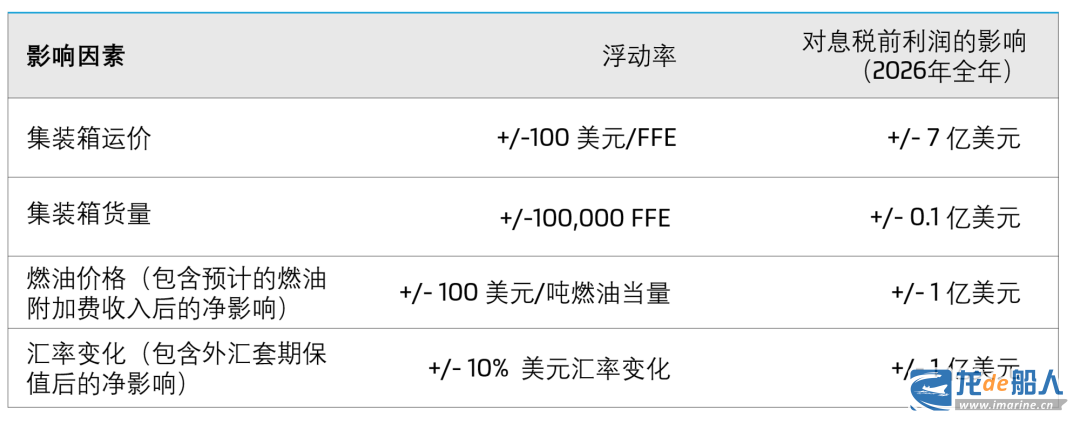
Factors Affecting Performance
A.P. Moller – Maersk’s financial performance in 2026 will be affected by uncertainties such as macroeconomic conditions, fuel prices, and freight rates. All other things being equal, the estimated impact of the four key factors on profits is as follows: