


According to Alphaliner data, over the past decade, the world’s top ten container liner companies have been reducing their reliance on chartered capacity. Currently, for the vast majority of the top ten liner owners, chartered capacity accounts for between 18% and 50% of their total deployed capacity—a significant decrease from the 40% to 70% range seen a decade ago. Taking the top five liner owners as a benchmark, chartered capacity now accounts for 30% to 40% of their deployed capacity.
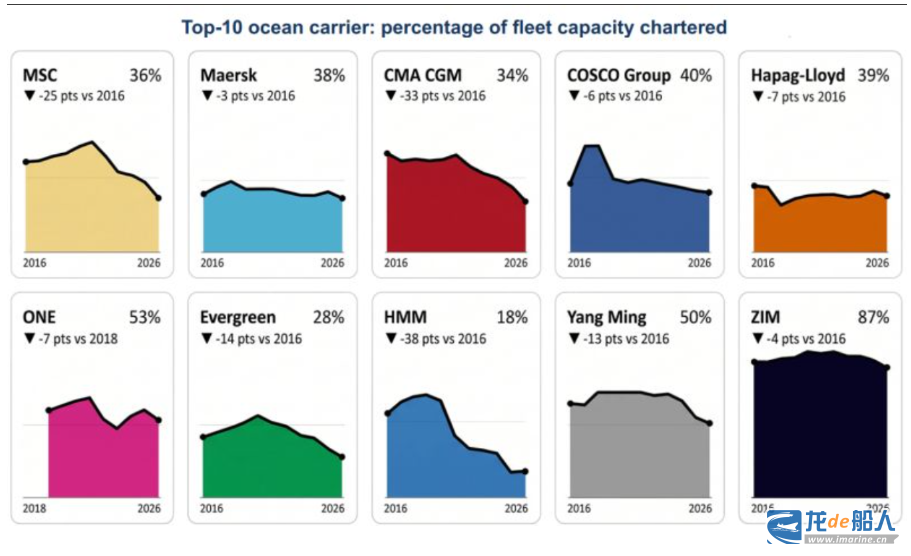
Specifically, Hyundai Merchant Marine (HMM) saw the sharpest decline: the proportion of chartered vessels in its container fleet fell from 56% in 2016 to 18%, a drop of 38%, as the company took delivery of 59 newbuilds during its fleet expansion.
CMA CGM of France ranked second in terms of the decline. The chartered capacity of CMA CGM’s container ship fleet fell from 67% in 2016 to approximately 34%, a decrease of 34%. From 2016 through 2026 to date, CMA CGM has acquired a total of approximately 160 secondhand container ships and placed orders for approximately 100 newbuilds, while continuing to actively lease capacity from non-operating shipowners.
Mediterranean Shipping Company (MSC), the world’s largest liner shipping company, ranks third. Since 2016, the proportion of chartered capacity in the company’s container fleet has fallen from 61% to 36—a 25% decrease—though during the COVID-19 pandemic, that proportion had at one point reached approximately 75%. The substantial profits generated during the COVID-19 pandemic and the subsequent freight rate boom have enabled liner shipping companies to invest in their own fleets, thereby reducing their reliance on chartered vessels.
The liner operators ranked fourth through tenth—Evergreen Marine, Yang Ming Marine Transport, Hapag-Lloyd, Ocean Network Express (ONE), COSCO Shipping, Zim Integrated Shipping Services, and Maersk—saw their respective figures drop from 42% to 28%, 63% to 50%, 46% to 39%, 60% to 53%, 46% to 40%, 91% to 87%, and 41% to 38%, representing declines of 14%, 13%, 7%, 7%, 6%, 4%, and 3%, respectively.
Based on the data in the figure above, Ocean Network Express’s shipping statistics date back to 2018; Zim Integrated Shipping Services remains heavily reliant on chartered vessels, with chartered capacity accounting for between 85% and 98% of the company’s total fleet over the past decade.
Currently, the distinction between shipowners’ own fleets and chartered fleets is becoming increasingly blurred, as some long-term bareboat charter contracts include purchase options or obligations, effectively turning nominally chartered vessels into deferred proprietary assets.