


On July 15, Jinhui Holdings Limited issued an announcement regarding a major acquisition of four vessels and a notice of a general meeting of shareholders. The announcement details two separate “very substantial acquisitions” involving a total of four Ultramax dry bulk carriers at an aggregate contract price of US$136.3 million; classified as “very substantial acquisitions” under the Hong Kong Stock Exchange’s listing rules, these transactions require shareholder approval before they can proceed.
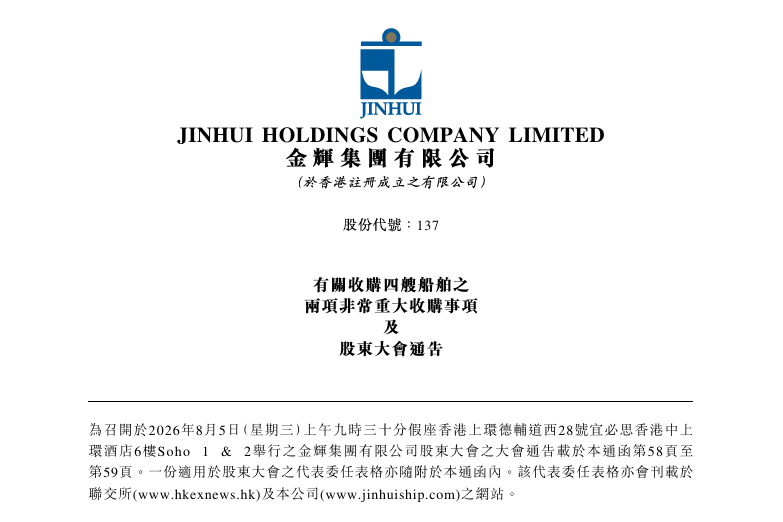
Jinhui Holdings has scheduled a general meeting of shareholders for August 5, 2026, to consider four ordinary resolutions, covering matters such as the approval of two vessel acquisitions and the authorization of the Board to execute all legal documents related to shipbuilding, financing, and ancillary leasing arrangements.
The announcement discloses that the partner for the first acquisition is Jiangmen Nanyang Ship Engineering. The parties signed a contract on June 3, 2026, for the construction of two 64,500 DWT bulk carriers; the cost per vessel is US$34.15 million, bringing the total value for the two vessels to US$68.30 million, with delivery expected by December 31, 2030.
The contracting parties for the second acquisition are Sumec Marine and its subsidiary, New Dayang Shipyard; a contract was signed on June 8, 2026, for the construction of two 64,100 DWT bulk carriers at a price of US$34 million per vessel (totaling US$68 million), with scheduled delivery by May 31, 2030, and June 30, 2030, respectively.
Jinhui Holdings stated that the terms of the transaction were reached through arm’s-length negotiations; the pricing aligns with prevailing market rates for newbuilds and supports the Group’s long-term strategy of fleet optimization. The Group currently operates a fleet of 21 vessels—comprising 18 owned and 3 chartered ships—with a total capacity of approximately 1.7 million deadweight tonnes. Given the current scarcity of high-quality, young second-hand bulk carriers, the volatility of asking prices, and the lengthening lead times for future newbuild deliveries, securing capacity at a leading domestic shipyard now serves to hedge against rising shipbuilding costs and the risk of a future capacity shortfall.
Once the new vessels enter service, they will be leased out to third parties, generating steady charter income and boosting the Group’s recurring operating revenue. Simultaneously, these four brand-new, eco-friendly vessels will gradually replace the Group’s existing aging, high-energy-consumption fleet, thereby lowering the average fleet age and mitigating risks associated with regulatory emissions compliance. A modernized, standardized fleet also enhances asset valuation, expands avenues for future bank financing, and strengthens the Group’s long-term earnings stability and core industry competitiveness.