


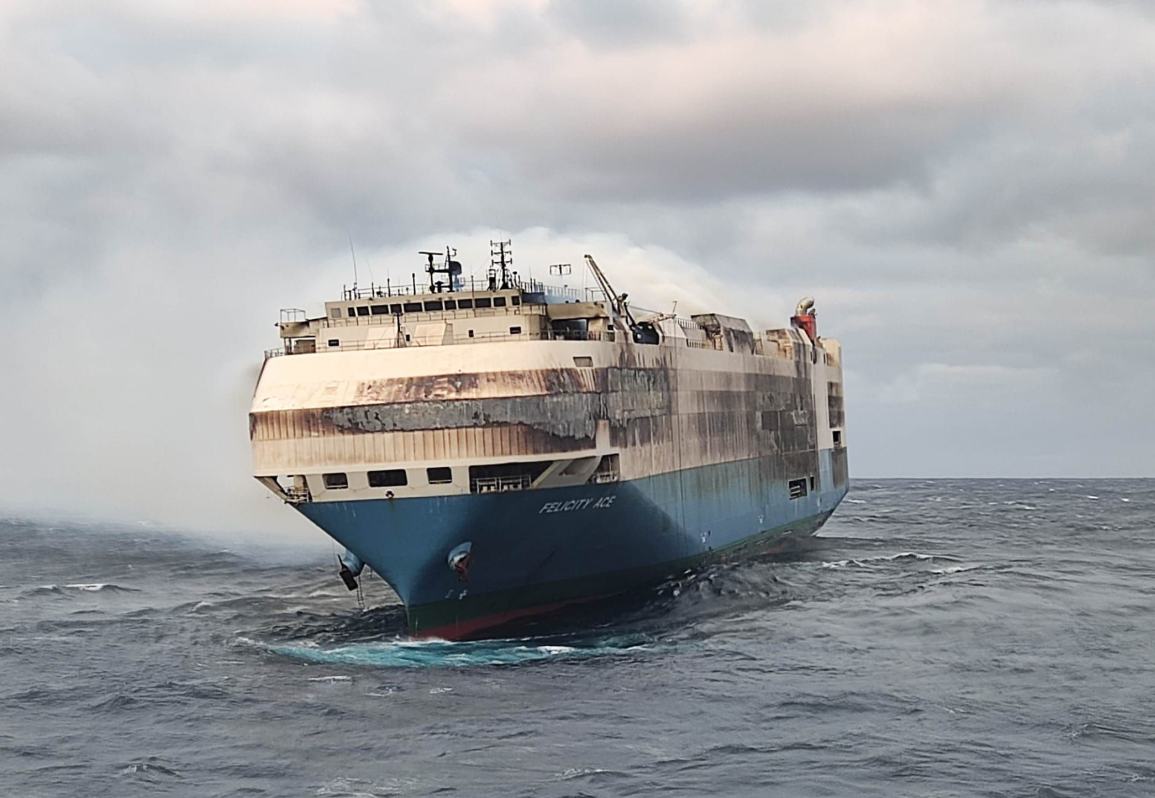
A major lawsuit stemming from the fire and sinking of the car carrier “Felicity Ace” has reached a pivotal ruling: A German court dismissed the plaintiffs’ claims, finding that the current evidence does not establish a link between the fire and sinking of the “Felicity Ace” and the batteries of the Porsche Taycan. The incident resulted in the sinking of the “Felicity Ace” and the total loss of nearly 4,000 vehicles.
According to the German legal news outlet Legal Tribune Online (LTO), the Stuttgart Regional Court has dismissed a claim seeking approximately €30 million against Porsche. The ruling is not yet final, and the plaintiff has the right to appeal.
The plaintiffs in this lawsuit are the Japanese owner of the vessel involved in the accident, Mitsui O.S.K. Lines (MOL), and five hull insurance underwriters. The plaintiffs allege that the major fire that occurred on the “Felicity Ace” in February 2022 was caused by the spontaneous combustion of a lithium-ion battery in a Porsche Taycan.
The court ruled that the burden of proof rested with the plaintiff, but since the plaintiff failed to present valid evidence proving that the lithium-ion battery in the Porsche Taycan was the cause of the fire on the “Felicity Ace,” the court did not accept the plaintiff’s allegation that the battery had caught fire.
According to reports, the vessel involved, the “Felicity Ace,” was built in 2005. It is approximately 199 meters long, 31 meters wide, and has a deadweight tonnage of 17,738 tons. Capable of carrying nearly 4,000 cars, it flies the Panamanian flag and was operated by Mitsui O.S.K. Lines at the time of the incident.
On February 16, 2022, the “Felicity Ace,” carrying 3,965 vehicles, caught fire approximately 90 nautical miles southwest of Faial, a central island in the Azores. The fire burned for nearly two weeks before the vessel sank on the morning of March 1, 2022, approximately 220 nautical miles off the coast of the Azores. Fortunately, all 22 crew members on board were successfully rescued, and there were no casualties.
During the incident, the Felicity Ace was carrying vehicles from brands such as Porsche, Audi, Bentley, Lamborghini, and Volkswagen, with estimated losses ranging from $400 million to $500 million. Earlier reports indicated that the cargo hold contained more than 100 Porsche Taycan electric vehicles. Mitsui O.S.K. Lines and Allianz Insurance Group believe that a malfunction in the lithium-ion batteries of the Porsche electric vehicles was the cause of the fire.
Due to the significant losses incurred, this incident quickly became one of the most closely watched car carrier disasters in the shipping industry and sparked widespread discussion within the sector regarding the risks of transporting new energy vehicles equipped with lithium-ion batteries by sea.
Several years have passed since the major accident involving the “Felicity Ace,” but the exact cause of the incident has yet to be officially confirmed. Although the Panama Maritime Authority submitted an accident investigation report to the International Maritime Organization (IMO) in 2022, the report has not yet been made public.
Given the large number of parties involved, the legal disputes surrounding the “Felicity Ace” fire and sinking are far from over, beyond the litigation cases mentioned earlier. Legal Tribune Online reports that, for example, Mitsui O.S.K. Lines and five hull insurers are pursuing claims totaling hundreds of millions of euros against logistics entities of Porsche and the Volkswagen Group.