


Shipping consultancy Alphaliner reports that as the container shipping market remains red-hot, shipowners have begun seeking alternatives to newbuilding projects. At least two Supramax bulk carriers are currently being converted into 2,500-TEU cellular container ships.
It is reported that the vessels slated for conversion are Diamond 53-type open-top ultra-handy bulk carriers, most of which were built by CSSC Chengxi Shipyard between 2005 and 2011. Featuring a double-hull design with open-top cargo holds, this vessel type is considered a more ideal candidate for conversion, as the process is relatively simpler compared to that of conventional bulk carriers.
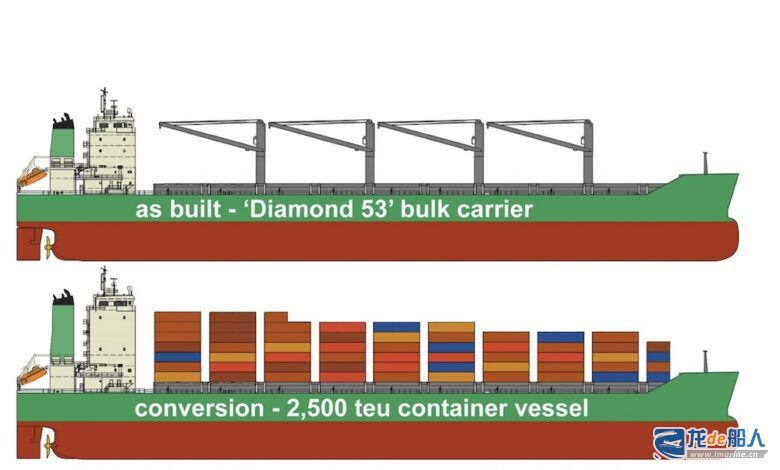
The main scope of the conversion includes removing the four midship cranes and raising the engine room by approximately two deck levels to accommodate container stacking on Deck 7. Upon completion of the conversion, the vessel’s overall dimensions will remain unchanged, with a length of 190 meters and a beam of 32.29 meters, and it will be able to accommodate 13 rows of containers. Construction on the first converted vessel is scheduled to begin in late May or early June 2026, with an estimated construction period of approximately three months. Upon completion, the vessel will be deployed for charter operations in the Chinese market.
The Diamond 53 open-top ultra-handymax bulk carrier has a maximum design speed of approximately 15 knots. While this is considered slow by container ship standards, Alphaliner believes this will not pose an operational obstacle to the shift from bulk to container shipping.
The reason is that major global liner shipping companies have recently shown strong demand for lower-specification vessels (those with lower speeds and limited container capacity). As a result, these converted vessels are expected to secure lucrative charters for services such as regional, domestic, or feeder routes, where availability is prioritized over speed.
Alphaliner notes that open-top bulk carriers are the only practical option for this type of conversion. Conventional bulk carriers, on the other hand, would require more extensive structural modifications. Unlike true container ships, open-top bulk carriers already feature a double-hull structure, and their cargo holds are designed with the loading requirements of containers or general cargo in mind. Although they lack container grid rails and lashing bridges, most functional gaps can be addressed within a manageable cost range simply by retrofitting container grids, raising the engine room, and installing basic lashing bridges.
This series of conversion projects is the latest indication that capacity in the container market remains tight. With most vessels sold out and charter rates remaining high, there is growing momentum to bring non-standard capacity into the market.
It is no longer surprising that the line between bulk and container shipping is becoming increasingly blurred. In addition to vessel conversions, newbuilding projects are already being designed to handle both bulk and container cargo.
In January 2026, COSCO Shipping Bulk placed an order with Beihai Shipbuilding for three new Newcastle bulk carriers capable of transporting containers. These vessels feature a dual-fuel design compatible with both methanol and ammonia; they are capable of carrying bulk cargo, general cargo, and containers, representing an innovative upgrade to the traditional 210,000 DWT bulk carrier class.
Additionally, during the COVID-19 pandemic, when the market saw widespread use of bulk carriers carrying containers, Star Bulk was among the first owners of Capesize bulk carriers to obtain container transport certification from classification societies.