

The South Korean government plans to invest 525 billion won (approximately $346 million) over the next five years to enhance the competitiveness of the shipbuilding industry and master core technologies for seven types of vessels, including liquefied natural gas (LNG) carriers and ammonia carriers; It plans to invest 1 trillion won (approximately $659 million) by 2030 to establish a 24/7 artificial intelligence (AI)-powered shipyard; take measures to maintain basic shipbuilding capacity; and promote public sector procurement of resource and energy vessels that hold strategic industrial significance.
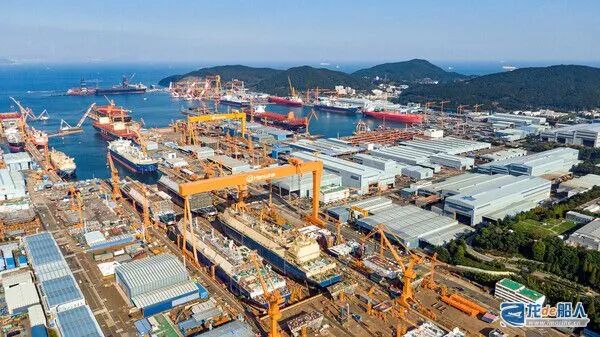
Recently, South Korea’s Ministry of Trade, Industry and Energy hosted the “K-Shipbuilding Future Vision Forum” to discuss development strategies aimed at leading the future shipbuilding market by enhancing the core competitiveness of South Korea’s domestic shipbuilding industry and building a win-win ecosystem. The forum was attended by representatives from the entire shipbuilding industry chain, including large, medium, and small shipbuilders; domestic and international partners; marine equipment suppliers; industry professionals; and financial institutions.
Prior to the forum, South Korea’s Ministry of Trade, Industry and Energy released the “K-Shipbuilding Future Vision: With Everyone’s Strength, Toward a Greater Future,” outlining three key development strategies: strengthening core competitiveness, expanding markets, and building a win-win ecosystem.
First, South Korea plans to secure orders for key vessel types that drive domestic demand. Currently, South Korean shipbuilders primarily focus on high-value-added vessel types through a selective order strategy, resulting in the country relying heavily on overseas shipyards to meet demand for vessels transporting safety-critical goods, such as car carriers, bulk carriers, and small container ships.
To this end, South Korea’s shipbuilding and shipping industries established the “Shipbuilding-Shipping Co-prosperity Council” on April 28 and agreed on cooperative measures, including deepening industrial synergy and placing joint orders for shipbuilding. South Korea has clearly emphasized that it will formulate relevant measures through government agencies to encourage the public sector to give priority to domestic shipyards when ordering resource- and energy-related vessels, such as LNG carriers and offshore wind power support vessels.
Second, South Korea announced the launch of the “7 Star-Ship Project.” Under the plan, South Korea will invest 525 billion won over the next five years to develop core technologies for seven ship types, with a focus on developing specialized cargo containment systems for ammonia carriers, hydrogen carriers, and liquefied carbon dioxide carriers.
Given that South Korea has completed technical validation of the liquid cargo tank containment system for small LNG carriers, the country has indicated that it will accelerate the validation process for large LNG carriers of 174,000 cubic meters and above; regarding environmentally friendly electric-powered vessels, it will promote independent R&D of electric propulsion technology for large vessels; Leveraging order opportunities arising from the development of renewable energy (such as offshore wind power) and the Northern Sea Route, the country will strongly support the development of domestically designed vessel types, including Korean-style offshore wind power support vessels and polar icebreakers.
In addition to ship design and shipyard orders, South Korea has announced plans to fully advance the application of AI technology in the shipbuilding industry. By 2030, the South Korean government and private companies plan to jointly invest approximately 1 trillion won to build the world’s first AI-powered shipyard capable of operating autonomously 24 hours a day. The goal is to develop and widely implement AI-based automation technologies across the entire shipbuilding process—including design, production, and operations—to boost productivity by up to 50% in each stage of the process.
In the area of autonomous shipping, South Korea has announced that, starting in 2026, it will invest 630 billion won over the next seven years to collect operational data from actual vessels required for the research and development of autonomous ships, and to use that data to develop fully autonomous navigation technology that meets the International Maritime Organization (IMO) Level 4 standards.
South Korea plans to focus on the Autonomous Navigation Subcommittee of the M.AX Alliance to precisely align with the technological needs of the industry; the alliance currently comprises 47 organizations, including shipbuilders and shipping companies. To address regulatory gray areas such as data collection and the use of location information, the country plans to proactively apply for special exemptions by actively utilizing the regulatory sandbox system.
In terms of market expansion, South Korea has announced plans to establish a shipbuilding industry alliance with countries such as India, Vietnam, and the Philippines that are interested in shipbuilding cooperation. The plan involves strategically facilitating the entry of South Korean companies into these markets to share the successful practices of South Korean shipbuilders, including shipyard construction, training of technical personnel, and production capacity optimization.
Meanwhile, the Korea-U.S. shipbuilding cooperation project, MASGA, will focus on advancing substantive cooperation in 2026. South Korea plans to help the United States revitalize its shipbuilding industry—including shipyards, the workforce, and productivity—while seizing opportunities that can generate new ship orders and marine equipment exports for South Korean shipbuilders. On May 9, South Korea’s Ministry of Trade, Industry and Energy and the U.S. Department of Commerce signed a memorandum of understanding regarding the MASGA project. The two sides will establish a Korea-U.S. Shipbuilding Cooperation Center and maintain close communication to accelerate the achievement of tangible results.