


Recently, Japanese shipbuilder Imabari Shipbuilding’s Saijo Shipyard successfully delivered the “RURI PLANET,” a 209,000 DWT liquefied natural gas (LNG) dual-fuel bulk carrier.
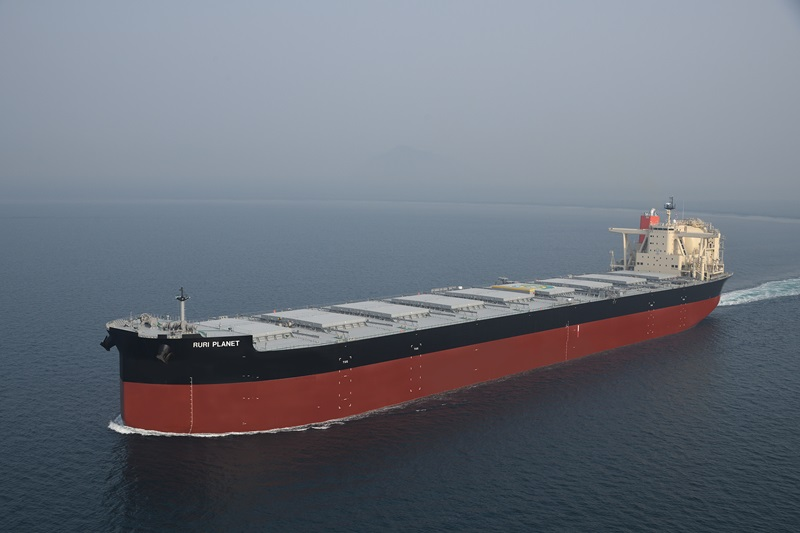
This vessel features main dimensions of 299.99 meters in overall length, 50.00 meters in width and 25.00 meters in depth, with a deadweight of 210,079 tons and a gross tonnage of 111,238. It is powered by a 7S60ME-C10.5-GI main engine and has a service speed of approximately 14.0 knots. The ship is classed by NK and registered under the flag of Liberia.
The LNG fuel tanks on the “RURI PLANET” are located aft of the upper deck accommodation area to ensure cargo capacity comparable to that of heavy fuel oil carriers and to achieve high transport efficiency. Each cargo hold is equipped with top tanks and hopper tanks, making it suitable for carrying solid bulk cargoes such as iron ore and coal. The design is intended to more efficiently load and transport high-density (3 tons/cubic meter) bulk cargoes, with iron ore being the primary cargo.
When using heavy fuel oil, the vessel complies with both Phase 2 and Phase 3 EEDI requirements (achieving at least a 30% reduction in emissions compared to the reference value); when using LNG, CO₂ emissions can be further reduced by approximately 20–30%, with virtually no sulfur oxide emissions.
In terms of environmental technology, the main engine is equipped with a selective catalytic reduction (SCR) system to reduce sulfur oxide (SOx) emissions; Both the generator and auxiliary boilers are dual-fuel types, allowing for the utilization of boil-off gas (BOG) generated in the LNG fuel tanks to prevent waste; the vessel’s propulsion performance and environmental performance have been improved through the installation of energy-saving appendages and twisted rudders (a new type of energy-saving appendage) near the propellers, a bow shape designed to reduce propulsion drag, and the use of hull coatings that minimize friction.