


To accelerate the processing of its order backlog and improve delivery efficiency, HD Hyundai Heavy Industries has introduced a new model for outsourcing hull sections: constructing half-ship grand blocks at two separate shipyards, followed by final assembly into a complete vessel. This marks the first such application in South Korea’s shipbuilding industry and represents a more innovative approach compared with the country’s conventional hull block outsourcing methods.
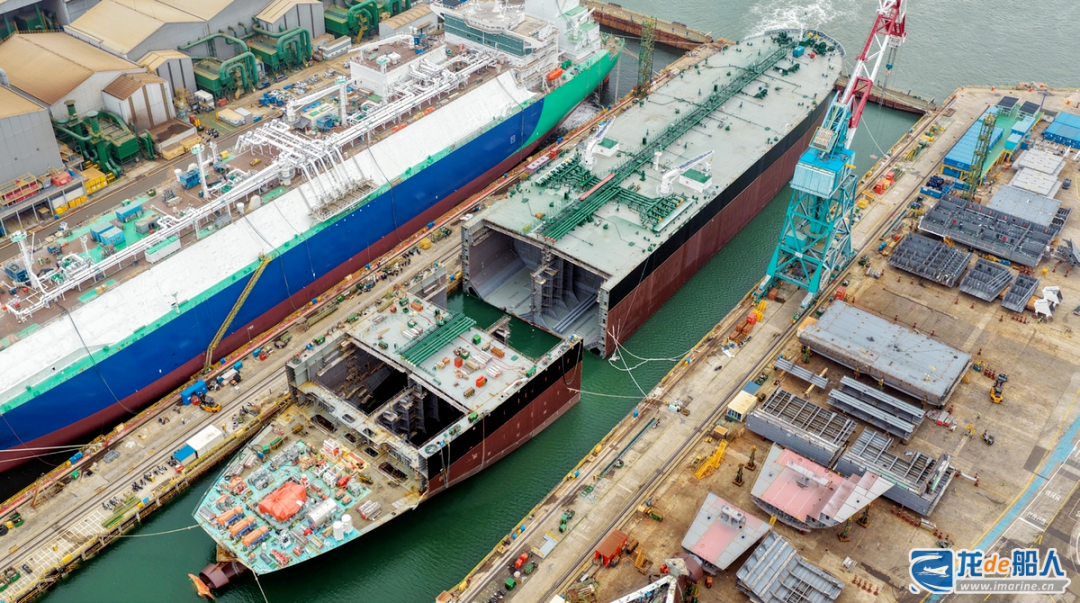
Since the ship is divided into two separate halves for construction at different shipyards—a process that differs significantly from traditional single-dock shipbuilding—HD Hyundai Heavy Industries established a dedicated task force in March 2025 to redesign the project’s workflow.
HD Hyundai Heavy Industries recently unveiled this process at its Ulsan shipyard: applied to a 157,000 DWT Suezmax tanker, the ship’s hull is gradually taking shape by joining two hull blocks, each over 100 meters long.
According to reports, HD Hyundai Heavy Industries outsourced the construction of the bow section (168 meters long) of this Suezmax tanker to HSG Seongdong Shipbuilding, a medium-sized South Korean shipyard, while the stern section (102 meters long) was built at HD Hyundai Heavy Industries’ Ulsan shipyard. After the bow section built by HSG Seongdong Shipbuilding was completed, it was towed to HD Hyundai Heavy Industries’ Ulsan shipyard, where it was assembled with the stern section built by the latter. Shipyard workers used large cranes to perform the assembly, install the outer hull plates, drain the dry dock, and connect the internal structural frames.
HD Hyundai Heavy Industries stated that piping and wiring work on this Suezmax tanker is expected to continue through mid-April, with the vessel scheduled for delivery to the owner in July.
Analysts say the logic behind HD Hyundai Heavy Industries’ “half-ship project” is straightforward: to free up drydock capacity. By constructing only the more technically complex stern sections—which include the engine room—at its own facilities, HD Hyundai Heavy Industries frees up dock capacity, allowing for the simultaneous pre-assembly of hull blocks for other vessels. This effectively shifts the company from a model of “building one ship per dock” to one of “building two or more ships in parallel.”
In contrast, while the technical difficulty and engineering complexity of the bow section are relatively low, it requires a significant amount of manpower and space; therefore, the decision was made to outsource this work to other shipyards, a move that will also provide them with a new source of revenue.
According to reports, HSG Cheongdong Shipbuilding—which is partnering with HD Hyundai Heavy Industries to advance a new outsourcing model—was formerly known as Sungdong Shipbuilding & Marine Engineering. The company specializes in building oil tankers and, at one point in 2007, ranked eighth globally in terms of order backlog. Between 2004 and 2017, it delivered a total of over 250 vessels, including Capesize bulk carriers and medium-sized oil tankers.
HD Hyundai Heavy Industries’ latest technological innovation stems primarily from the surge in orders driven by the shipbuilding industry’s new supercycle. Given that the industry was severely impacted by overcapacity during the previous cycle, major South Korean shipyards are aiming to expand their effective production capacity without constructing new dry docks. For example, Samsung Heavy Industries has adopted a model of outsourcing entire vessels, while HJ Heavy Industries has outsourced the superstructures of container ships to Daesun Shipbuilding to boost production capacity.