


The Supreme Court ruled that Hanwha Ocean’s annual management performance pay to workers cannot be reflected in severance pay, according to Maeil Business Newspaper, a South Korean media outlet. This is because management profits, which are the basis for calculating incentives, are determined by management’s judgment or economic conditions at home and abroad rather than the work of executives and employees, so they cannot be seen as a price for work.
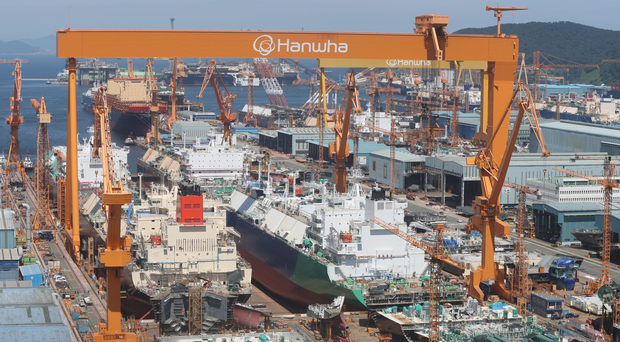
On the 12th, the Supreme Court’s second division (Chief Justice Um Sang-pil) confirmed the lower court’s ruling against the plaintiff in an appeal filed against the company by 972 former and current workers of Hanwha Ocean.
Former and current workers filed a lawsuit claiming that the management performance pay they received while working at Hanwha Ocean (formerly Daewoo Shipbuilding & Marine Engineering) should also be included in the average wage, which is the standard for calculating severance pay. Hanwha Ocean paid management performance pay in the name of ‘performance distribution bonuses’ from 2001 to 2014 and ‘performance compensation linked to management evaluation’ from 2018 to 2020. Performance pay has been set flexibly according to the company’s operating profit, net profit, and ordinary profit.
Both the first and second trials ruled in favor of the company. “Operating profit, net income, and ordinary profit, which are the basis of management performance in this case, are directly affected by numerous factors such as management strategy and judgment, current status of the same industry, economic conditions at home and abroad, and raw material prices,” the Changwon District Court said. “It is difficult to evaluate it as a price of work because it is not proportional to the quantity and quality of work.”
The court then explained, “Workers have no right to claim profit distribution other than salaries, and instead do not bear the risk of loss due to management failure,” adding, “Nevertheless, the reason for paying management performance pay at the expense of some of the shareholders’ profits is to boost workers’ morale or welfare.” The fact that the company and the labor union set separate standards or pay incentives every year through labor-management agreements was also based on the fact that there was no wage ability.
The second trial and the Supreme Court also dismissed both appeals and appeals, judging that there was no fault in the judgment of the first trial.
The Supreme Court reaffirmed the existing law that “if the money and goods paid to workers by employers are to be paid as wages, the money and goods must be paid as the object of work, and the obligation to pay money and goods must be closely related to the provision of work.”
In January, the Supreme Court ruled that the former should be reflected in the calculation of severance pay by distinguishing between “target incentives” and “performance incentives” in a case to the same effect filed with Samsung Electronics.